







Question: Title: SAGDD Production Treating - Preliminary Process Design Purpose: Preliminary process design of a production treating train in a SAGD Central Processing Facility (CPF). Deliverables
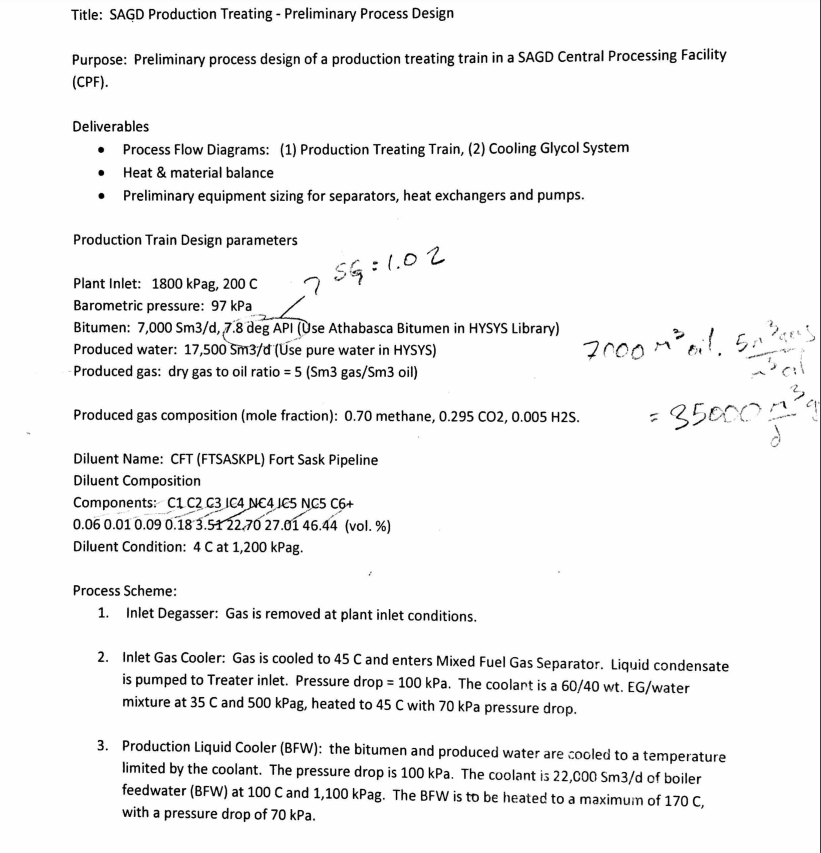
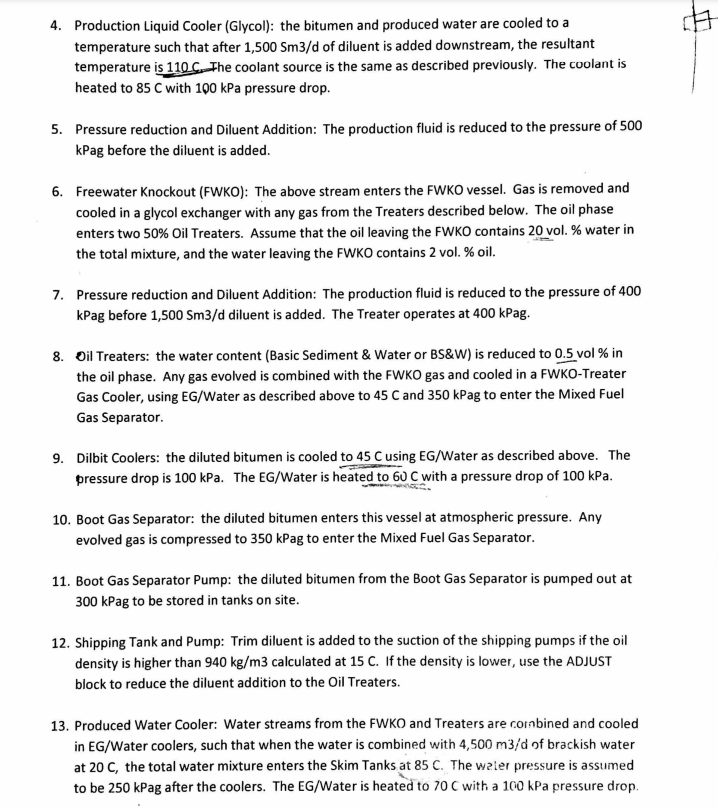
Title: SAGDD Production Treating - Preliminary Process Design Purpose: Preliminary process design of a production treating train in a SAGD Central Processing Facility (CPF). Deliverables - Process Flow Diagrams: (1) Production Treating Train, (2) Cooling Glycol System - Heat \& material balance - Preliminary equipment sizing for separators, heat exchangers and pumps. Production Train Design parameters Plant Inlet: 1800kPag,200C Barometric pressure: 97kPa Bitumen: 7,000 Sm3/d,7.8 deg API (Use Athabasca Bitumen in HYSYS Library) Produced water: 17,500Sm3/d (Use pure water in HYSYS) Produced gas: dry gas to oil ratio =5 (Sm3 gas/Sm3 oil) Produced gas composition (mole fraction): 0.70 methane, 0.295CO2,0.005H2S. Diluent Composition Components: C1C2 C3 IC4 NE4 JE5 NC5 C6+ 0.060.010.090.183.5122.7027.0146.44 (vol. \%) Diluent Condition: 4C at 1,200 kPag. Process Scheme: 1. Inlet Degasser: Gas is removed at plant inlet conditions. 2. Inlet Gas Cooler: Gas is cooled to 45C and enters Mixed Fuel Gas Separator. Liquid condensate is pumped to Treater inlet. Pressure drop =100kPa. The coolant is a 60/40wt. EG/water mixture at 35C and 500kPag, heated to 45C with 70kPa pressure drop. 3. Production Liquid Cooler (BFW): the bitumen and produced water are cooled to a temperature limited by the coolant. The pressure drop is 100kPa. The coolant is 22,COOSm3/d of boiler feedwater (BFW) at 100C and 1,100kPag. The BFW is to be heated to a maximum of 170C, with a pressure drop of 70kPa. 4. Production Liquid Cooler (Glycol): the bitumen and produced water are cooled to a temperature such that after 1,500Sm3/d of diluent is added downstream, the resultant temperature is 110c. The coolant source is the same as described previously. The coolant is heated to 85C with 100kPa pressure drop. 5. Pressure reduction and Diluent Addition: The production fluid is reduced to the pressure of 500 kPag before the diluent is added. 6. Freewater Knockout (FWKO): The above stream enters the FWKO vessel. Gas is removed and cooled in a glycol exchanger with any gas from the Treaters described below. The oil phase enters two 50% Oil Treaters. Assume that the oil leaving the FWKO contains 20vol. \% water in the total mixture, and the water leaving the FWKO contains 2 vol. \% oil. 7. Pressure reduction and Diluent Addition: The production fluid is reduced to the pressure of 400 kPag before 1,500Sm3/d diluent is added. The Treater operates at 400kPag. 8. Oil Treaters: the water content (Basic Sediment \& Water or BS\&W) is reduced to 0.5 vol \% in the oil phase. Any gas evolved is combined with the FWKO gas and cooled in a FWKO-Treater Gas Cooler, using EG/Water as described above to 45C and 350kPag to enter the Mixed Fuel Gas Separator. 9. Dilbit Coolers: the diluted bitumen is cooled to 45C using EG/Water as described above. The pressure drop is 100kPa. The EG/Water is heated to 60C with a pressure drop of 100kPa. 10. Boot Gas Separator: the diluted bitumen enters this vessel at atmospheric pressure. Any evolved gas is compressed to 350kPag to enter the Mixed Fuel Gas Separator. 11. Boot Gas Separator Pump: the diluted bitumen from the Boot Gas Separator is pumped out at 300kPag to be stored in tanks on site. 12. Shipping Tank and Pump: Trim diluent is added to the suction of the shipping pumps if the oil density is higher than 940kg/m3 calculated at 15C. If the density is lower, use the ADJUST block to reduce the diluent addition to the Oil Treaters. 13. Produced Water Cooler: Water streams from the FWKO and Treaters are cornbined and cooled in EG/ Water coolers, such that when the water is combined with 4,500m3/d of brackish water at 20C, the total water mixture enters the Skim Tanks at 85C. The waler pressure is assumed to be 250kPag after the coolers. The EG/Water is heated to 70C with a 100kPa pressure drop
Step by Step Solution
There are 3 Steps involved in it

Get step-by-step solutions from verified subject matter experts
 Study Help