







Question: To be implemented in Python. This is how Q1 looks in the csv file: 5 -6 0 -6 3 -1 0 -1 1 Consider the
To be implemented in Python.
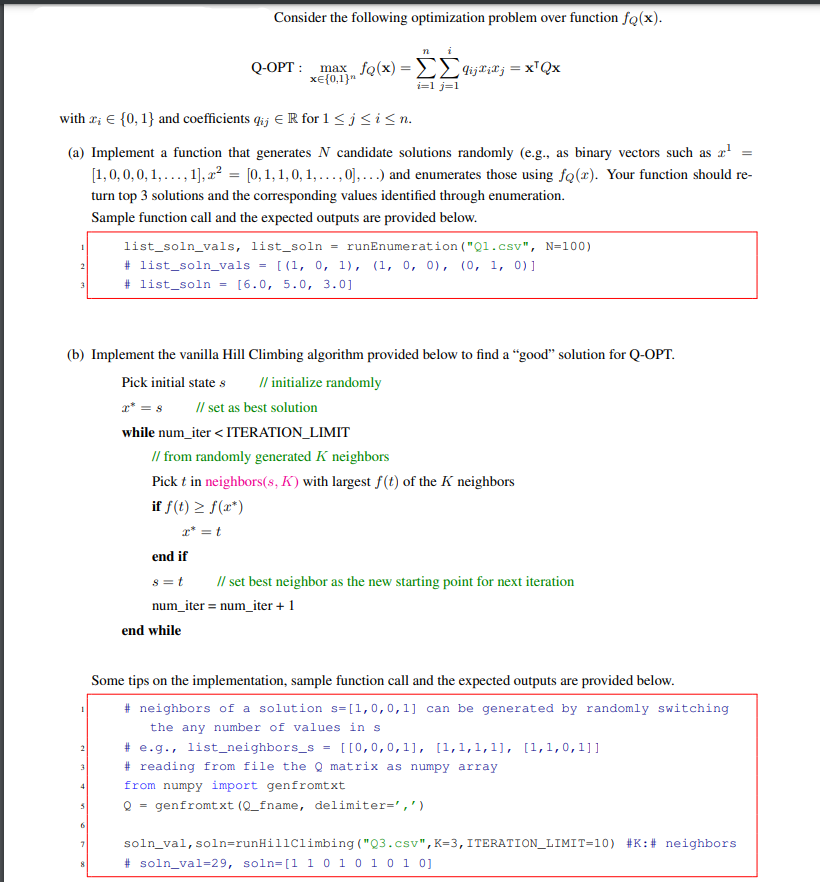
This is how Q1 looks in the csv file:
| 5 | -6 | 0 |
| -6 | 3 | -1 |
| 0 | -1 | 1 |
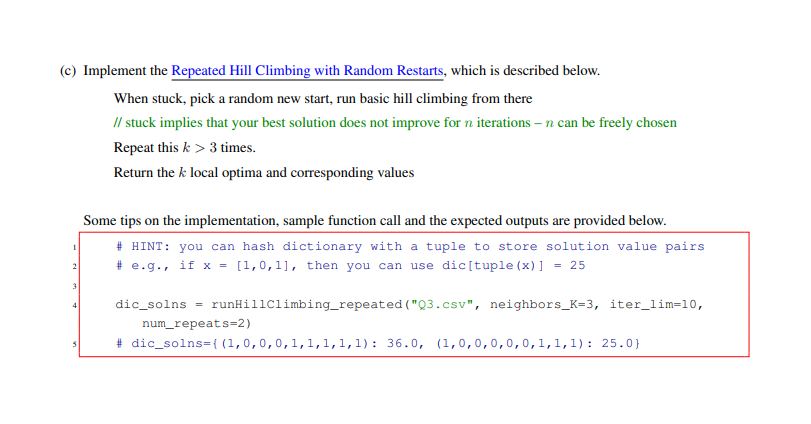
Consider the following optimization problem over function fo(x). Q-OPT: max, fQ(x) = lij lil; = x'Qx xe" i=1 j=1 with 2; E {0,1} and coefficients qij R for 1 Sisisn. (a) Implement a function that generates N candidate solutions randomly (e.g., as binary vectors such as r= [1,0,0,0,1,..., 1], x2 = [0,1,1,0, 1, ..., 0],...) and enumerates those using fQ(x). Your function should re- turn top 3 solutions and the corresponding values identified through enumeration. Sample function call and the expected outputs are provided below. list_soln_vals, list_soln = runEnumeration ("01.csv", N=100) # list_soln_vals = [(1, 0, 1), (1, 0, 0), (0, 1, 0) # list_soln = [6.0, 5.0, 3.0] 1 2 3 (b) Implement the vanilla Hill Climbing algorithm provided below to find a good solution for Q-OPT. Pick initial states // initialize randomly 2* = 8 // set as best solution while num_iter
Step by Step Solution
There are 3 Steps involved in it

Get step-by-step solutions from verified subject matter experts
 Study Help