







Question: To complete your assignment, read the case study on the Brief tab and provide your responses in the Questions tab. You can switch between tabs

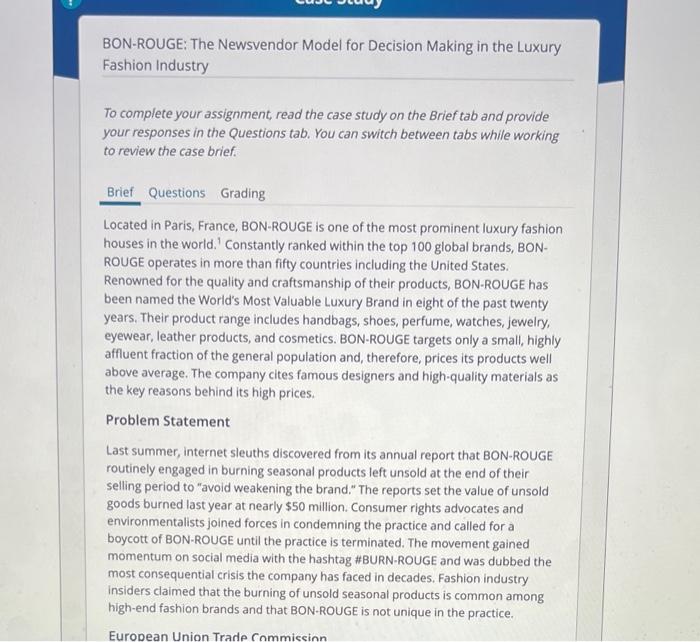
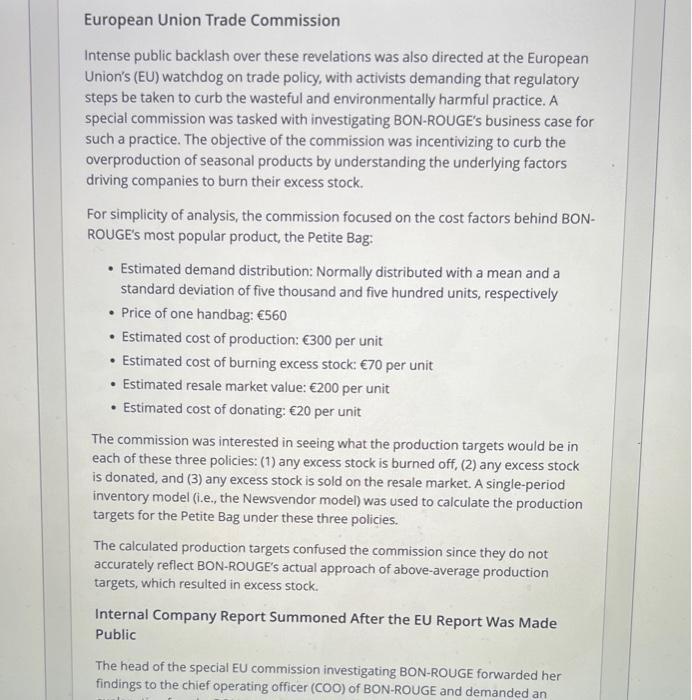
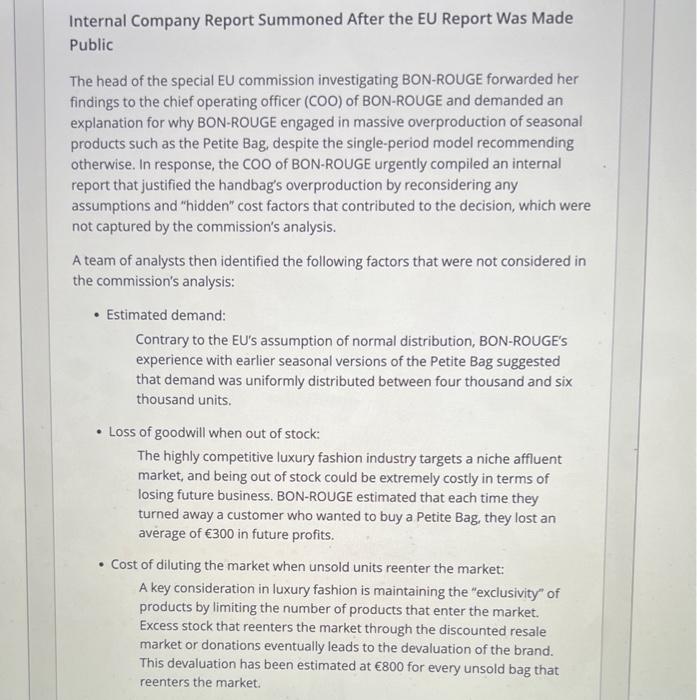
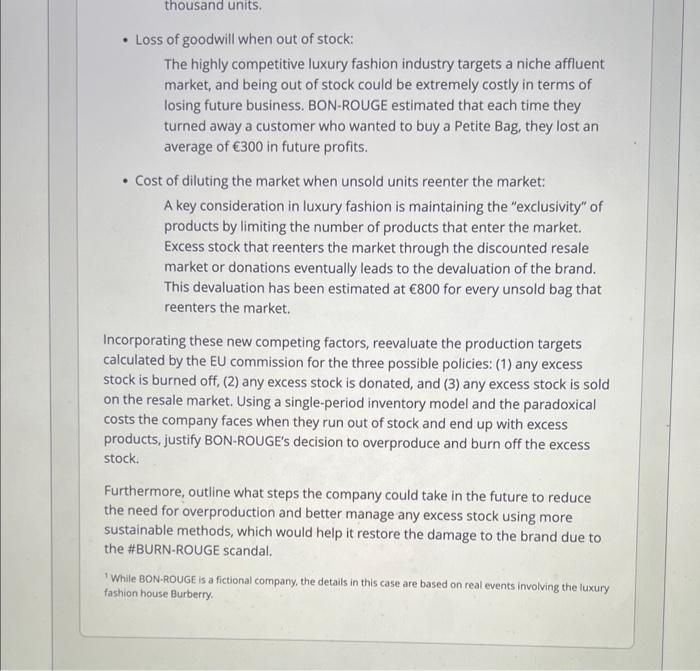
To complete your assignment, read the case study on the Brief tab and provide your responses in the Questions tab. You can switch between tabs while working to review the case brief. Using the calculations done by the EU commission, describe the complex, paradoxical considerations companies like BON-ROUGE face and how they could, in the future, use operations management techniques to reduce the need for overproduction and better manage any excess stock. BON-ROUGE: The Newsvendor Model for Decision Making in the Luxury Fashion Industry To complete your assignment, read the case study on the Brief tab and provide your responses in the Questions tab. You can switch between tabs while working to review the case brief. Grading Located in Paris, France, BON-ROUGE is one of the most prominent luxury fashion houses in the world.' Constantly ranked within the top 100 global brands, BONROUGE operates in more than fifty countries including the United States. Renowned for the quality and craftsmanship of their products, BON-ROUGE has been named the World's Most Valuable Luxury Brand in eight of the past twenty years. Their product range includes handbags, shoes, perfume, watches, jewelry, eyewear, leather products, and cosmetics. BON-ROUGE targets only a small, highly affluent fraction of the general population and, therefore, prices its products well above average. The company cites famous designers and high-quality materials as the key reasons behind its high prices. Problem Statement Last summer, internet sleuths discovered from its annual report that BON-ROUGE routinely engaged in burning seasonal products left unsold at the end of their selling period to "avoid weakening the brand." The reports set the value of unsold goods burned last year at nearly $50 million. Consumer rights advocates and environmentalists joined forces in condemning the practice and called for a boycott of BON-ROUGE until the practice is terminated. The movement gained momentum on social media with the hashtag \#BURN-ROUGE and was dubbed the most consequential crisis the company has faced in decades. Fashion industry insiders claimed that the burning of unsold seasonal products is common among high-end fashion brands and that BON-ROUGE is not unique in the practice. European Union Trade Commission Intense public backlash over these revelations was also directed at the European Union's (EU) watchdog on trade policy, with activists demanding that regulatory steps be taken to curb the wasteful and environmentally harmful practice. A special commission was tasked with investigating BON-ROUGE's business case for such a practice. The objective of the commission was incentivizing to curb the overproduction of seasonal products by understanding the underlying factors driving companies to burn their excess stock. For simplicity of analysis, the commission focused on the cost factors behind BONROUGE's most popular product, the Petite Bag: - Estimated demand distribution: Normally distributed with a mean and a standard deviation of five thousand and five hundred units, respectively - Price of one handbag: 560 - Estimated cost of production: 300 per unit - Estimated cost of burning excess stock: 70 per unit - Estimated resale market value: 200 per unit - Estimated cost of donating: 20 per unit The commission was interested in seeing what the production targets would be in each of these three policies: (1) any excess stock is burned off, (2) any excess stock is donated, and (3) any excess stock is sold on the resale market. A single-period inventory model (i.e., the Newsvendor model) was used to calculate the production targets for the Petite Bag under these three policies. The calculated production targets confused the commission since they do not accurately reflect BON-ROUGE's actual approach of above-average production targets, which resulted in excess stock. Internal Company Report Summoned After the EU Report Was Made Public The head of the special EU commission investigating BON-ROUGE forwarded her findings to the chief operating officer (COO) of BON-ROUGE and demanded an Internal Company Report Summoned After the EU Report Was Made Public The head of the special EU commission investigating BON-ROUGE forwarded her findings to the chief operating officer (COO) of BON-ROUGE and demanded an explanation for why BON-ROUGE engaged in massive overproduction of seasonal products such as the Petite Bag, despite the single-period model recommending otherwise. In response, the COO of BON-ROUGE urgently compiled an internal report that justified the handbag's overproduction by reconsidering any assumptions and "hidden" cost factors that contributed to the decision, which were not captured by the commission's analysis. A team of analysts then identified the following factors that were not considered in the commission's analysis: - Estimated demand: Contrary to the EU's assumption of normal distribution, BON-ROUGE's experience with earlier seasonal versions of the Petite Bag suggested that demand was uniformly distributed between four thousand and six thousand units. - Loss of goodwill when out of stock: The highly competitive luxury fashion industry targets a niche affluent market, and being out of stock could be extremely costly in terms of losing future business. BON-ROUGE estimated that each time they turned away a customer who wanted to buy a Petite Bag, they lost an average of 300 in future profits. - Cost of diluting the market when unsold units reenter the market: A key consideration in luxury fashion is maintaining the "exclusivity" of products by limiting the number of products that enter the market. Excess stock that reenters the market through the discounted resale market or donations eventually leads to the devaluation of the brand. This devaluation has been estimated at 800 for every unsold bag that reenters the market. - Loss of goodwill when out of stock: The highly competitive luxury fashion industry targets a niche affluent market, and being out of stock could be extremely costly in terms of losing future business. BON-ROUGE estimated that each time they turned away a customer who wanted to buy a Petite Bag, they lost an average of 300 in future profits. - Cost of diluting the market when unsold units reenter the market: A key consideration in luxury fashion is maintaining the "exclusivity" of products by limiting the number of products that enter the market. Excess stock that reenters the market through the discounted resale market or donations eventually leads to the devaluation of the brand. This devaluation has been estimated at 800 for every unsold bag that reenters the market. Incorporating these new competing factors, reevaluate the production targets calculated by the EU commission for the three possible policies: (1) any excess stock is burned off, (2) any excess stock is donated, and (3) any excess stock is sold on the resale market. Using a single-period inventory model and the paradoxical costs the company faces when they run out of stock and end up with excess products, justify BON-ROUGE's decision to overproduce and burn off the excess stock. Furthermore, outline what steps the company could take in the future to reduce the need for overproduction and better manage any excess stock using more sustainable methods, which would help it restore the damage to the brand due to the \#BURN-ROUGE scandal. 'While BON-ROUGE is a fictional company, the details in this case are based on real events involving the luxury tashion house Burberry
Step by Step Solution
There are 3 Steps involved in it

Get step-by-step solutions from verified subject matter experts
 Study Help