







Question: To define a function pointer, you use syntax that is a combination of declaring a function and declaring a variable. First, list the function return
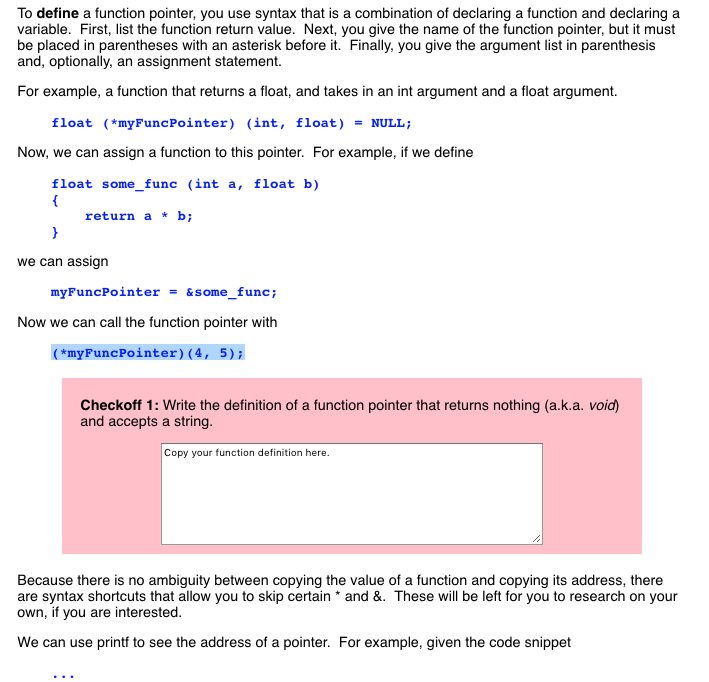
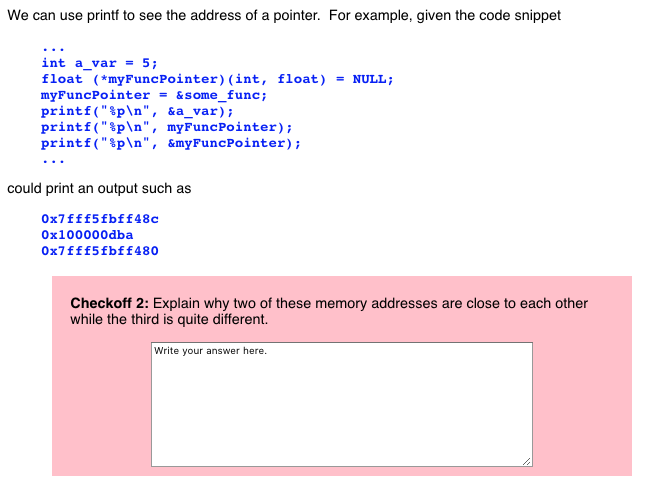
To define a function pointer, you use syntax that is a combination of declaring a function and declaring a variable. First, list the function return value. Next, you give the name of the function pointer, but it must be placed in parentheses with an asterisk before it. Finally, you give the argument list in parenthesis and, optionally, an assignment statement. For example, a function that returns a float, and takes in an int argument and a float argument. float (*myFuncPointer) (int, float) NULL; = Now, we can assign a function to this pointer. For example, if we define float some_func (int a, float b) return ab we can assign myFuncPointer-&some_ func Now we can call the function pointer with (*myFuncPointer) (4, 5) Checkoff 1: Write the definition of a function pointer that returns nothing (a.k.a. void) and accepts a string. Copy your function definition here. Because there is no ambiguity between copying the value of a function and copying its address, there are syntax shortcuts that allow you to skip certain and &. These will be left for you to research on your own, if you are interested. We can use printf to see the address of a pointer. For example, given the code snippet To define a function pointer, you use syntax that is a combination of declaring a function and declaring a variable. First, list the function return value. Next, you give the name of the function pointer, but it must be placed in parentheses with an asterisk before it. Finally, you give the argument list in parenthesis and, optionally, an assignment statement. For example, a function that returns a float, and takes in an int argument and a float argument. float (*myFuncPointer) (int, float) NULL; = Now, we can assign a function to this pointer. For example, if we define float some_func (int a, float b) return ab we can assign myFuncPointer-&some_ func Now we can call the function pointer with (*myFuncPointer) (4, 5) Checkoff 1: Write the definition of a function pointer that returns nothing (a.k.a. void) and accepts a string. Copy your function definition here. Because there is no ambiguity between copying the value of a function and copying its address, there are syntax shortcuts that allow you to skip certain and &. These will be left for you to research on your own, if you are interested. We can use printf to see the address of a pointer. For example, given the code snippet
Step by Step Solution
There are 3 Steps involved in it

Get step-by-step solutions from verified subject matter experts
 Study Help