







Question: *To give clients a seamless and responsive experience, high availability must be ensured in client- server systems. The Queue Load Leveling Pattern is one efficient
*To give clients a seamless and responsive experience, high availability must be ensured in client- server systems. The Queue Load Leveling Pattern is one efficient pattern that addresses availability issues. In order to avoid overload and preserve system stability, this pattern focuses on balancing the burden and controlling incoming requests.
*The Queue Load Leveling Pattern is critical in ensuring availability from a client-server perspective since it balances the server's load. The system can handle peak loads more effectively by adding a buffer between clients and the server. It also lessens the possibility of server breakdowns or performance degradation brought on by unexpected increases in incoming requests.
UML Component Diagram
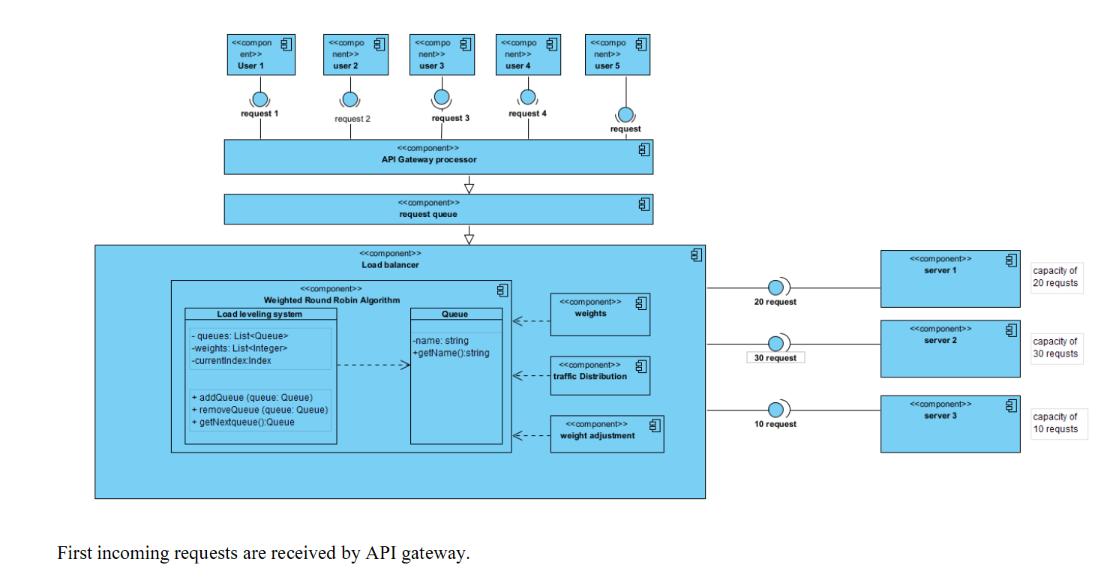
*Requests are stored in the Request Queue and then sent to the Load Levelling Processor
1) based on this UML component diagram, draw the activity diagram and explain properly.(We have used WRR weighted round robin algorithm for this)
2)Dont use chatgpt, diagram and explanations should be like professional.
note:Dont draw the diagram with the small lines and boxes give me a proper sketch as i mentioned UML component diagram.
< > User 1 request 1 >> user 2 -queues: List -weights: List Integer -currentindex index O request 2 + addQueue (queue: Queue) +removeQueue (queue: Queue) + getNextqueue() Queue excompo nont>> user 3 < > Weighted Round Robin Algorithm Load leveling system < >> API Gateway processor ic request 3 < > request queue < >> Load balancer Queue -name: string +getName(:string First incoming requests are received by API gateway. excompo nent>> user 4 8 request 4 ---- excompo nent>>> user 5 request < > weights < > traffic Distribution < > weight adjustment 8 8 8 8 20 request 30 request 10 request < >> server 1 < > server 2 < > server 3 8 81 8 capacity of 20 requsts capacity of 30 requsts capacity of 10 requsts < > User 1 request 1 >> user 2 -queues: List Queue> -weights: List Integer -currentindex index O request 2 + addQueue (queue: Queue) +removeQueue (queue: Queue) + getNextqueue() Queue excompo nont>> user 3 < > Weighted Round Robin Algorithm Load leveling system < >> API Gateway processor ic request 3 < > request queue < >> Load balancer Queue -name: string +getName():string First incoming requests are received by API gateway. excompo nent>> user 4 8 request 4 ---- excompo nent>>> user 5 request < > weights < > traffic Distribution < > weight adjustment 8 8 8 8 20 request 30 request 10 request < >> server 1 < > server 2 < > server 3 8 81 8 capacity of 20 requsts capacity of 30 requsts capacity of 10 requsts
Step by Step Solution
3.43 Rating (166 Votes )
There are 3 Steps involved in it
Below is the ... View full answer

Get step-by-step solutions from verified subject matter experts
 Study Help