







Question: to identify if there are any logical errors. If there are no logical errors, just say vali proof and move on to the next one.
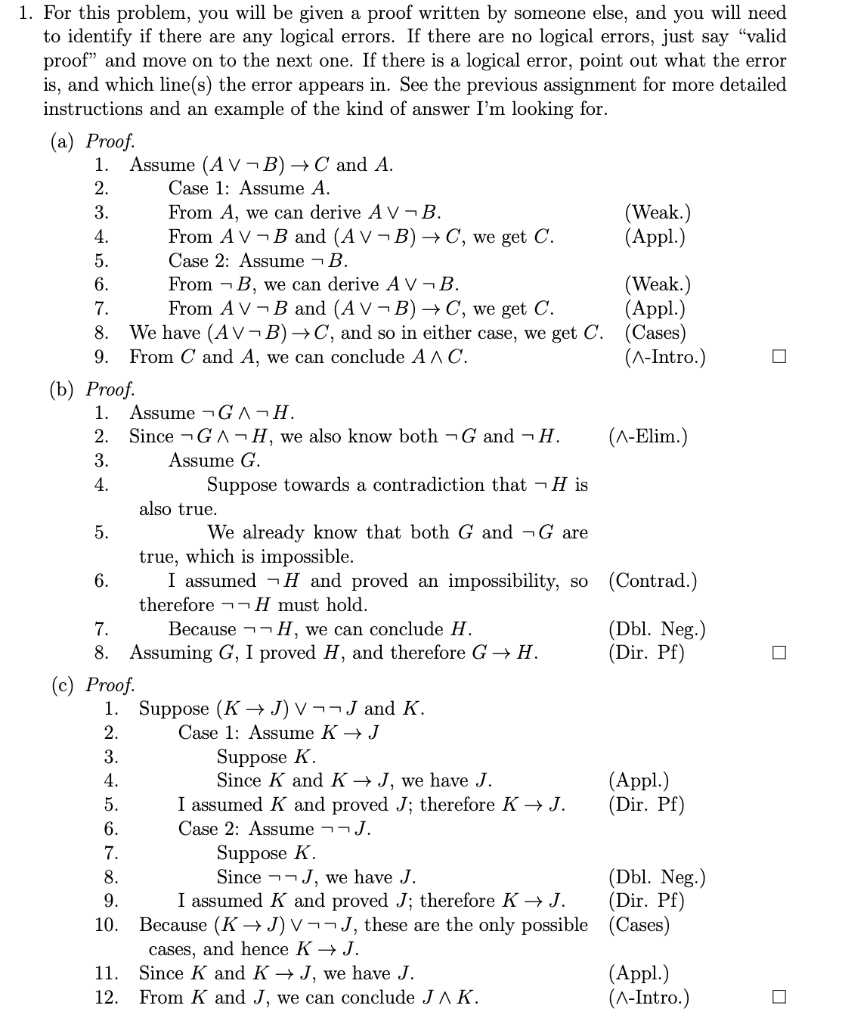
to identify if there are any logical errors. If there are no logical errors, just say "vali proof" and move on to the next one. If there is a logical error, point out what the erre is, and which line(s) the error appears in. See the previous assignment for more detaile instructions and an example of the kind of answer I'm looking for. (a) Proof. 1. Assume (AB)C and A. 2. Case 1: Assume A. 3. From A, we can derive AB. (Weak.) 4. From AB and (AB)C, we get C. (Appl.) 5. Case 2: Assume B. 6. From B, we can derive AB. (Weak.) 7. From AB and (AB)C, we get C. (Appl.) 8. We have (AB)C, and so in either case, we get C. (Cases) 9. From C and A, we can conclude AC. ( -Intro.) (b) Proof. 1. Assume GH. 2. Since GH, we also know both G and H. (-Elim.) 3. Assume G. 4. Suppose towards a contradiction that H is also true. 5. We already know that both G and G are true, which is impossible. 6. I assumed H and proved an impossibility, so (Contrad.) therefore H must hold. 7. Because H, we can conclude H. (Dbl. Neg.) 8. Assuming G, I proved H, and therefore GH. (Dir. Pf) (c) Proof. 1. Suppose (KJ)J and K. 2. Case 1: Assume KJ 3. Suppose K. 4. Since K and KJ, we have J (Appl.) 5. I assumed K and proved J; therefore KJ. (Dir. Pf) 6. Case 2: Assume J. 7. Suppose K. 8. Since J, we have J. (Dbl. Neg.) 9. I assumed K and proved J; therefore KJ. (Dir. Pf) 10. Because (KJ)J, these are the only possible (Cases) cases, and hence KJ. 11. Since K and KJ, we have J. Appl.) 12. From K and J, we can conclude JK. ( -Intro.)
Step by Step Solution
There are 3 Steps involved in it

Get step-by-step solutions from verified subject matter experts
 Study Help