







Question: Top question select: y axis or x axis select: (-x,-y), (y,-x), (-y,x) select: (-x,y) or (x, -y) Select: (x-9, y+2) or (x+2, y-9) Middle question
Top question select: y axis or x axis select: (-x,-y), (y,-x), (-y,x) select: (-x,y) or (x, -y) Select: (x-9, y+2) or (x+2, y-9) Middle question select: reflection, translation or rotation. Select: the second student, both students, neither student, or the first student. Last question select: y-axis, both axis, x-axis Select: the second student, neither student, the first student, or both students.
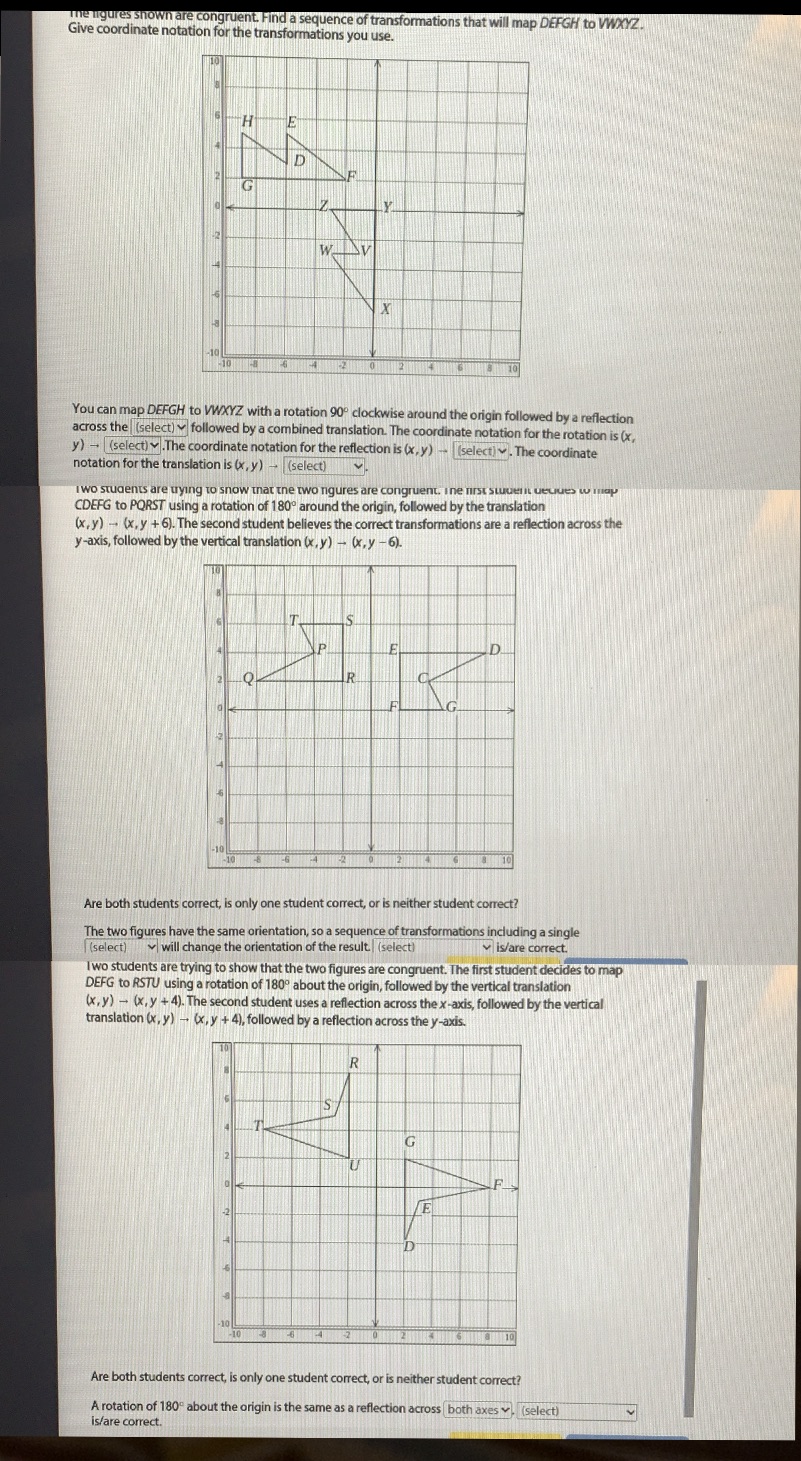
The figures shown are congruent. Find a sequence of transformations that will map DEFGH to VWXYZ. Give coordinate notation for the transformations you use. H E D G X You can map DEFGH to VWXYZ with a rotation 90" clockwise around the origin followed by a reflection across the (select)y followed by a combined translation. The coordinate notation for the rotation is (x, y) - (select) v .The coordinate notation for the reflection is (x, y) - (select) v. The coordinate notation for the translation is (, y) - (select) ~ I wo students are uying to snow that the two figures are congruent. I ne first stue it veques w inap CDEFG to PORST using a rotation of 180 around the origin, followed by the translation (x, y) - (x,y +6). The second student believes the correct transformations are a reflection across the y-axis, followed by the vertical translation (x, y) - (x,y -6). Are both students correct, is only one student correct, or is neither student correct? The two figures have the same orientation, so a sequence of transformations including a single (select) will change the orientation of the result. (select) vis/are correct. Iwo students are trying to show that the two figures are congruent. The first student decides to map DEFG to RSTU using a rotation of 180 about the origin, followed by the vertical translation (x, y) - (x, y + 4). The second student uses a reflection across the x-axis, followed by the vertical translation (x, y) - (x, y +4), followed by a reflection across the y-axis. R G U Are both students correct, is only one student correct, or is neither student correct? A rotation of 180" about the origin is the same as a reflection across both axes v. (select) is/are correct
Step by Step Solution
There are 3 Steps involved in it

Get step-by-step solutions from verified subject matter experts
 Study Help