







Question: Topic: Abstract Algebra Please Write on Paper neatly, step by step. Answer only if you know how it works. Prove the Chinese Remainder Theorem for
Topic: Abstract Algebra Please Write on Paper neatly, step by step. Answer only if you know how it works.
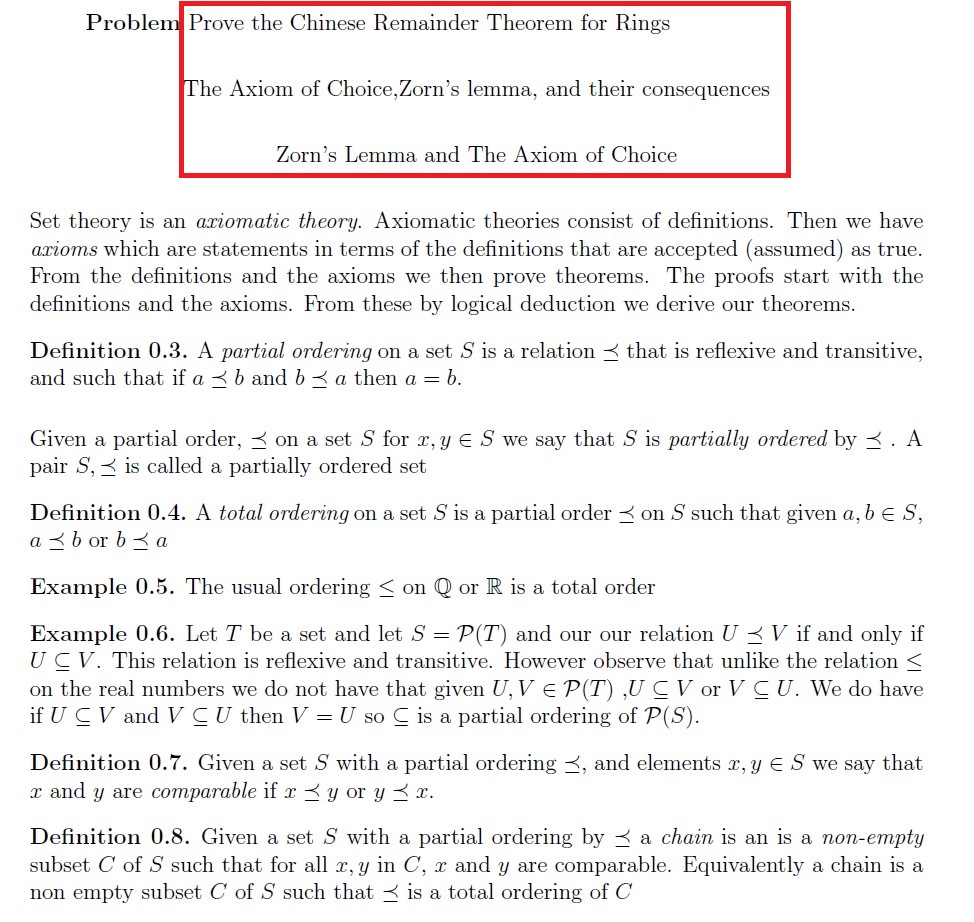
Prove the Chinese Remainder Theorem for Rings he Axiom of ChoiceZorn's lemma: and their consequences Zorn's Lemma. and The Axiom of Choice Set theory is an axiomatic theory. Axiomatic theories consist of denitions. Then we have axioms which are statements in terms of the denitions that are accepted (assumed) as true. From the denitions and the axioms we then prove theorems. The proofs start with the denitions and the axioms. From these by logical deduction we derive our theorems. Denition 0.3. A partial ordering on a set S is a relation :i that is reexive and transitive, and such that if a j b and b j a then a = b. Given a partial order, j on a set S for at: y E S we say that S is partially ordered by j . A pair 3, j is called a partially ordered set Denition 0.4. A total ordering on a set S is a partial order j on S such that given a: b E S, a j b or b j a Example 0.5. The usual ordering E on Q or lit is a total order Example 0.6. Let T be a set and let 3 = TNT) and our our relation U j V if and only if U C; V. This relation is reflexive and transitive. However observe that unlike the relation 3 on the real numbers we do not have that given U , V E 13(le 5U E V or V Q U. Tl-lu're do have if U Q V and V *1; U then V = U so L: is a partial ordering of 79(5). Denition 0.7. Given a set S with a. partial ordering :4, and elements :13, y E S we say that :c and y are comparable if :c j y or y -_
Step by Step Solution
There are 3 Steps involved in it

Get step-by-step solutions from verified subject matter experts
 Study Help