







Question: Topic: Discrete Mathematics and its Applications Chapter 13 Modeling Computation:Finite-State Machines with No Output and Language Recognition One of the founders of evolutionary computation, Laurence
Topic: Discrete Mathematics and its Applications" Chapter 13 Modeling Computation:Finite-State Machines with No Output and Language Recognition"

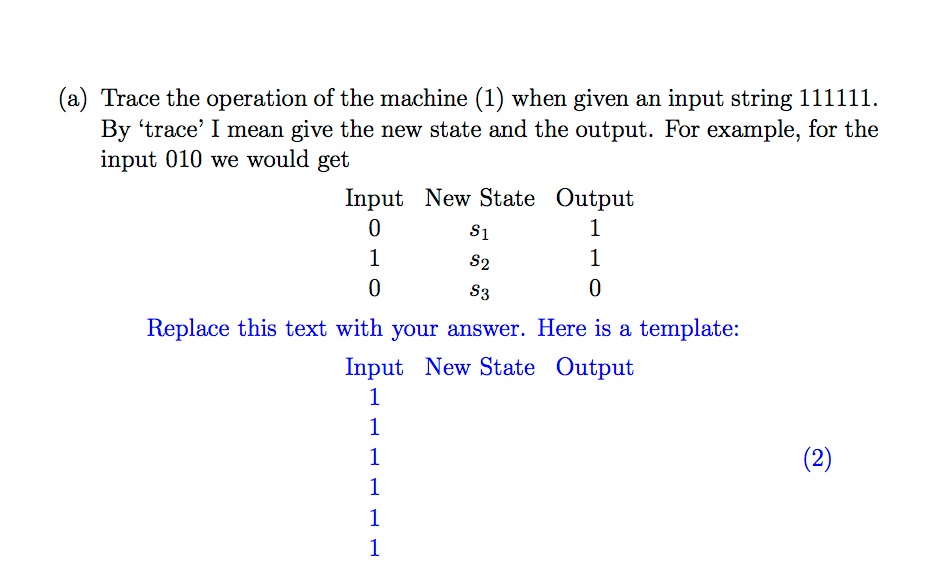
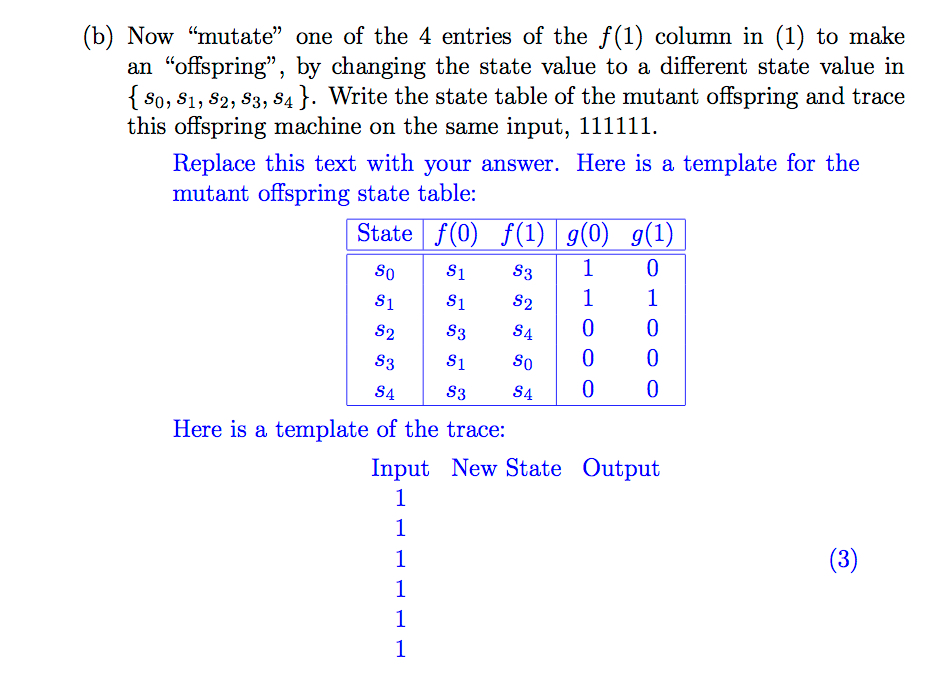
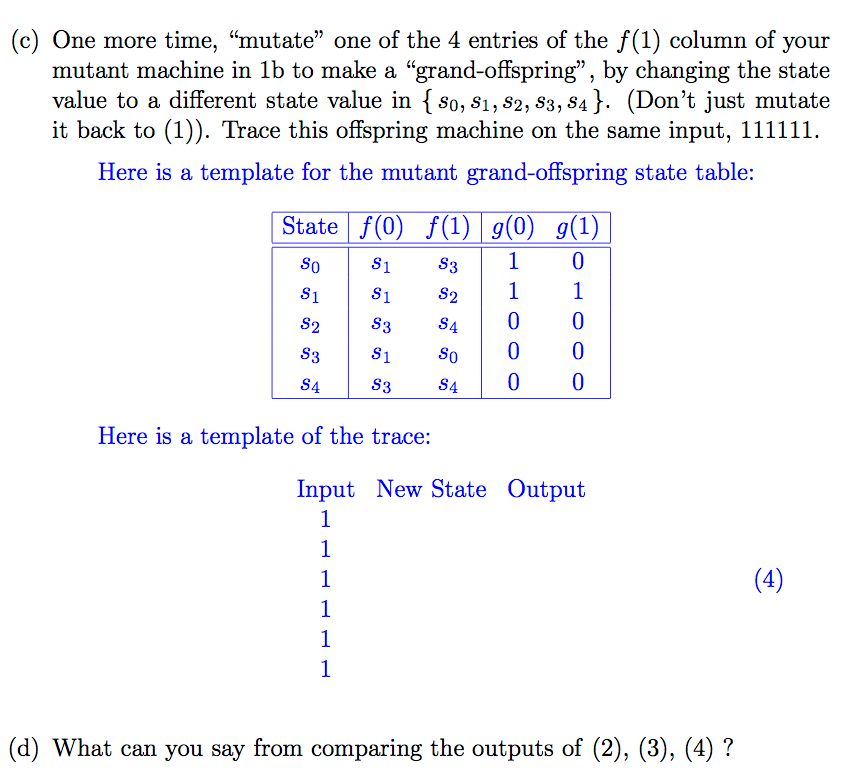
One of the founders of evolutionary computation, Laurence Fogel, tried to see if you could evolve finite state machines to do computations by a combination of mutation and selection of the fittest (Fogel et al., 1965), and out of this came the field called EvolutionaryProgramming. We will trv mutating the finite state machine in Table 3, p. 861 (given below) to see how it changes its computation. 9. State f(0) f(1) g(0) g(1) 0 1 S21 8283 S40 0 S3 S4S3S40 0 If we keep the number of states fixed at 5, and keep the same input and output alphabets, then mutations can consist of changing entries of the transition func- tion f, or the output function g. Since the output doesn't affect the sequence of states, we will mutate the states. One of the founders of evolutionary computation, Laurence Fogel, tried to see if you could evolve finite state machines to do computations by a combination of mutation and selection of the fittest (Fogel et al., 1965), and out of this came the field called EvolutionaryProgramming. We will trv mutating the finite state machine in Table 3, p. 861 (given below) to see how it changes its computation. 9. State f(0) f(1) g(0) g(1) 0 1 S21 8283 S40 0 S3 S4S3S40 0 If we keep the number of states fixed at 5, and keep the same input and output alphabets, then mutations can consist of changing entries of the transition func- tion f, or the output function g. Since the output doesn't affect the sequence of states, we will mutate the states
Step by Step Solution
There are 3 Steps involved in it

Get step-by-step solutions from verified subject matter experts
 Study Help