







Question: Topic is Operating Systems. Some questions could have multiple correct answers. Choose all correct answers. a point for each correct answer selected. a half-point off
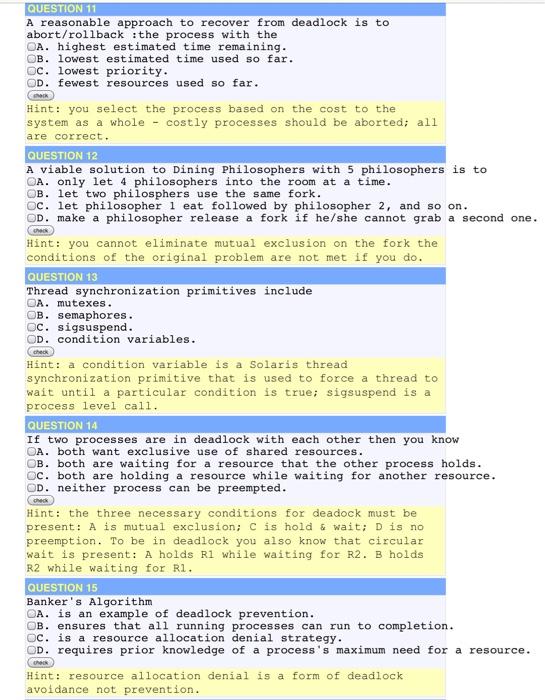
QUESTION 11 A reasonable approach to recover from deadlock is to abort/rollback :the process with the OA. highest estimated time remaining. OB. lowest estimated time used so far. OC. lowest priority. OD. fewest resources used so far. he Check Hint: you select the process based on the cost to the system as a whole - costly processes should be aborted; all are correct. QUESTION 12 A viable solution to Dining Philosophers with 5 philosophers is to OA. only let 4 philosophers into the room at a time. OB. let two philosphers use the same fork. oc. let philosopher 1 eat followed by philosopher 2, and so on. OD. make a philosopher release a fork if he/she cannot grab a second one. Hint: you cannot eliminate mutual exclusion on the fork the conditions of the original problem are not met if you do. QUESTION 13 Thread synchronization primitives include OA. mutexes. OB. semaphores. Oc. sigsuspend. OD. condition variables. Hint: condition variable is a Solaris thread synchronization primitive that is used to force a thread to wait until a particular condition is true; sigsuspend is a process level call. QUESTION 14 If two processes are in deadlock with each other then you know OA. both want exclusive use of shared resources. OB. both are waiting for a resource that the other process holds. oc. both are holding a resource while waiting for another resource. OD. neither process can be preempted. Hint: the three necessary conditions for deadock must be present: A is mutual exclusion; C is hold wait; D is no preemption. To be in deadlock you also know that circular wait is present: A holds R1 while waiting for R2. B holds R2 while waiting for Ri. QUESTION 15 Banker's Algorithm OA. is an example of deadlock prevention. OB. ensures that all running processes can run to completion. oc. is a resource allocation denial strategy. OD. requires prior knowledge of a process's maximum need for a resource. Hint: resource allocation denial is a form of deadlock avoidance not prevention
Step by Step Solution
There are 3 Steps involved in it

Get step-by-step solutions from verified subject matter experts
 Study Help