







Question: Topic is Operating Systems. Some questions could have multiple correct answers. Choose all correct answers. a point for each correct answer selected. a half-point off
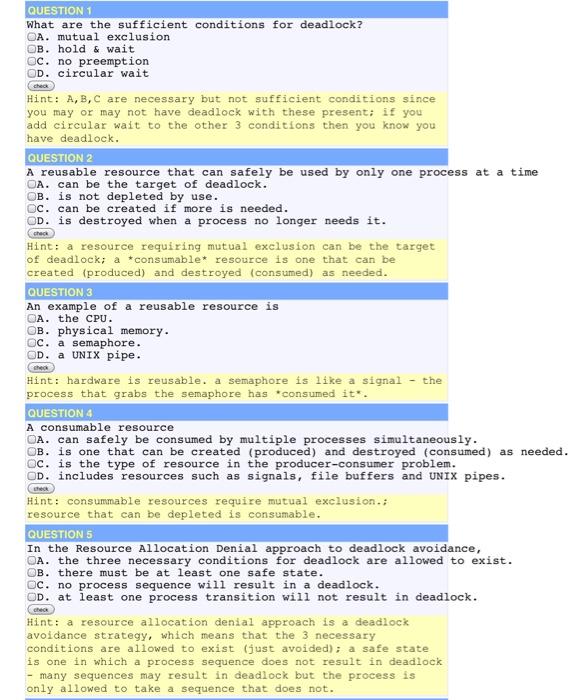
QUESTION 1 What are the sufficient conditions for deadlock? OA. mutual exclusion OB. hold & wait OC. no preemption OD. circular wait check she Hint: A,B,C are necessary but not sufficient conditions since you may or may not have deadlock with these present: if you add circular wait to the other 3 conditions then you know you have deadlock QUESTION 2 A reusable resource that can safely be used by only one process at a time OA. can be the target of deadlock. OB. is not depleted by use. Oc. can be created if more is needed. OD. is destroyed when a process no longer needs it. Hint: a resource requiring mutual exclusion can be the target of deadlock; a *consumable* resource is one that can be created produced) and destroyed (consumed) as needed. QUESTION 3 An example of a reusable resource is OA. the CPU. OB. physical memory. OC. a semaphore. OD. a UNIX pipe. Hint: hardware is reusable. a semaphore is like a signal - the process that grabs the semaphore has *consumed it. QUESTION 4 A consumable resource OA. can safely be consumed by multiple processes simultaneously. OB. is one that can be created (produced) and destroyed (consumed) as needed. oc. is the type of resource in the producer-consumer problem. OD. includes resources such as signals, file buffers and UNIX pipes. Hint: consummable resources require mutual exclusion.; resource that can be depleted is consumable. QUESTIONS In the Resource Allocation Denial approach to deadlock avoidance, OA. the three necessary conditions for deadlock are allowed to exist. OB. there must be at least one safe state. Oc. no process sequence will result in a deadlock. OD. at least one process transition will not result in deadlock. Hint: a resource allocation denial approach is a deadlock avoidance strategy, which means that the 3 necessary conditions are allowed to exist (just avoided); a safe state is one in which a process sequence does not result in deadlock - many sequences may result in deadlock but the process is only allowed to take a sequence that does not. check
Step by Step Solution
There are 3 Steps involved in it

Get step-by-step solutions from verified subject matter experts
 Study Help