







Question: Topic: Planning and control CASE 2: Fresh Salads Ltd: The Iceberg Lettuce Harvest Introduction Fresh Salads Ltd is an important division of a privately-owned farming
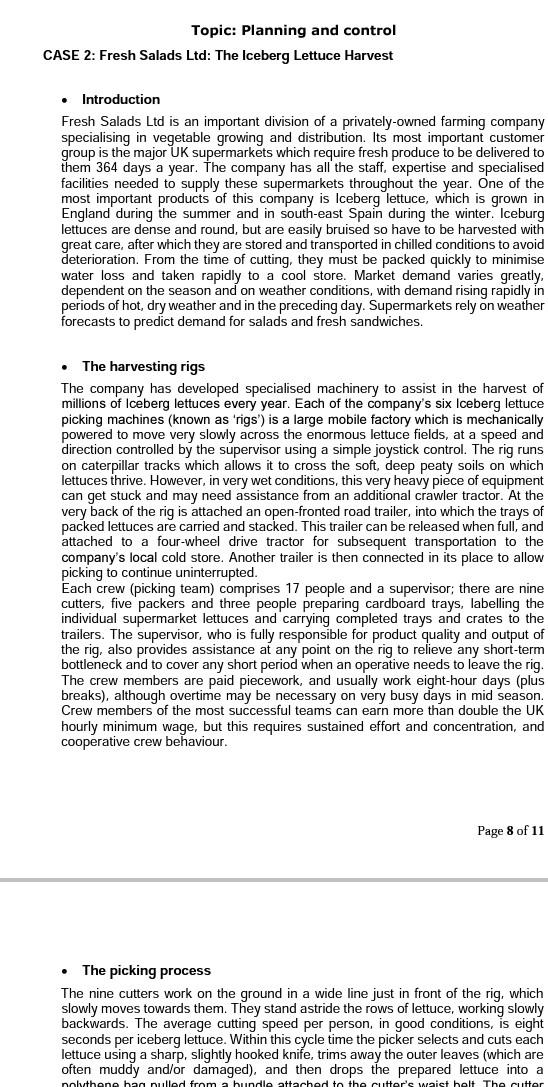
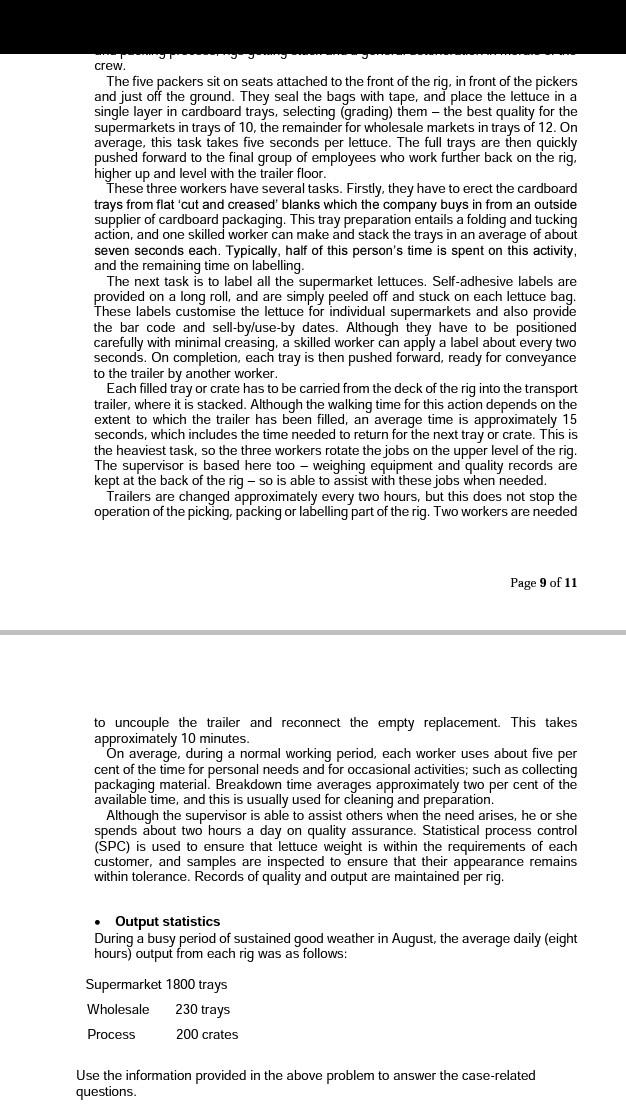

Topic: Planning and control CASE 2: Fresh Salads Ltd: The Iceberg Lettuce Harvest Introduction Fresh Salads Ltd is an important division of a privately-owned farming company specialising in vegetable growing and distribution. Its most important customer group is the major UK supermarkets which require fresh produce to be delivered to them 364 days a year. The company has all the staff, expertise and specialised facilities needed to supply these supermarkets throughout the year. One of the most important products of this company is Iceberg lettuce, which is grown in England during the summer and in south-east Spain during the winter. Iceburg lettuces are dense and round, but are easily bruised so have to be harvested with great care, after which they are stored and transported in chilled conditions to avoid deterioration. From the time of cutting, they must be packed quickly to minimise water loss and taken rapidly to a cool store. Market demand varies greatly dependent on the season and on weather conditions, with demand rising rapidly in periods of hot, dry weather and in the preceding day. Supermarkets rely on weather forecasts to predict demand for salads and fresh sandwiches. . The harvesting rigs The company has developed specialised machinery to assist in the harvest of millions of Iceberg lettuces every year. Each of the company's six Iceberg lettuce picking machines (known as 'rigs') is a large mobile factory which is mechanically powered to move very slowly across the enormous lettuce fields, at a speed and direction controlled by the supervisor using a simple joystick control. The rig runs on caterpillar tracks which allows it to cross the soft, deep peaty soils on which lettuces thrive. However, in very wet conditions, this very heavy piece of equipment can get stuck and may need assistance from an additional crawler tractor. At the very back of the rig is attached an open-fronted road trailer, into which the trays of packed lettuces are carried and stacked. This trailer can be released when full and attached to a four-wheel drive tractor for subsequent transportation to the company's local cold store. Another trailer is then connected in its place to allow picking to continue uninterrupted. Each crew (picking team) comprises 17 people and a supervisor, there are nine cutters, five packers and three people preparing cardboard trays, labelling the individual supermarket lettuces and carrying completed trays and crates to the trailers. The supervisor, who is fully responsible for product quality and output of rig, also provides assistance at any point on the rig to relieve any short-term bottleneck and to cover any short period when an operative needs to leave the rig. The crew members are paid piecework, and usually work eight-hour days (plus breaks), although overtime may be necessary on very busy days in mid season. Crew members of the most successful teams can earn more than double the UK hourly minimum wage, but this requires sustained effort and concentration, and cooperative crew behaviour. the Page 8 of 11 The picking process The nine cutters work on the ground in a wide line just in front of the rig, which slowly moves towards them. They stand astride the rows of lettuce, working slowly backwards. The average cutting speed per person, in good conditions, is eight seconds per iceberg lettuce. Within this cycle time the picker selects and cuts each lettuce using a sharp, slightly hooked knife, trims away the outer leaves (which are often muddy and/or damaged), and then drops the prepared lettuce into a poluthene han nulled from a bundle attached to the cutter's waist belt The cutter crew. The five packers sit on seats attached to the front of the rig. in front of the pickers and just off the ground. They seal the bags with tape, and place the lettuce in a single layer in cardboard trays, selecting (grading) them - the best quality for the supermarkets in trays of 10, the remainder for wholesale markets in trays of 12. On average, this task takes five seconds per lettuce. The full trays are then quickly pushed forward to the final group of employees who work further back on the rig, higher up and level with the trailer floor. These three workers have several tasks. Firstly, they have to erect the cardboard trays from flat 'cut and creased' blanks which the company buys in from an outside supplier of cardboard packaging. This tray preparation entails a folding and tucking action, and one skilled worker can make and stack the trays in an average of about seven seconds each. Typically, half of this person's time is spent on this activity, and the remaining time on labelling. The next task is to label all the supermarket lettuces. Self-adhesive labels are provided on a long roll, and are simply peeled off and stuck on each lettuce bag These labels customise the lettuce for individual supermarkets and also provide the bar code and sell-by/use-by dates. Although they have to be positioned carefully with minimal creasing, a skilled worker can apply a label about every two seconds. On to the trailer by another ch tray is then pushed forward, ready for conveyance 1 completion, each worker Each filled tray or crate has to be carried from the deck of the rig into the transport trailer, where it is stacked. Although the walking time for this action depends on the extent to which the trailer has been filled, an average time is approximately 15 seconds, which includes the time needed to return for the next tray or crate. This is the heaviest task, so the three workers rotate the jobs on the upper level of the rig. The supervisor is based here too - weighing equipment and quality records are kept at the back of the rig - so is able to assist with these jobs when needed. Trailers are changed approximately every two hours, but this does not stop the operation of the picking, packing or labelling part of the rig. Two workers are needed Page 9 of 11 cent to uncouple the trailer and reconnect the empty replacement. This takes approximately 10 minutes. On average, during a normal working period, each worker uses about five per f the time for personal needs and for occasional activities, such as collecting packaging material. Breakdown time averages approximately two per cent of the available time, and this is usually used for cleaning and preparation. Although the supervisor is able to assist others when the need arises, he or she spends about two hours a day on quality assurance. Statistical process control (SPC) is used to ensure that lettuce weight is within the requirements of each customer, and samples are inspected to ensure that their appearance remains within tolerance. Records of quality and output are maintained per rig. Output statistics During a busy period of sustained good weather in August, the average daily (eight hours) output from each rig was as follows: Supermarket 1800 trays Wholesale 230 trays Process 200 crates Use the information provided in the above problem to answer the case-related questions. Question 1 (18 marks) (a) Identify any three transformed resources from the case. (b) Identify any three transforming resources from the case. (6) (c) Identify any three outputs of the process described in this case. (6) Question 2 (10 marks) Enterpret the main operations objectives for the macro operation? Base your answer on the five operations objectives: quality, speed, dependability, flexibility, and cost. (10) Question 3 (6 marks) In a typical UK summer, the weather can cycle frequently between cool, dull periods with spells of heavy rainfall, and periods of hot, dry and sunny weather. What capacity management problems could arise during such variations in the weather, and how can management best respond to such fluctuations? (6) Total 34 marks
Step by Step Solution
There are 3 Steps involved in it
1 Expert Approved Answer
Step: 1 Unlock

Question Has Been Solved by an Expert!
Get step-by-step solutions from verified subject matter experts
Step: 2 Unlock
Step: 3 Unlock
 Study Help