







Question: Toshlba's Notebook Computer Assembly LIne The dally schedules are shared with the nearby Fujlhashi Parts Collection and Distribution Center. Parts are brought from Fujhashi to
Toshlba's Notebook Computer Assembly LIne The dally schedules are shared with the nearby Fujlhashi Parts Collection and Distribution Center. Parts are brought from Fujhashi to
the plant within two hours of when they are needed. The materlal supply system is very tightly coordinated and works well.
The assembly line consists of a meter conveyor belt that carries the computers, separated at meter intervals by white stripes
on the belt. Workers stand shoulder to shoulder on one side of the conveyor and work on the units as they move by In addition to the
assembly workers, a highly skilled worker, called a "supporter," is assigned to each line. The supporter moves along the line, assisting
workers who are falling behind and replacing workers who need to take a break. Supporters also make decislons about what to do
when problems are encountered during the assembly process such as a defective part The line speed and the number of workers
vary from day to day, depending on production demand and the workers' skills and avallability. Although the assembly line has
positions, often they are not all used.
Exhibit provides detalls of how the engineers who designed the new subnotebook computer felt that the new line should be
organized.
Exhibit : Engineers' Initial design of the assembly line
In words, the following is a brief description of what is done at each workstation:
Workstation : The first operator lays out the major components of a computer between two white lines on the conveyor. The operator
then prepares the cover for accepting the LCD screen by installing fasteners and securing a cable.
Workstation : The second operator performs two different tasks. First, the LCD screen is installed in the cover. This task needs to be
done after the cover is assembled task A second Independent task done by the operator is the preparation of the base so that the
Main Printed Circuit Board MPCB can be Installed.
Workstation : Here the MPCB is Installed In the base. After this is done. the Central Processina Unit CPU and backuo batterles are Workstation : The first operator lays out the major components of a computer between two white lines on the conveyor. The operator
then prepares the cover for accepting the LCD screen by Installing fasteners and securing a cable.
Workstation : The second operator performs two different tasks. First, the LCD screen is Installed in the cover. This task needs to be
done after the cover is assembled task A second Independent task done by the operator is the preparation of the base so that the
Main Printed Circuit Board MPCB can be installed.
Workstation : Here the MPCB is installed in the base. After this i
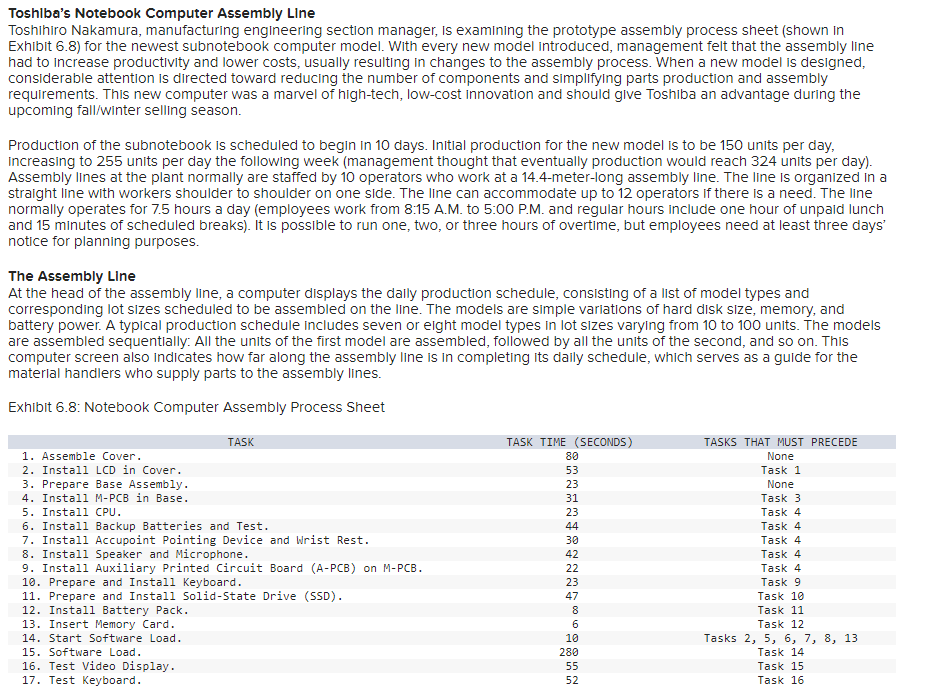
Toshihiro Nakamura, manufacturing engineering section manager, is examining the prototype assembly process sheet shown in
Exhibit for the newest subnotebook computer model. With every new model introduced, management felt that the assembly line
had to increase productivity and lower costs, usually resulting in changes to the assembly process. When a new model is designed,
considerable attention is directed toward reducing the number of components and simplifying parts production and assembly
requirements. This new computer was a marvel of hightech, lowcost innovation and should give Toshiba an advantage during the
upcoming fallwinter selling season.
Production of the subnotebook is scheduled to begin in days. Initial production for the new model is to be units per day,
Increasing to units per day the following week management thought that eventually production would reach units per day
Assembly lines at the plant normally are staffed by operators who work at a meterlong assembly line. The line is organized in a
straight line with workers shoulder to shoulder on one side. The line can accommodate up to operators if there is a need. The line
normally operates for hours a day employees work from : AM to : PM and regular hours include one hour of unpald lunch
and minutes of scheduled breaks It is possible to run one, two, or three hours of overtime, but employees need at least three days'
notice for planning purposes.
The Assembly Line
At the head of the assembly line, a computer displays the dally production schedule, consisting of a list of model types and
corresponding lot sizes scheduled to be assembled on the line. The models are simple variations of hard disk size, memory, and
battery power. A typical production schedule includes seven or eight model types in lot sizes varying from to units. The models
are assembled sequentlally: All the units of the first model are assembled, followed by all the units of the second, and so on This
computer screen also indicates how far along the assembly line is in completing its daily schedule, which serves as a guide for the
materlal handlers who supply parts to the assembly lines.
Exhibit : Notebook Computer Assembly Pr
Step by Step Solution
There are 3 Steps involved in it
1 Expert Approved Answer
Step: 1 Unlock

Question Has Been Solved by an Expert!
Get step-by-step solutions from verified subject matter experts
Step: 2 Unlock
Step: 3 Unlock
 Study Help