







Question: 6-1 Suppose interest rates on residential mortgages of equal risk are 5.5% in California and 7.0% in New York. Could this differential persist? What forces
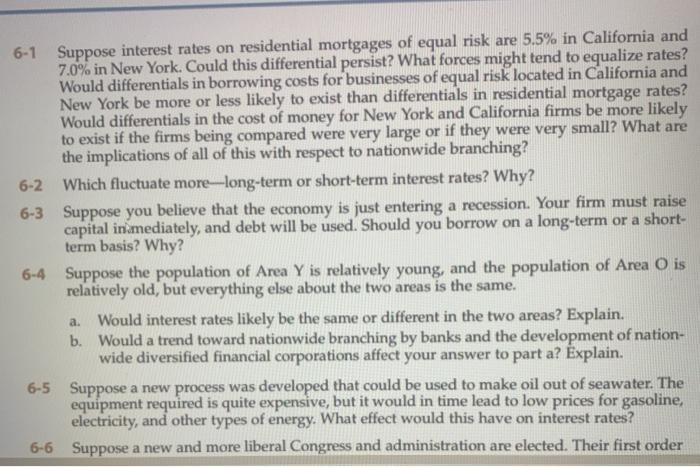
6-1 Suppose interest rates on residential mortgages of equal risk are 5.5% in California and 7.0% in New York. Could this differential persist? What forces might tend to equalize rates? Would differentials in borrowing costs for businesses of equal risk located in California and New York be more or less likely to exist than differentials in residential mortgage rates? Would differentials in the cost of money for New York and California firms be more likely to exist if the firms being compared were very large or if they were very small? What are the implications of all of this with respect to nationwide branching? 6-2 Which fluctuate more--long-term or short-term interest rates? Why? 6-3 Suppose you believe that the economy is just entering a recession. Your firm must raise capital in mediately, and debt will be used. Should you borrow on a long-term or a short- term basis? Why? 6-4 Suppose the population of Area Y is relatively young, and the population of Area O is relatively old, but everything else about the two areas is the same. Would interest rates likely be the same or different in the two areas? Explain. b. Would a trend toward nationwide branching by banks and the development of nation- wide diversified financial corporations affect your answer to part a? Explain. 6-5 Suppose a new process was developed that could be used to make oil out of seawater. The equipment required is quite expensive, but it would in time lead to low prices for gasoline, electricity, and other types of energy. What effect would this have on interest rates? 6-6 Suppose a new and more liberal Congress and administration are elected. Their first order a
Step by Step Solution
There are 3 Steps involved in it

Get step-by-step solutions from verified subject matter experts
 Study Help