







Question: Amortize Discount by Interest Method On the first day of its fiscal year, Ebert Company issued $14,000,000 of 5-year, 12% bonds to finance its operations.
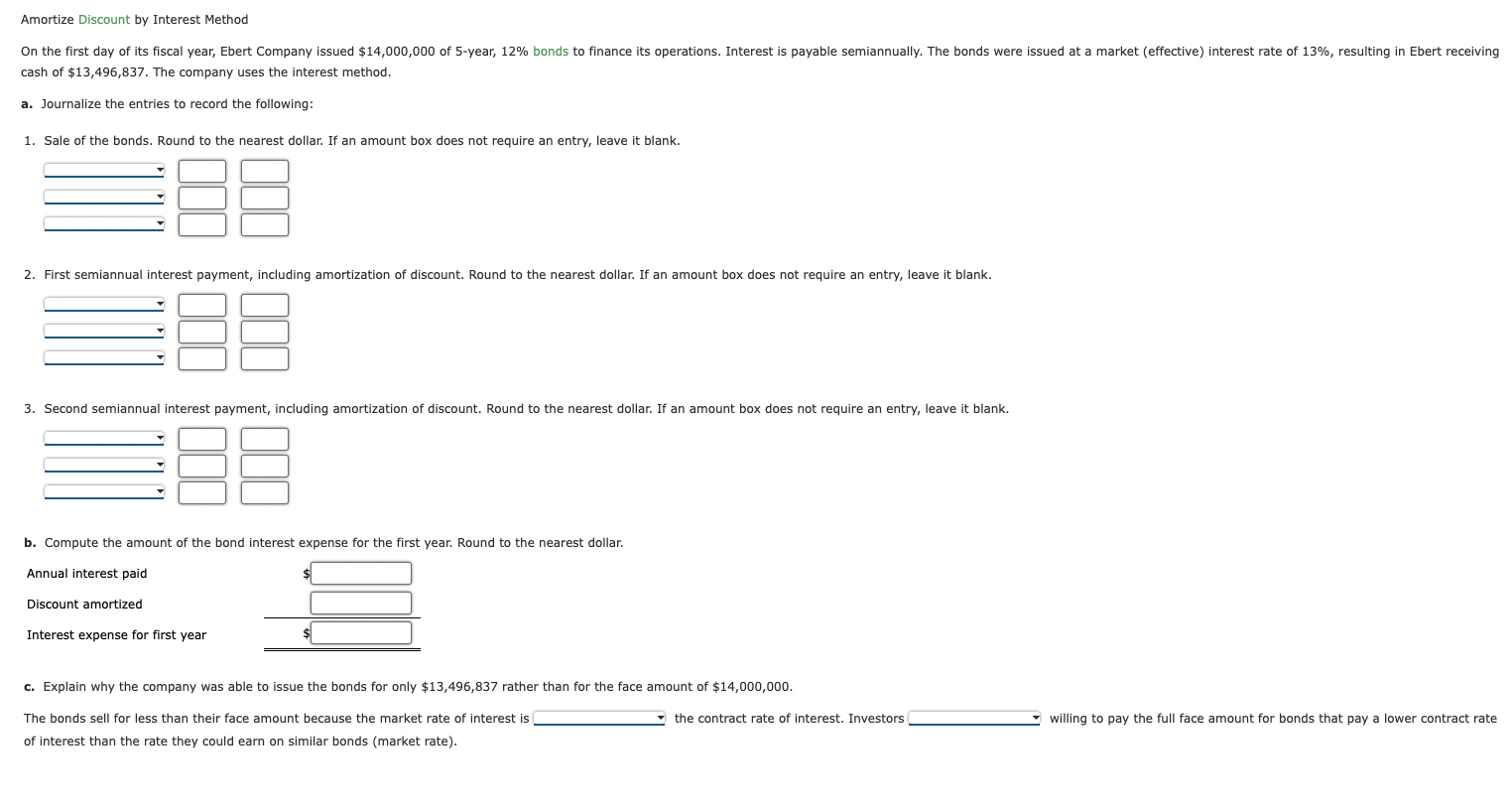
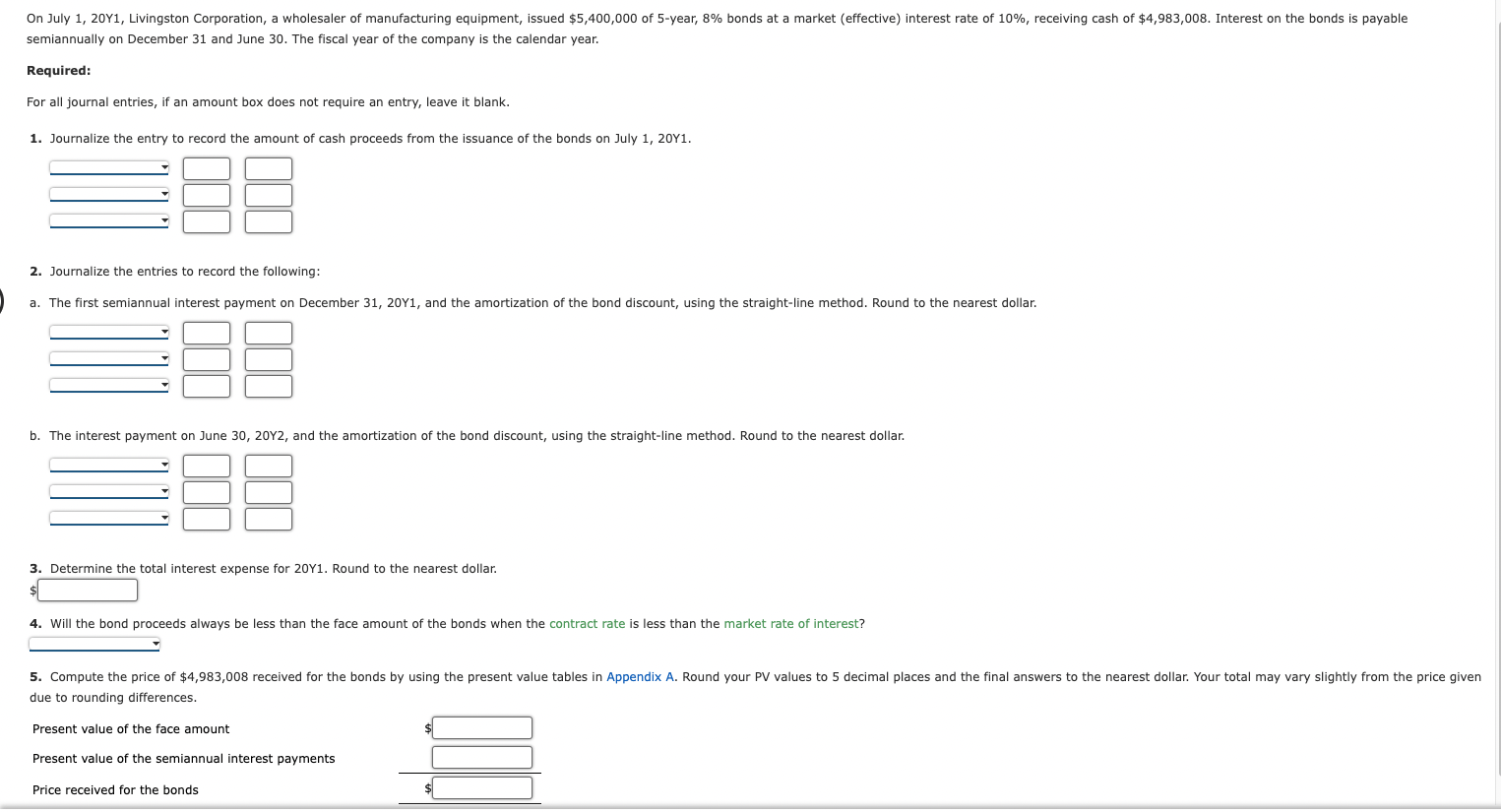
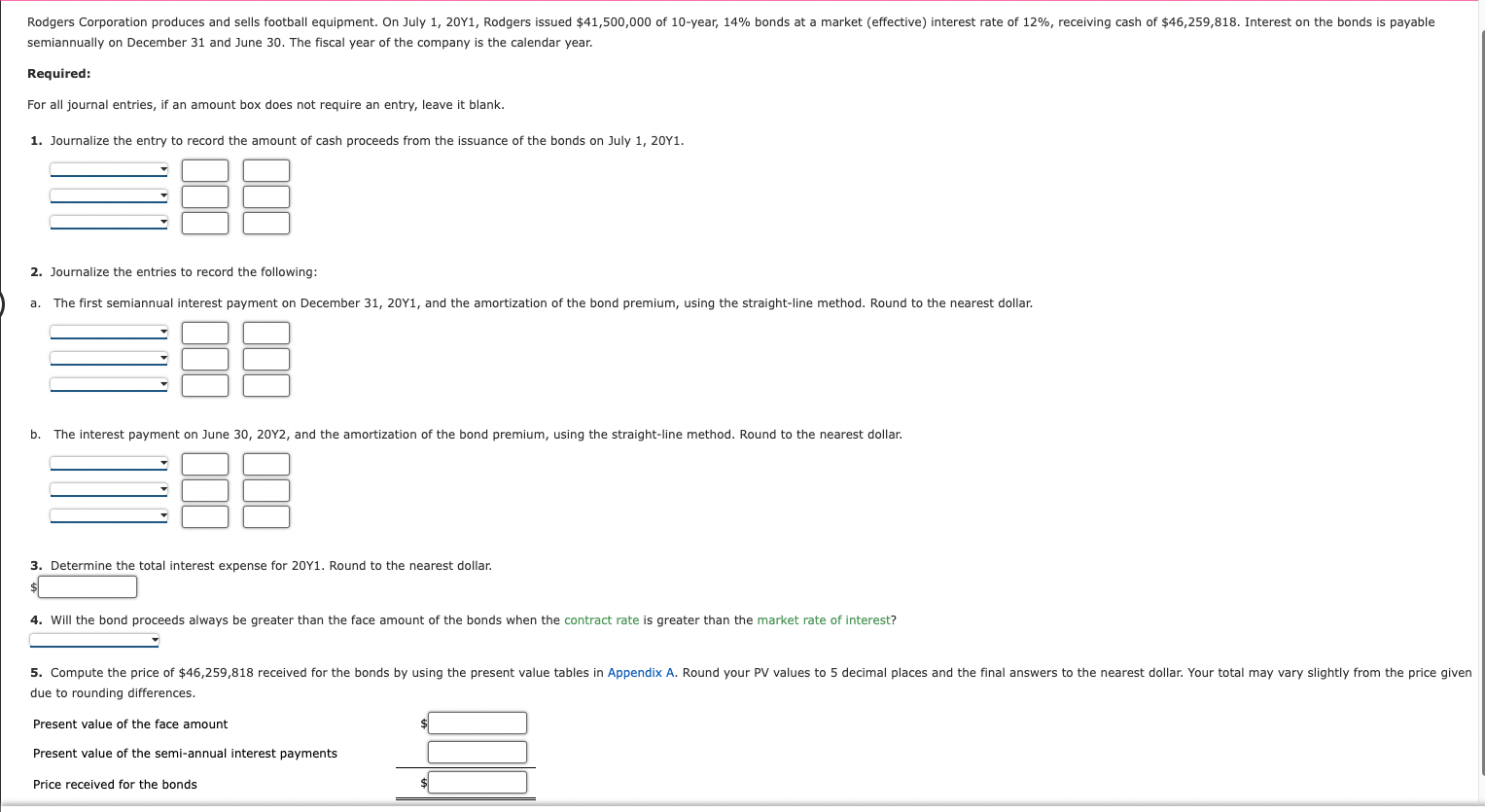
Amortize Discount by Interest Method On the first day of its fiscal year, Ebert Company issued $14,000,000 of 5-year, 12% bonds to finance its operations. Interest is payable semiannually. The bonds were issued at a market (effective) interest rate of 13%, resulting in Ebert receiving cash of $13,496,837. The company uses the interest method. a. Journalize the entries to record the following: 1. Sale of the bonds. Round to the nearest dollar. If an amount box does not require an entry, leave it blank. 2. First semiannual interest payment, including amortization of discount. Round to the nearest dollar. If an amount box does not require an entry, leave it blank. 3. Second semiannual interest payment, including amortization of discount. Round to the nearest dollar. If an amount box does not require an entry, leave it blank. b. Compute the amount of the bond interest expense for the first year. Round to the nearest dollar. Annual interest paid Discount amortized Interest expense for first year c. Explain why the company was able to issue the bonds for only $13,496,837 rather than for the face amount of $14,000,000. the contract rate of interest. Investors willing to pay the full face amount for bonds that pay a lower contract rate The bonds sell for less than their face amount because the market rate of interest is of interest than the rate they could earn on similar bonds (market rate). On July 1, 2011, Livingston Corporation, a wholesaler of manufacturing equipment, issued $5,400,000 of 5-year, 8% bonds at a market (effective) interest rate of 10%, receiving cash of $4,983,008. Interest on the bonds is payable semiannually on December 31 and June 30. The fiscal year of the company is the calendar year. Required: For all journal entries, if an amount box does not require an entry, leave it blank. 1. Journalize the entry to record the amount of cash proceeds from the issuance of the bonds on July 1, 20Y1. 2. Journalize the entries to record the following: a. The first semiannual interest payment on December 31, 20Y1, and the amortization of the bond discount, using the straight-line method. Round to the nearest dollar. b. The interest payment on June 30, 20Y2, and the amortization of the bond discount, using the straight-line method. Round to the nearest dollar. 89 3. Determine the total interest expense for 20Y1. Round to the nearest dollar. $ 4. Will the bond proceeds always be less than the face amount of the bonds when the contract rate is less than the market rate of interest? 5. Compute the price of $4,983,008 received for the bonds by using the present value tables in Appendix A. Round your PV values to 5 decimal places and the final answers to the nearest dollar. Your total may vary slightly from the price given due to rounding differences. Present value of the face amount Present value of the semiannual interest payments Price received for the bonds Rodgers Corporation produces and sells football equipment. On July 1, 2011, Rodgers issued $41,500,000 of 10-year, 14% bonds at a market (effective) interest rate of 12%, receiving cash of $46,259,818. Interest on the bonds is payable semiannually on December 31 and June 30. The fiscal year of the company is the calendar year. Required: For all journal entries, if an amount box does not require an entry, leave it blank. 1. Journalize the entry to record the amount of cash proceeds from the issuance of the bonds on July 1, 2011. 2. Journalize the entries to record the following: a. The first semiannual interest payment on December 31, 20Y1, and the amortization of the bond premium, using the straight-line method. Round to the nearest dollar. b. The interest payment on June 30, 20Y2, and the amortization of the bond premium, using the straight-line method. Round to the nearest dollar. 3. Determine the total interest expense for 20Y1. Round to the nearest dollar. 4. Will the bond proceeds always be greater than the face amount of the bonds when the contract rate is greater than the market rate of interest? 5. Compute the price of $46,259,818 received for the bonds by using the present value tables in Appendix A. Round your PV values to 5 decimal places and the final answers to the nearest dollar. Your total may vary slightly from the price given due to rounding differences. Present value of the face amount Present value of the semi-annual interest payments Price received for the bonds
Step by Step Solution
There are 3 Steps involved in it

Get step-by-step solutions from verified subject matter experts
 Study Help