







Question: DSI did make some minor modifications to the program, and they sent some people out to consult with Andrews and her staff on how to
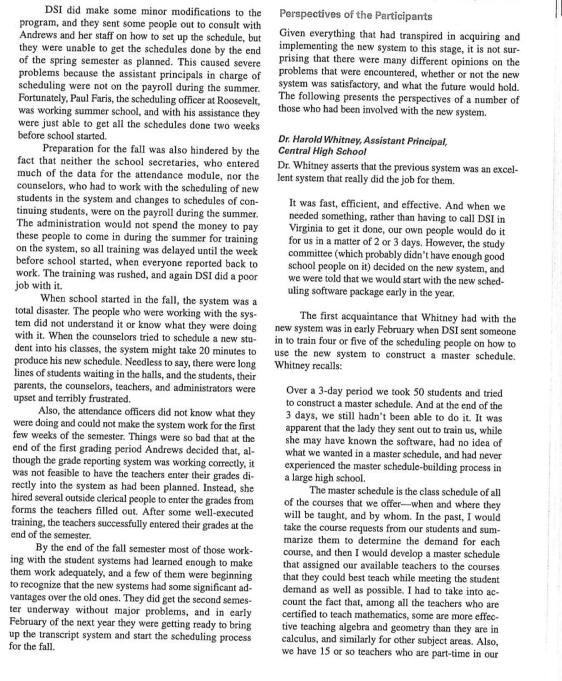
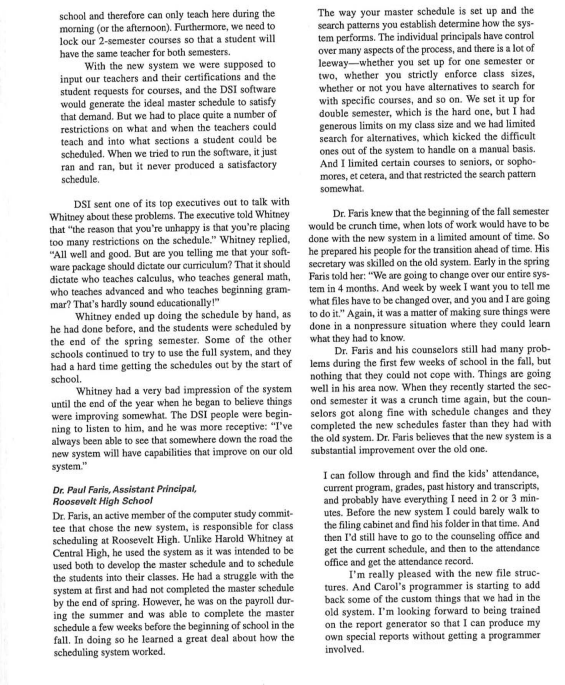
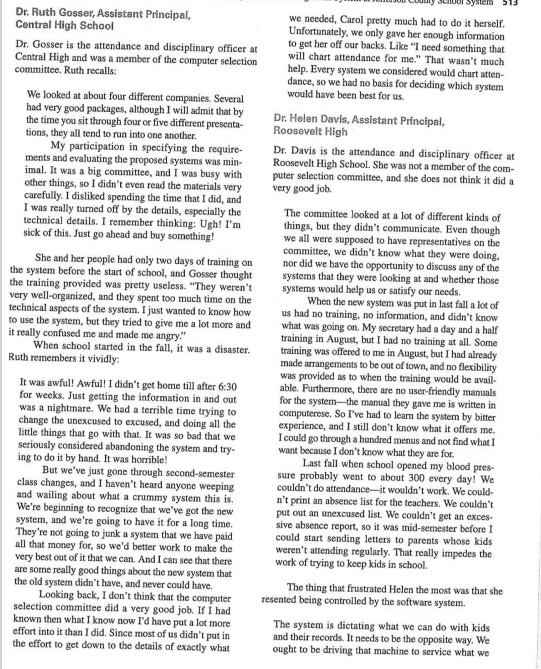
DSI did make some minor modifications to the program, and they sent some people out to consult with Andrews and her staff on how to set up the schedule, but they were unable to get the schedules done by the end of the spring semester as planned. This caused severe problems because the assistant principals in charge of scheduling were not on the payroll during the summer. Fortunately, Paul Faris, the scheduling officer at Roosevelt, was working summer school, and with his assistance they were just able to get all the schedules done two weeks before school started. Preparation for the fall was also hindered by the fact that neither the school secretaries, who entered much of the data for the attendance module, nor the counselors, who had to work with the scheduling of new students in the system and changes to schedules of continuing students, were on the payroll during the summer. The administration would not spend the money to pay these people to come in during the summer for training on the system, so all training was delayed until the week before school started, when everyone reported back to work. The training was rushed, and again DSI did a poor job with it. When school started in the fall, the system was a total disaster. The people who were working with the system did not understand it or know what they were doing with it. When the counselors tried to schedule a new student into his classes, the system might take 20 minutes to produce his new schedule. Needless to say, there were long lines of students waiting in the halls, and the students, their parents, the counselors, teachers, and administrators were upset and terribly frustrated. Also, the attendance officers did not know what they were doing and could not make the system work for the first few weeks of the semester. Things were so bad that at the end of the first grading period Andrews decided that, although the grade reporting system was working correctly, it was not feasible to have the teachers enter their grades directly into the system as had been planned. Instead, she hired several outside clerical people to enter the grades from forms the teachers filled out. After some well-executed training, the teachers successfully entered their grades at the end of the semester. By the end of the fall semester most of those working with the student systems had learned enough to make them work adequately, and a few of them were beginning to recognize that the new systems had some significant advantages over the old ones. They did get the second semester underway without major problems, and in early February of the next year they were getting ready to bring up the transcript system and start the scheduling process for the fall. Perspectives of the Participants Given everything that had transpired in acquiring and implementing the new system to this stage, it is not surprising that there were many different opinions on the problems that were encountered, whether or not the new system was satisfactory, and what the future would hold. The following presents the perspectives of a number of those who had been involved with the new system. Dr. Harold Whitney, Assistant Principal, Central High School Dr. Whitney asserts that the previous system was an excellent system that really did the job for them. It was fast, efficient, and effective. And when we needed something, rather than having to call DSI in Virginia to get it done, our own people would do it for us in a matter of 2 or 3 days. However, the study committee (which probably didn't have enough good school people on it) decided on the new system, and we were told that we would start with the new scheduling software package early in the year. The first acquaintance that Whitney had with the new system was in early February when DSI sent someone in to train four or five of the scheduling people on how to use the new system to construct a master schedule. Whitney recalls: Over a 3-day period we took 50 students and tried to construct a master schedule. And at the end of the 3 days, we still hadn't been able to do it. It was apparent that the lady they sent out to train us, while she may have known the software, had no idea of what we wanted in a master schedule, and had never experienced the master schedule-building process in a large high school. The master schedule is the class schedule of all of the courses that we offer-when and where they will be taught, and by whom. In the past, I would take the course requests from our students and summarize them to determine the demand for each course, and then I would develop a master schedule that assigned our available teachers to the courses that they could best teach while meeting the student demand as well as possible. I had to take into account the fact that, among all the teachers who are certified to teach mathematics, some are more effective teaching algebra and geometry than they are in calculus, and similarly for other subject areas. Also, we have 15 or so teachers who are part-time in our school and therefore can only teach here during the morning (or the afternoon). Furthermore, we need to lock our 2-semester courses so that a student will have the same teacher for both semesters. With the new system we were supposed to input our teachers and their certifications and the student requests for courses, and the DSI software would generate the ideal master schedule to satisfy that demand. But we had to place quite a number of restrictions on what and when the teachers could teach and into what sections a student could be scheduled. When we tried to run the software, it just ran and ran, but it never produced a satisfactory schedule. DSI sent one of its top executives out to talk with Whitney about these problems. The executive told Whitney that "the reason that you're unhappy is that you're placing too many restrictions on the schedule." Whitney replied, "All well and good. But are you telling me that your software package should dictate our curriculum? That it should dictate who teaches calculus, who teaches general math, who teaches advanced and who teaches beginning grammar? That's hardly sound educationally!" Whitney ended up doing the schedule by hand, as he had done before, and the students were scheduled by the end of the spring semester. Some of the other schools continued to try to use the full system, and they had a hard time getting the schedules out by the start of school. Whitney had a very bad impression of the system until the end of the year when he began to believe things were improving somewhat. The DSI people were beginning to listen to him, and he was more receptive: "I've always been able to see that somewhere down the road the new system will have capabilities that improve on our old system." Dr. Paul Faris, Assistant Principal, Roosevelt High School Dr. Faris, an active member of the computer study committee that chose the new system, is responsible for class scheduling at Roosevelt High. Unlike Harold Whitney at Central High, he used the system as it was intended to be used both to develop the master schedule and to schedule the students into their classes. He bad a struggle with the system at first and had not completed the master schedule by the end of spring. However, he was on the payroll during the summer and was able to complete the master schedule a few weeks before the beginning of school in the fall. In doing so he learned a great deal about how the scheduling system worked. The way your master schedule is set up and the search patterns you establish determine how the system performs. The individual principals have control over many aspects of the process, and there is a lot of leeway-whether you set up for one semester or two, whether you strictly enforce class sizes, whether or not you bave alternatives to search for with specific courses, and so on. We set it up for double semester, which is the hard one, but I had generous limits on my class size and we had limited search for alternatives, which kicked the difficult ones out of the system to handle on a manual basis. And I limited certain courses to seniors, or sophomores, et cetera, and that restricted the search pattern somewhat. Dr. Faris knew that the beginning of the fall semester would be crunch time, when lots of work would have to be done with the new system in a limited amount of time. So he prepared his people for the transition ahead of time. His secretary was skilled on the old system. Early in the spring Faris told her: "We are going to change over our entire system in 4 months. And week by week I want you to tell me what files have to be changed over, and you and I are going to do it." Again, it was a matter of making sure things were done in a nonpressure situation where they could learn what they had to know. Dr. Faris and his counselors still had many problems during the first few weeks of school in the fall, but nothing that they could not cope with. Things are going well in his area now. When they recently started the second semester it was a crunch time again, but the counselors got along fine with schedule changes and they completed the new schedules faster than they had with the old system. Dr. Faris believes that the new system is a substantial improvement over the old one. I can follow through and find the kids' attendance, current program, grades, past history and transcripts, and probably have everything I need in 2 or 3 minutes. Before the new system I could barely walk to the filing cabinet and find his folder in that time. And then I'd still have to go to the counseling office and get the current schedule, and then to the attendance office and get the attendance record. I'm really pleased with the new file structures. And Carol's programmer is starting to add back some of the custom things that we had in the old system. I'm looking forward to being trained on the report generator so that I can produce my own special reports without getting a programmer involved. Dr. Ruth Gosser, Assistant Principal, Central High School Dr. Gosser is the attendance and disciplinary officer at Central High and was a member of the computer selection committee. Ruth recalls: We looked at about four different companies. Several had very good packages, although I will admit that by the time you sit through four or five different presentations, they all tend to run into one another. My participation in specifying the requirements and evaluating the proposed systems was minimal. It was a big committee, and I was busy with other things, so I didn't even read the materials very carefully. I disliked spending the time that I did, and I was really turned off by the details, especially the technical details. I remember thinking: Ugh! I'm sick of this. Just go ahead and buy something! She and her people had only two days of training on the system before the start of school, and Gosser thought the training provided was pretty useless. "They weren't very well-organized, and they spent too much time on the technical aspects of the system. I just wanted to know how to use the system, but they tried to give me a lot more and it really confused me and made me angry." When school started in the fall, it was a disaster. Ruth remembers it vividly: It was awful! Awful! I didn't get home till after 6:30 for weeks. Just getting the information in and out was a nightmare. We had a terrible time trying to change the unexcused to excused, and doing all the little things that go with that. It was so bad that we seriously considered abandoning the system and trying to do it by hand. It was horrible! But we've just gone through second-semester class changes, and I haven't heard anyone weeping and wailing about what a crummy system this is. We're beginning to recognize that we've got the new system, and we're going to have it for a long time. They're not going to junk a system that we have paid all that money for, so we'd better work to make the very best out of it that we can. And I can see that there are some really good things about the new system that the old system didn't have, and never could have. Looking back, I don't think that the computer selection committee did a very good job. If I had known then what I know now I'd have put a lot more effort into it than I did. Since most of us didn't put in the effort to get down to the details of exactly what we needed, Carol pretty much had to do it herself. Unfortunately, we only gave her enough information to get her off our backs. Like "I need something that will chart attendance for me." That wasn't much help. Every system we considered would chart attendance, so we had no basis for deciding which system would have been best for us. Dr. Helen Davis, Assistant Principal, Roosevelt High Dr. Davis is the attendance and disciplinary officer at Roosevelt High School. She was not a member of the computer selection committee, and she does not think it did a very good job. The committee looked at a lot of different kinds of things, but they didn't communicate. Even though we all were supposed to have representatives on the committee, we didn't know what they were doing. nor did we have the opportunity to discuss any of the systems that they were looking at and whether those systems would help us or satisfy our needs. When the new system was put in last fall a lot of us had no training, no information, and didn't know what was going on. My secretary had a day and a half training in August, but I had no training at all. Some training was offered to me in August, but I had already made arrangements to be out of town, and no flexibility was provided as to when the training would be available. Furthermore, there are no user-friendly manuals for the system-the manual they gave me is written in computerese. So Trve had to leam the system by bitter experience, and I still don't know what it offers me. I could go through a hundred menus and not find what I want because I don't know what they are for. Last fall when school opened my blood pressure probably went to about 300 every day! We couldn't do attendance - it wouldn't work. We couldn't print an absence list for the teachers. We couldn't put out an unexcused list. We couldn't get an excessive absence report, so it was mid-semester before I could start sending letters to parents whose kids weren't attending regularly. That really impedes the work of trying to keep kids in school. The thing that frustrated Helen the most was that she resented being controlled by the software system. The system is dictating what we can do with kids and their records. It needs to be the opposite way. We ought to be driving that machine to service what we
Step by Step Solution
There are 3 Steps involved in it

Get step-by-step solutions from verified subject matter experts
 Study Help