



Question: Problem 13-36 (LO. 4, 8) Jenna, a longtime client of yours, is an architect and president of the local Rotary chapter. To keep up to
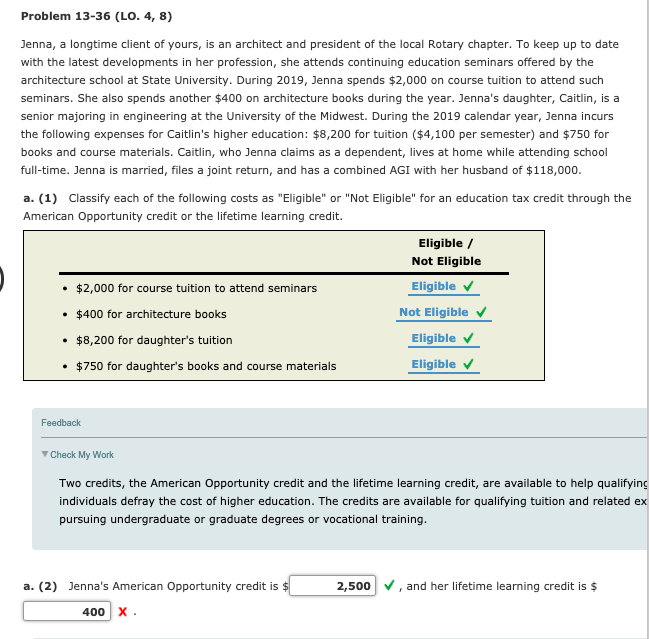
Problem 13-36 (LO. 4, 8) Jenna, a longtime client of yours, is an architect and president of the local Rotary chapter. To keep up to date with the latest developments in her profession, she attends continuing education seminars offered by the architecture school at State University. During 2019, Jenna spends $2,000 on course tuition to attend such seminars. She also spends another $400 on architecture books during the year. Jenna's daughter, Caitlin, is a senior majoring in engineering at the University of the Midwest. During the 2019 calendar year, Jenna incurs the following expenses for Caitlin's higher education: $8,200 for tuition ($4,100 per semester) and $750 for books and course materials. Caitlin, who Jenna claims as a dependent, lives at home while attending school full-time. Jenna is married, files a joint return, and has a combined AGI with her husband of $118,000. a. (1) Classify each of the following costs as "Eligible" or "Not Eligible" for an education tax credit through the American Opportunity credit or the lifetime learning credit. Eligible / Not Eligible $2,000 for course tuition to attend seminars Eligible $400 for architecture books Not Eligible $8,200 for daughter's tuition Eligible $750 for daughter's books and course materials Eligible Feedback Check My Work Two credits, the American Opportunity credit and the lifetime learning credit, are available to help qualifying individuals defray the cost of higher education. The credits are available for qualifying tuition and related ex pursuing undergraduate or graduate degrees or vocational training. 2,500 , and her lifetime learning credit is $ a. (2) Jenna's American Opportunity credit is $ 400 x
Step by Step Solution
There are 3 Steps involved in it

Get step-by-step solutions from verified subject matter experts