







Question: Trial Balance Errors The trial balance. for ]. Singhal (Io. is shown on page. 64. it does not balance. The following errors were made during
![Trial Balance Errors The trial balance. for ]. Singhal (Io. is](https://s3.amazonaws.com/si.experts.images/answers/2024/06/667f9727706c0_799667f97275051a.jpg)
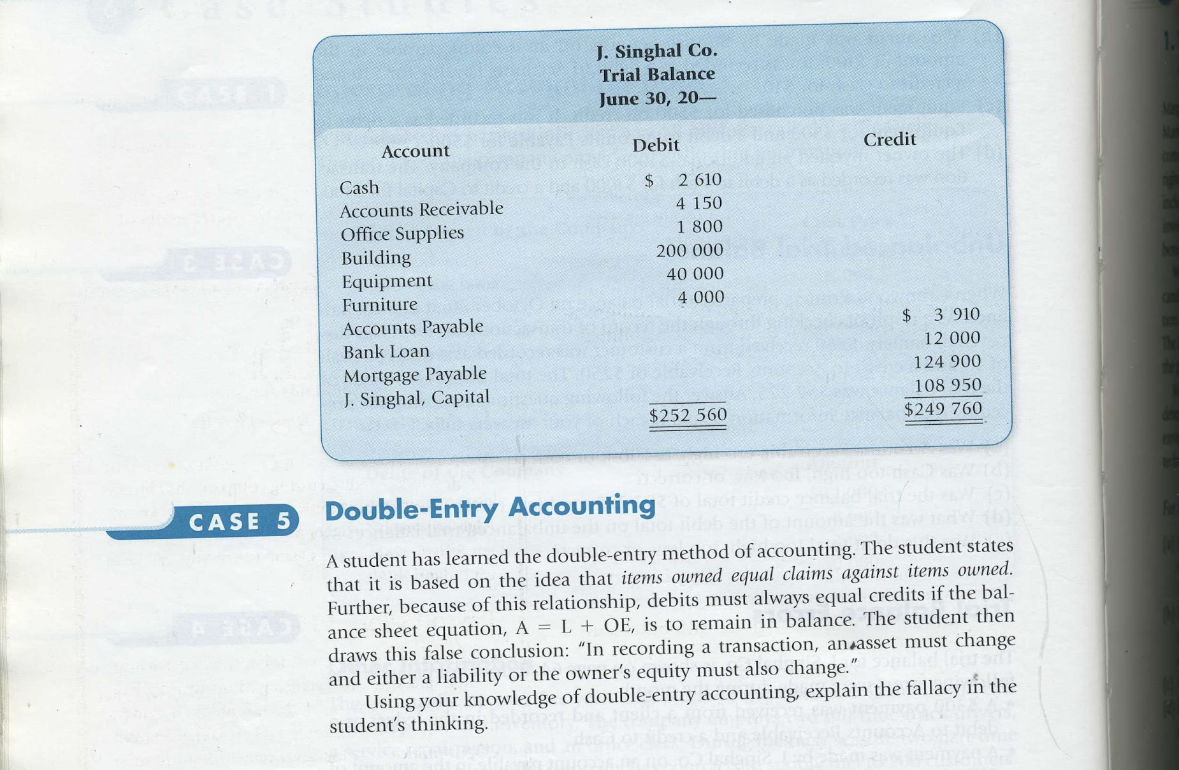
Trial Balance Errors The trial balance. for ]. Singhal (Io. is shown on page. 64. it does not balance. The following errors were made during the month. . A $300 payment was received from a client and recorded in the. ledger as a debit to Accounts Receivable and a credit to Cash. 0 A payment was made by J. Singhal Co. on an account payable in the. amount of $100, It was recorded as a debit to Accounts Payable for $10 and a credit to Cash for $10. . Equipment was purchased For $500 on credit. It was recorded as a debit to liquipment for $500 and a debit to Accounts Payable for $500. 0 The owner invested an additional $1000 cash in the company, The transac tion was recorded as a debit to Cash for $1000 and credit to Capital for $100. . A $1200 payment on the mortgage was recorded as a $2'l00 debit to Mortgage Payable. and a 5 | 200 credit to Cash. - A $100 purchase ofofce supplies For cash was not recorded. (a) For each of the errors, indicate the accounts affected. the amount, and whether the account balances are too high or too low. {b} Prepare a new, corrected trial balance. 1m 30: 20- I . ' Account Debit Credit Cash 99 2 610 Accounts Receivable 4 150 Ofce Supplies 1 800 Building 200 000 Equipment 40 000 Furniture . {1 000 Accounts Payable . $ 3 910 Bank Loan 12 000 Mortgage Payable 124 900 I. Singbal. Capital 108 950 $252 560 $249 760 J m Double-Entry Accounting A student has learned the doubleeemry method of accounting. The student states that it is based on the idea that items owned equal claims against items owned. Further, because of this relationship, debits must always equal credits if the bal ance sheet equation. A = l. + OE. is to remain in balance. The student then draws this false conclusion: "In recording a transaction, amasset must change and either a liability or the owner's equity must also change. " Using your knowledge of double-entry accounting, explain the fallacy iii the students thinking
Step by Step Solution
There are 3 Steps involved in it

Get step-by-step solutions from verified subject matter experts
 Study Help