



Question: TRUE FALSE 1) TF Dividends are an expense and thus should be included as a deduction in arriving at net income for a period. 2)
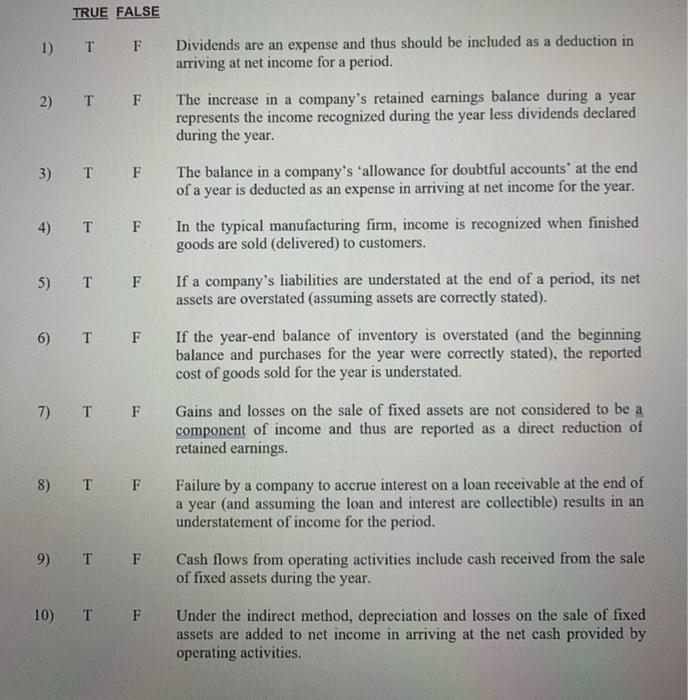
TRUE FALSE 1) TF Dividends are an expense and thus should be included as a deduction in arriving at net income for a period. 2) TF The increase in a company's retained earnings balance during a year represents the income recognized during the year less dividends declared during the year. 3) T F The balance in a company's allowance for doubtful accounts' at the end of a year is deducted as an expense in arriving at net income for the year. 4) T F In the typical manufacturing firm, income is recognized when finished goods are sold (delivered) to customers. 5) T F If a company's liabilities are understated at the end of a period, its net assets are overstated (assuming assets are correctly stated). 6) T F If the year-end balance of inventory is overstated (and the beginning balance and purchases for the year were correctly stated), the reported cost of goods sold for the year is understated. 7) TF Gains and losses on the sale of fixed assets are not considered to be a component of income and thus are reported as a direct reduction of retained earnings. 8) TF Failure by a company to accrue interest on a loan receivable at the end of a year (and assuming the loan and interest are collectible) results in an understatement of income for the period. 9) TF Cash flows from operating activities include cash received from the sale of fixed assets during the year. 10) TF Under the indirect method, depreciation and losses on the sale of fixed assets are added to net income in arriving at the net cash provided by operating activities
Step by Step Solution
There are 3 Steps involved in it

Get step-by-step solutions from verified subject matter experts