







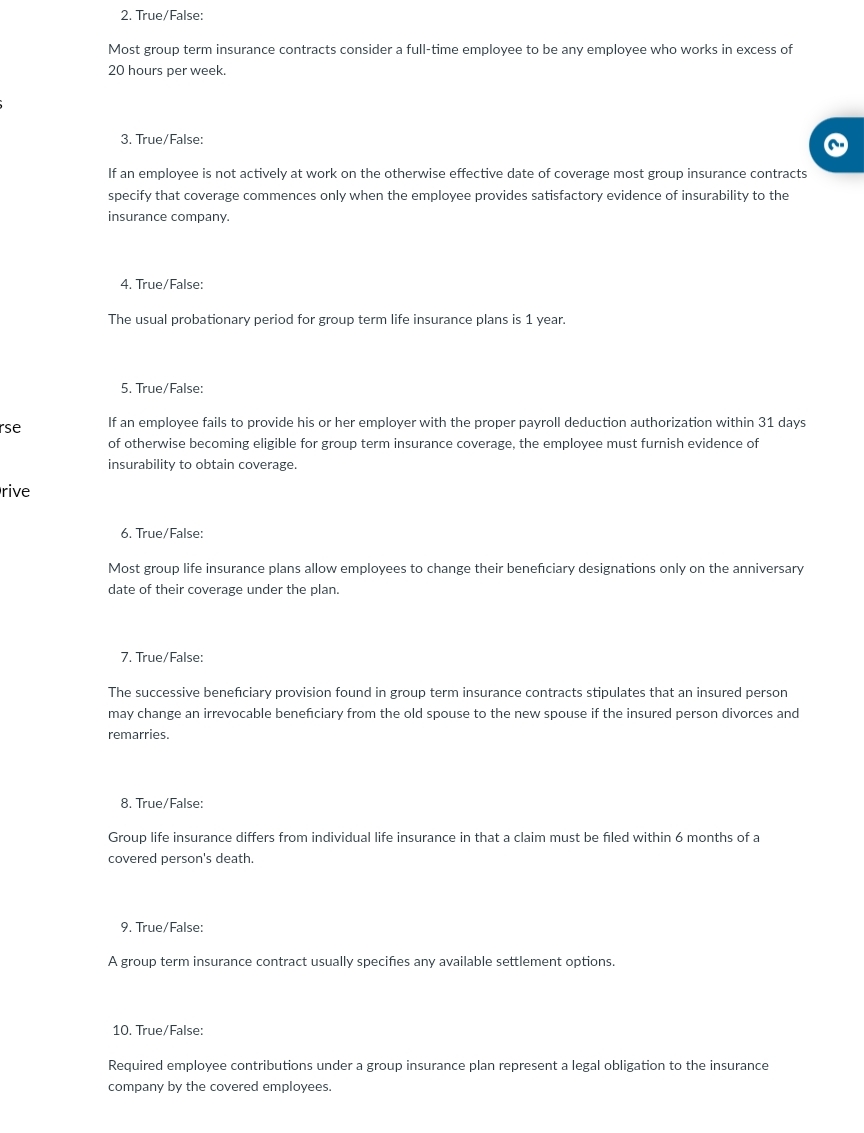
Question: True / False: Most group term insurance contracts consider a full - time employee to be any employee who works in excess of 2 0
TrueFalse:
Most group term insurance contracts consider a fulltime employee to be any employee who works in excess of hours per week.
TrueFalse:
If an employee is not actively at work on the otherwise effective date of coverage most group insurance contracts specify that coverage commences only when the employee provides satisfactory evidence of insurability to the insurance company.
TrueFalse:
The usual probationary period for group term life insurance plans is year.
TrueFalse:
If an employee fails to provide his or her employer with the proper payroll deduction authorization within days of otherwise becoming eligible for group term insurance coverage, the employee must furnish evidence of insurability to obtain coverage.
TrueFalse:
Most group life insurance plans allow employees to change their beneficiary designations only on the anniversary date of their coverage under the plan.
TrueFalse:
The successive beneficiary provision found in group term insurance contracts stipulates that an insured person may change an irrevocable beneficiary from the old spouse to the new spouse if the insured person divorces and remarries.
TrueFalse:
Group life insurance differs from individual life insurance in that a claim must be filed within months of a covered person's death.
TrueFalse:
A group term insurance contract usually specifies any available settlement options.
TrueFalse:
Required employee contributions under a group insurance plan represent a legal obligation to the insurance company by the covered employees.
Step by Step Solution
There are 3 Steps involved in it
1 Expert Approved Answer
Step: 1 Unlock

Question Has Been Solved by an Expert!
Get step-by-step solutions from verified subject matter experts
Step: 2 Unlock
Step: 3 Unlock
 Study Help