







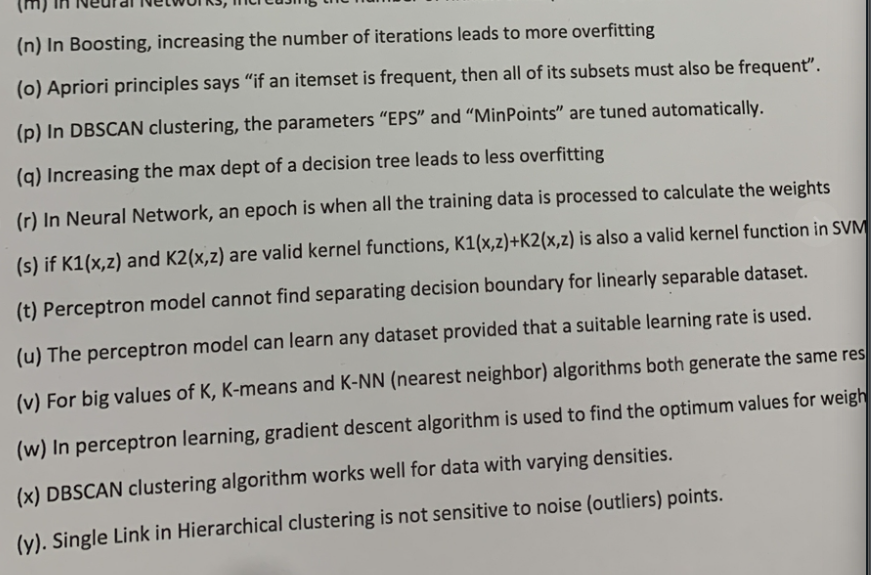
Question: TRUE / FALSE ONLY (n) In Boosting, increasing the number of iterations leads to more overfitting (o) Apriori principles says if an itemset is frequent,
 TRUE / FALSE ONLY
(n) In Boosting, increasing the number of iterations leads to more overfitting (o) Apriori principles says "if an itemset is frequent, then all of its subsets must also be frequent". (p) In DBSCAN clustering, the parameters "EPS" and "MinPoints" are tuned automatically. (q) Increasing the max dept of a decision tree leads to less overfitting (r) In Neural Network, an epoch is when all the training data is processed to calculate the weights (s) if K1(x,z) and K2(x,z) are valid kernel functions, K1(x,z)+K2(x,z) is also a valid kernel function in SV (t) Perceptron model cannot find separating decision boundary for linearly separable dataset. (u) The perceptron model can learn any dataset provided that a suitable learning rate is used. (v) For big values of K, K-means and K-NN (nearest neighbor) algorithms both generate the same (w) In perceptron learning, gradient descent algorithm is used to find the optimum values for wei (x) DBSCAN clustering algorithm works well for data with varying densities. (y). Single Link in Hierarchical clustering is not sensitive to noise (outliers) points. (n) In Boosting, increasing the number of iterations leads to more overfitting (o) Apriori principles says "if an itemset is frequent, then all of its subsets must also be frequent". (p) In DBSCAN clustering, the parameters "EPS" and "MinPoints" are tuned automatically. (q) Increasing the max dept of a decision tree leads to less overfitting (r) In Neural Network, an epoch is when all the training data is processed to calculate the weights (s) if K1(x,z) and K2(x,z) are valid kernel functions, K1(x,z)+K2(x,z) is also a valid kernel function in SV (t) Perceptron model cannot find separating decision boundary for linearly separable dataset. (u) The perceptron model can learn any dataset provided that a suitable learning rate is used. (v) For big values of K, K-means and K-NN (nearest neighbor) algorithms both generate the same (w) In perceptron learning, gradient descent algorithm is used to find the optimum values for wei (x) DBSCAN clustering algorithm works well for data with varying densities. (y). Single Link in Hierarchical clustering is not sensitive to noise (outliers) points
Step by Step Solution
There are 3 Steps involved in it

Get step-by-step solutions from verified subject matter experts
 Study Help