







Question: True False or Incoherent 1. A countable union of countable sets is countable. 2. An arbitrary union of countable sets is countable. 3. A finite
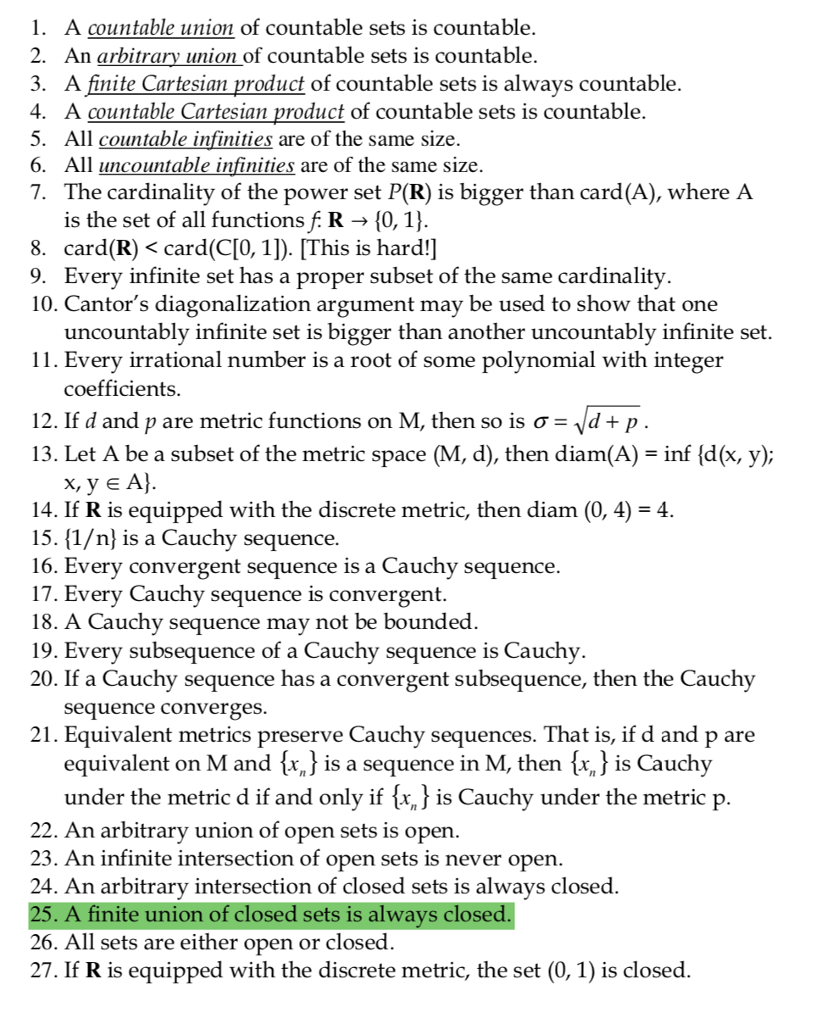
True False or Incoherent
1. A countable union of countable sets is countable. 2. An arbitrary union of countable sets is countable. 3. A finite Cartesian product of countable sets is always countable. 4. A countable Cartesian product of countable sets is countable. 5. All countable infinities are of the same size. 6. All uncountable infinities are of the same size. 7. The cardinality of the power set P(R) is bigger than card (A), where A is the set of all functions f. R {0, 1}. 8. card(R) < card(C[0, 1]). [This is hard!] 9. Every infinite set has a proper subset of the same cardinality. 10. Cantor's diagonalization argument may be used to show that one uncountably infinite set is bigger than another uncountably infinite set. 11. Every irrational number is a root of some polynomial with integer coefficients. = d+p. 12. If d and p are metric functions on M, then so is = 13. Let A be a subset of the metric space (M, d), then diam(A) = inf {d(x, y); x, y = A}. 14. If R is equipped with the discrete metric, then diam (0, 4) = 4. 15. {1/n) is a Cauchy sequence. 16. Every convergent sequence is a Cauchy sequence. 17. Every Cauchy sequence is convergent. 18. A Cauchy sequence may not be bounded. 19. Every subsequence of a Cauchy sequence is Cauchy. 20. If a Cauchy sequence has a convergent subsequence, then the Cauchy sequence converges. 21. Equivalent metrics preserve Cauchy sequences. That is, if d and p are equivalent on M and {x} is a sequence in M, then {x} is Cauchy under the metric d if and only if {x} is Cauchy under the metric p. 22. An arbitrary union of open sets is open. 23. An infinite intersection of open sets is never open. 24. An arbitrary intersection of closed sets is always closed. 25. A finite union of closed sets is always closed. 26. All sets are either open or closed. 27. If R is equipped with the discrete metric, the set (0, 1) is closed.
Step by Step Solution
3.35 Rating (164 Votes )
There are 3 Steps involved in it
The detailed answer for the above question is provided below ANSWER AND STEPBYSTEP EXPLANATION 1 True This is a wellknown result in set theory One can ... View full answer

Get step-by-step solutions from verified subject matter experts
 Study Help