







Question: true or false 10. (T/F) The Unix fork() system call, when placed after the exec() system call will never get executed. 11. (T/F) Your application
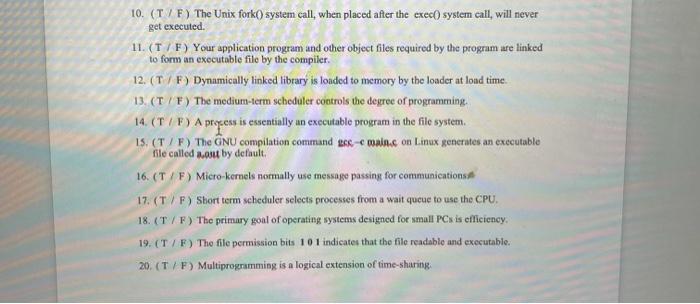
10. (T/F) The Unix fork() system call, when placed after the exec() system call will never get executed. 11. (T/F) Your application program and other object files required by the program are linked to form an executable file by the compiler. 12. (TF) Dynamically linked library is loaded to memory by the loader at load time 13. (T / F) The medium-term scheduler controls the degree of programming 14. (T / A process is essentially an executable program in the file system 15. (T/F) The GNU compilation command see mainc on Linux generates an executable file called out by default. 16. (T/F) Micro kernels normally use message passing for communications 17. (T/F) Short term scheduler selects processes from a wait queue to use the CPU. 18. (T/F) The primary goal of operating systems designed for small PCx is efficiency 19. (T/F) Tho file permission bits 101 indicates that the file readable and executable. 20. (T/F) Multiprogramming is a logical extension of time-shuring
Step by Step Solution
There are 3 Steps involved in it

Get step-by-step solutions from verified subject matter experts
 Study Help