







Question: True or false PLEASE READ EACH STATEMENT AND DECIDE WHETHER IT IS TRUE OR FALSE. PLEASE SUBMIT YOUR ANSWERS IN THE FOLLOWING FORMAT 1.T, 2.F,
True or false 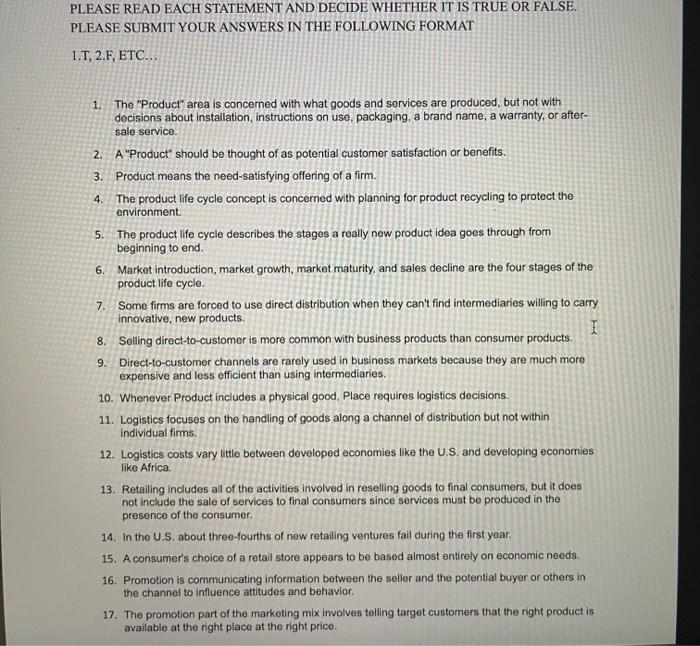
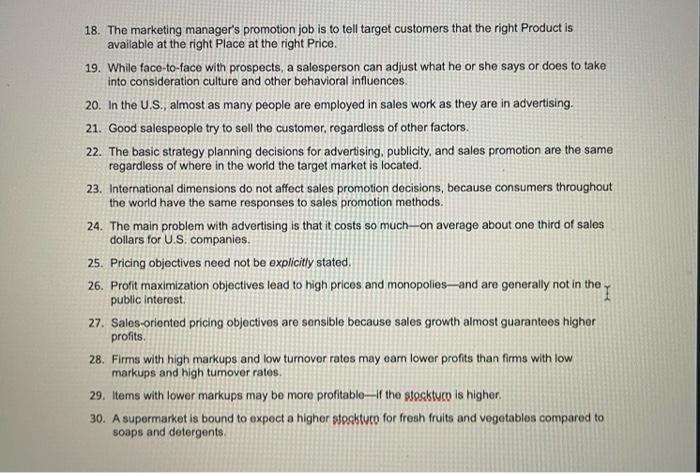
PLEASE READ EACH STATEMENT AND DECIDE WHETHER IT IS TRUE OR FALSE. PLEASE SUBMIT YOUR ANSWERS IN THE FOLLOWING FORMAT 1.T, 2.F, ETC... 4. 1. The "Product area is concerned with what goods and services are produced, but not with decisions about installation, instructions on use, packaging, a brand name, a warranty, or after- sale service. 2. A "Product should be thought of as potential customer satisfaction or benefits. 3. Product means the need-satisfying offering of a firm. The product life cycle concept is concerned with planning for product recycling to protect the environment 5. The product life cycle describes the stages a really new product idea goes through from beginning to end. 6. Market introduction, market growth, market maturity, and sales decline are the four stages of the product life cycle. 7. Some firms are forced to use direct distribution when they can't find intermediaries willing to carry innovative, new products I 8. Selling direct-to-customer is more common with business products than consumer products. 9. Direct-to-customer channels are rarely used in business markets because they are much more expensive and less efficient than using intermediaries. 10. Whenever Product includes a physical good, Place requires logistics decisions. 11. Logistics focuses on the handling of goods along a channel of distribution but not within individual firms. 12. Logistics costs vary little between developed economies like the U.S. and developing economies like Africa. 13. Retailing includes all of the activities involved in reselling goods to final consumers, but it does not include the sale of services to final consumers since services must be produced in the presence of the consumer. 14. In the U.S. about three-fourths of new retailing ventures fall during the first year 15. A consumer's choice of a retail store appears to be based almost entirely on economic needs 16. Promotion is communicating information between the seller and the potential buyer or others in the channel to influence attitudes and behavior. 17. The promotion part of the marketing mix involves telling target customers that the right product is available at the right place at the right price. 18. The marketing manager's promotion job is to tell target customers that the right Product is available at the right place at the right Price 19. While face-to-face with prospects, a salesperson can adjust what he or she says or does to take into consideration culture and other behavioral influences 20. In the U.S., almost as many people are employed in sales work as they are in advertising. 21. Good salespeople try to sell the customer, regardless of other factors. 22. The basic strategy planning decisions for advertising, publicity, and sales promotion are the same regardless of where in the world the target market is located. 23. International dimensions do not affect sales promotion decisions, because consumers throughout the world have the same responses to sales promotion methods. 24. The main problem with advertising is that it costs so much-on average about one third of sales dollars for U.S. companies. 25. Pricing objectives need not be explicitly stated. 26. Profit maximization objectives lead to high prices and monopolies and are generally not in the public interest I 27. Sales-oriented pricing objectives are sensible because sales growth almost guarantees higher profits 28. Firms with high markups and low turnover rates may cam lower profits than firms with low markups and high turnover rates. 29. Items with lower markups may be more profitable-If the stockstuco is higher 30. A supermarket is bound to expect a higher sockturo for fresh fruits and vegetables compared to soaps and detergents PLEASE READ EACH STATEMENT AND DECIDE WHETHER IT IS TRUE OR FALSE. PLEASE SUBMIT YOUR ANSWERS IN THE FOLLOWING FORMAT 1.T, 2.F, ETC... 4. 1. The "Product area is concerned with what goods and services are produced, but not with decisions about installation, instructions on use, packaging, a brand name, a warranty, or after- sale service. 2. A "Product should be thought of as potential customer satisfaction or benefits. 3. Product means the need-satisfying offering of a firm. The product life cycle concept is concerned with planning for product recycling to protect the environment 5. The product life cycle describes the stages a really new product idea goes through from beginning to end. 6. Market introduction, market growth, market maturity, and sales decline are the four stages of the product life cycle. 7. Some firms are forced to use direct distribution when they can't find intermediaries willing to carry innovative, new products I 8. Selling direct-to-customer is more common with business products than consumer products. 9. Direct-to-customer channels are rarely used in business markets because they are much more expensive and less efficient than using intermediaries. 10. Whenever Product includes a physical good, Place requires logistics decisions. 11. Logistics focuses on the handling of goods along a channel of distribution but not within individual firms. 12. Logistics costs vary little between developed economies like the U.S. and developing economies like Africa. 13. Retailing includes all of the activities involved in reselling goods to final consumers, but it does not include the sale of services to final consumers since services must be produced in the presence of the consumer. 14. In the U.S. about three-fourths of new retailing ventures fall during the first year 15. A consumer's choice of a retail store appears to be based almost entirely on economic needs 16. Promotion is communicating information between the seller and the potential buyer or others in the channel to influence attitudes and behavior. 17. The promotion part of the marketing mix involves telling target customers that the right product is available at the right place at the right price. 18. The marketing manager's promotion job is to tell target customers that the right Product is available at the right place at the right Price 19. While face-to-face with prospects, a salesperson can adjust what he or she says or does to take into consideration culture and other behavioral influences 20. In the U.S., almost as many people are employed in sales work as they are in advertising. 21. Good salespeople try to sell the customer, regardless of other factors. 22. The basic strategy planning decisions for advertising, publicity, and sales promotion are the same regardless of where in the world the target market is located. 23. International dimensions do not affect sales promotion decisions, because consumers throughout the world have the same responses to sales promotion methods. 24. The main problem with advertising is that it costs so much-on average about one third of sales dollars for U.S. companies. 25. Pricing objectives need not be explicitly stated. 26. Profit maximization objectives lead to high prices and monopolies and are generally not in the public interest I 27. Sales-oriented pricing objectives are sensible because sales growth almost guarantees higher profits 28. Firms with high markups and low turnover rates may cam lower profits than firms with low markups and high turnover rates. 29. Items with lower markups may be more profitable-If the stockstuco is higher 30. A supermarket is bound to expect a higher sockturo for fresh fruits and vegetables compared to soaps and detergents Step by Step Solution
There are 3 Steps involved in it
1 Expert Approved Answer
Step: 1 Unlock

Question Has Been Solved by an Expert!
Get step-by-step solutions from verified subject matter experts
Step: 2 Unlock
Step: 3 Unlock
 Study Help