







Question: True or False questions MULTIPLE CHOICE. Choose the one alternative that best completes the statement or answers the question. 1) The auditor traces Items from
True or False questions
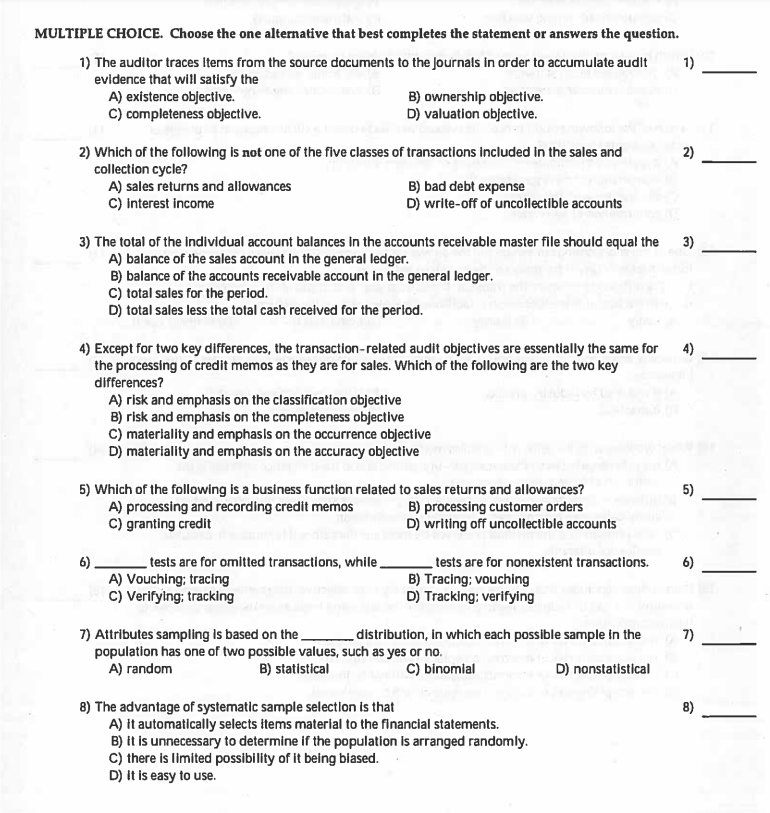
MULTIPLE CHOICE. Choose the one alternative that best completes the statement or answers the question. 1) The auditor traces Items from the source documents to the Journals in order to accumulate audit 1) evidence that will satisfy the A) existence objective. B) ownership objective. C) completeness objective. D) valuation objective. 2) 2) Which of the following is not one of the five classes of transactions included in the sales and collection cycle? A) sales returns and allowances B) bad debt expense C) Interest income D) write-off of uncollectible accounts 3) 3) The total of the individual account balances in the accounts receivable master file should equal the A) balance of the sales account in the general ledger. B) balance of the accounts receivable account in the general ledger. c) total sales for the period. D) total sales less the total cash received for the period. 4) 4) Except for two key differences, the transaction-related audit objectives are essentially the same for the processing of credit memos as they are for sales. Which of the following are the two key differences? A) risk and emphasis on the classification objective B) risk and emphasis on the completeness objective C) materiality and emphasis on the occurrence objective D) materiality and emphasis on the accuracy objective 5) 5) Which of the following is a business function related to sales returns and allowances? A) processing and recording credit memos B) processing customer orders C) granting credit D) writing off uncollectible accounts 6) 6) tests are for omitted transactions, while A) Vouching; tracing C) Verifying: tracking tests are for nonexistent transactions. B) Tracing; vouching D) Tracking: verifying 7) 7) Attributes sampling is based on the distribution, in which each possible sample in the population has one of two possible values, such as yes or no. A) random B) statistical C) binomial D) nonstatistical 8) 8) The advantage of systematic sample selection is that A) It automatically selects items material to the financial statements. B) it is unnecessary to determine if the population is arranged randomly. C) there is limited possibility of it being biased. D) it is easy to use
Step by Step Solution
There are 3 Steps involved in it

Get step-by-step solutions from verified subject matter experts
 Study Help