







Question: true or false TF17. All languages th DFSM at can be recognized by an NDFSM can be recognized by a T F 18. No infinite
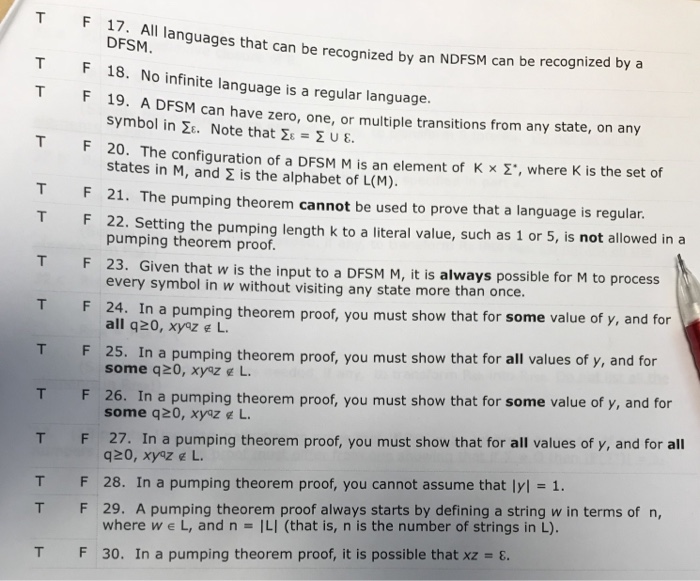
TF17. All languages th DFSM at can be recognized by an NDFSM can be recognized by a T F 18. No infinite language is a regular language. 19. A DFSM can have zero, one, or multiple transitions from any state, on any symbol in . Note that - u . F 20. The configuration of a DFSM M is an element of K , where K is the set of states in M, and is the alphabet of L(M). TF 21. The pumping theorem cannot be used to prove that a language is regular. T F 22. Setting the pumping length k to a literal value, such as 1 or 5, is not allowed in a T F 23. Given that w is the input to a DFSM M, it is always possible for M to process T F 24. pumping theorem proof. every symbol in w without visiting any state more than once all q20, xyz e L some q20, xyaz L some q20, xyz L. q20, xyaz L. 29. A pumping theorem proof always starts by defining a string w in terms of n, In a pumping theorem proof, you must show that for some value of y, and for T F 25. In a pumping theorem proof, you must show that for all values of y, and for T F 26. In a pumping theorem proof, you must show that for some value of y, and for TF 27. In a pumping theorem proof, you must show that for all values of y, and for all T F 28. In a pumping theorem proof, you cannot assume that lyl 1. T F (that is, n is the number of strings in L). where w e L, and n = 30, In a pumping theorem proof, it is possible that xz = . T F
Step by Step Solution
There are 3 Steps involved in it

Get step-by-step solutions from verified subject matter experts
 Study Help