







Question: True or False: The Navier - Stokes equations are derived from the conservation of momentum for fluid motion, taking into account viscosity, pressure, and external
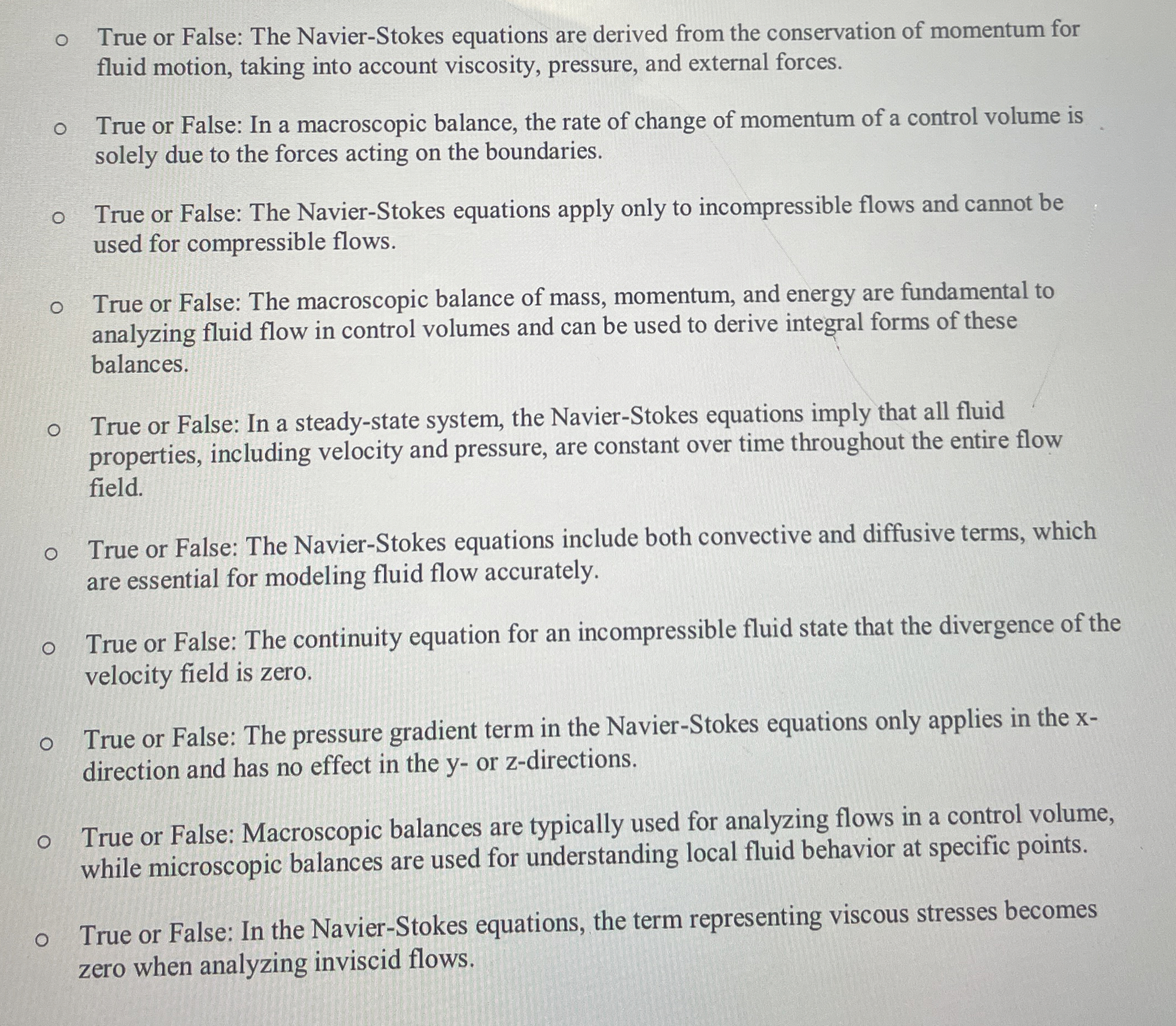
True or False: The NavierStokes equations are derived from the conservation of momentum for fluid motion, taking into account viscosity, pressure, and external forces.
True or False: In a macroscopic balance, the rate of change of momentum of a control volume is solely due to the forces acting on the boundaries.
True or False: The NavierStokes equations apply only to incompressible flows and cannot be used for compressible flows.
True or False: The macroscopic balance of mass, momentum, and energy are fundamental to analyzing fluid flow in control volumes and can be used to derive integral forms of these balances.
True or False: In a steadystate system, the NavierStokes equations imply that all fluid properties, including velocity and pressure, are constant over time throughout the entire flow field.
True or False: The NavierStokes equations include both convective and diffusive terms, which are essential for modeling fluid flow accurately.
True or False: The continuity equation for an incompressible fluid state that the divergence of the velocity field is zero.
True or False: The pressure gradient term in the NavierStokes equations only applies in the direction and has no effect in the y or z directions.
True or False: Macroscopic balances are typically used for analyzing flows in a control volume, while microscopic balances are used for understanding local fluid behavior at specific points.
True or False: In the NavierStokes equations, the term representing viscous stresses becomes zero when analyzing inviscid flows.
Step by Step Solution
There are 3 Steps involved in it
1 Expert Approved Answer
Step: 1 Unlock

Question Has Been Solved by an Expert!
Get step-by-step solutions from verified subject matter experts
Step: 2 Unlock
Step: 3 Unlock
 Study Help