







Question: True or false? U: A hapter One Ise whether the sentence or statement is true or false. 1. When there are no primary sources for
True or false?
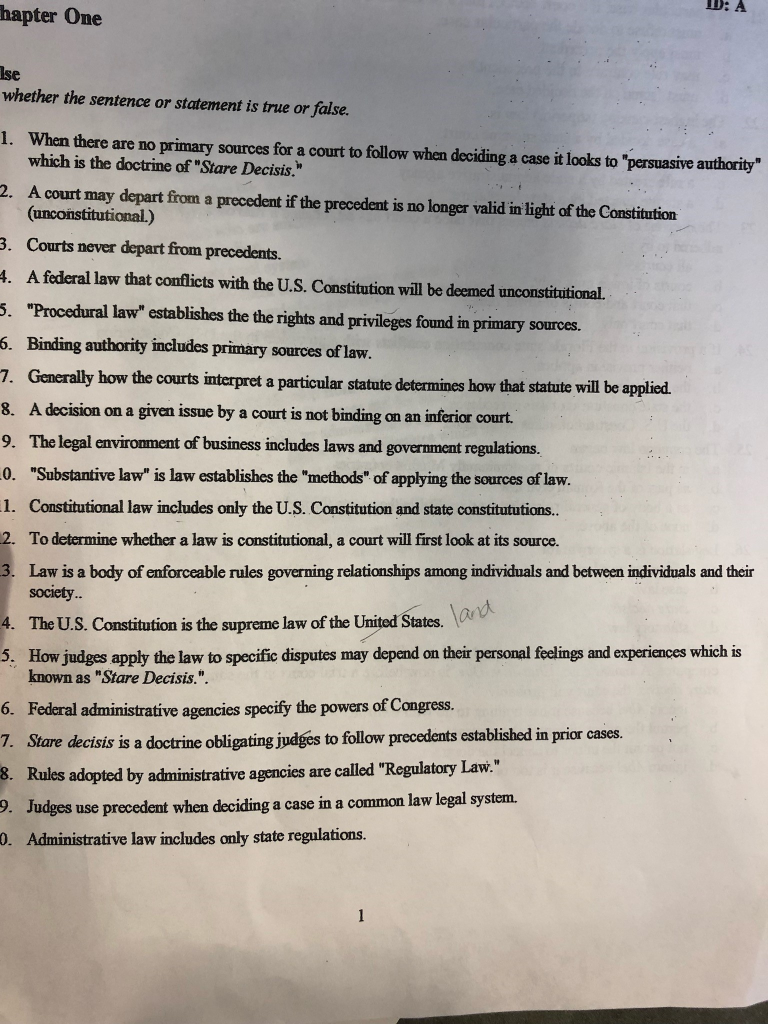
U: A hapter One Ise whether the sentence or statement is true or false. 1. When there are no primary sources for a court to follow when deciding a case it looks to "persuasive authority" which is the doctrine of "Stare Decisis." 2. A court may depart from a precedent if the precedent is no longer valid in light of the Constitution (unconstitutional) 3. Courts never depart from precedents. 4. A federal law that conflicts with the U.S. Constitution will be deemed unconstitutional. 5. "Procedural law" establishes the the rights and privileges found in primary sources. 6. Binding authority includes primary sources of law. 7. Generally how the courts interpret a particular statute determines how that statute will be applied. 8. A decision on a given issue by a court is not binding on an inferior court. 9. The legal environment of business includes laws and government regulations. LO. "Substantive law" is law establishes the "methods of applying the sources of law. 1. Constitutional law includes only the U.S. Constitution and state constitututions.. -2. To determine whether a law is constitutional, a court will first look at its source. 3. Law is a body of enforceable rules governing relationships among individuals and between individuals and their society.. 4. The U.S. Constitution is the supreme law of the United States. 5. How judges apply the law to specific disputes may depend on their personal feelings and experiences which is known as "Stare Decisis.". 6. Federal administrative agencies specify the powers of Congress. 7. Stare decisis is a doctrine obligating judges to follow precedents established in prior cases. 8. Rules adopted by administrative agencies are called "Regulatory Law." 9. Judges use precedent when deciding a case in a common law legal system. 0. Administrative law includes only state regulations
Step by Step Solution
There are 3 Steps involved in it

Get step-by-step solutions from verified subject matter experts
 Study Help