Question: True (T) or False (P)? Every equality constraint can be replaced equivalently by two inequalities. The maximization of a function f subject to a set
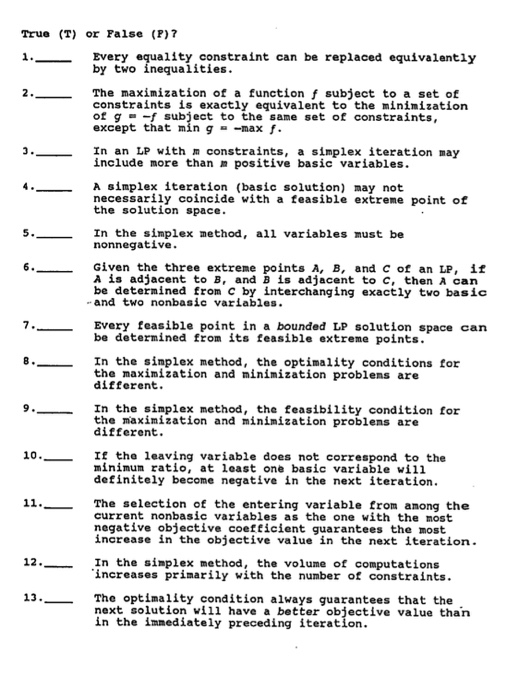
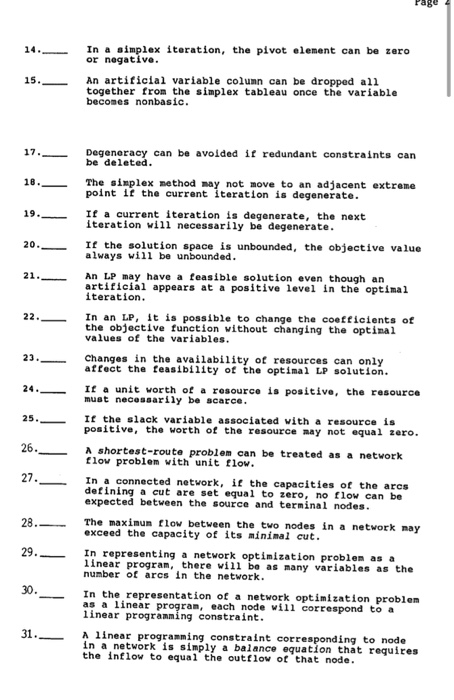
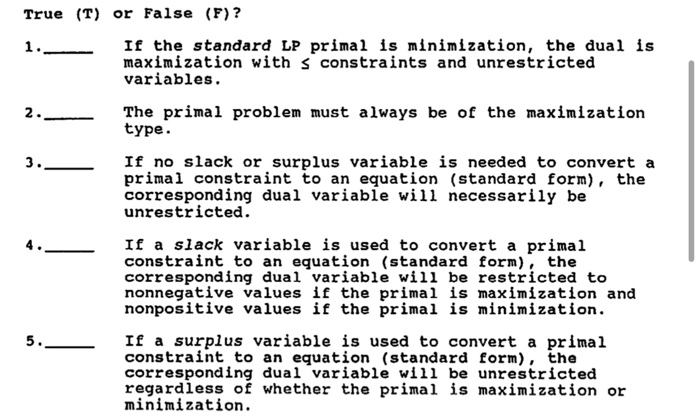
True (T) or False (P)? Every equality constraint can be replaced equivalently by two inequalities. The maximization of a function f subject to a set of constraints is exactly equivalent to the minimization of g f subject to the same set of constraints, except that min g--max f. In an LP with constraints, a simplex iteration may include more than a positive basic variables. A simplex 1teration (basic solution) may not necessarily coincide with a feasible extreme point of the solution space. In the simplex method, all variables must be nonnegative. Given the three extreme points A, B, and C of an LP, if A is adjacent to B, and B is adjacent to c, then A can be determined from C by interchanging exactly two basic - and two nonbasic variables. Every feasible point in a bounded LP solution space can be determined from its feasible extreme points. In the simplex method, the optimality conditions for the maximization and minimization problems are different. In the simplex method, the feasibility condition for the maximization and minimization problens are different. If the leaving variable does not correspond to the minimum ratio, at least one basic variable will definitely become negative in the next iteration. The selection of the entering variable from anong the current nonbasic variables as the one with the most negative objective coefficient guarantees the most increase in the objective value in the next iteration. In the simplex method, the volume of computations increases primarily with the number of constraints. The optimality condition always guarantees that the next solution vill have a better objective value than in the immediately preceding iteration. In a simplex iteration, the pivot element can be zero or negative. An artificial variable column can be dropped all together from the simplex tableau once the variable becomes nonbasic. Degeneracy can be avoided it redundant constraints can be deleted. The simplex method may not move to an adjacent extreme point le the current iteration is degenerate. If a current iteration is degenerate, the next iteration will necessarily be degenerate. If the solution space is unbounded, the objective value always will be unbounded. An LP may have a feasible solution even though an artificial appears at a positive level in the optimal iteration. In an LP, it is possible to change the coereicients of the objective function without changing the optimal values of the variables. Changes in the availability of resources can only affect the feasibility of the optimal LP solution. If a unit worth of a resource is positive, the resource muat necessarily be scarce. If the slack variable associated with a resource is positive, the worth of the resource may not equal zero. A shortest-route problem can be treated as a network Clov problem with unit flow. In a connected network, if the capacities of the ares defining a cut are set equal to zero, no flow can be expected between the source and terminal nodes. The maximun flow between the two nodes in a network may exceed the capacity of its minimal cut. In representing a network optimization problem as a linear program, there will be as many variables as the number of arcs in the network. In the representation of a network optimization problem as a linear program, each node will correspond to a linear programming constraint. A linear programming constraint corresponding to node in a network is simply a balance equation that requires the inflow to equal the outflow of that node. True (T) or False (F)? 1.- If the standard LP primal is minimization, the dual is maximization with s constraints and unrestricted variables. The primal problem must always be of the maximization type. If no slack or surplus variable is needed to convert a primal constraint to an equation (standard form), the corresponding dual variable will necessarily be unrestricted. If a slack variable is used to convert a primal constraint to an equation (standard form), the corresponding dual variable will be restricted to nonnegative values if the primal is maximization and nonpositive values if the primal is minimization. If a surplus variable is used to convert a primal constraint to an equation (standard form), the corresponding dual variable will be unrestricted regardless of whether the primal is maximization or minimization









 Study Help