Question: TRY IT, APPLY IT Suppose you are the top manager of an outpatient surgery center that is owned and used by dozens of surgeons. You
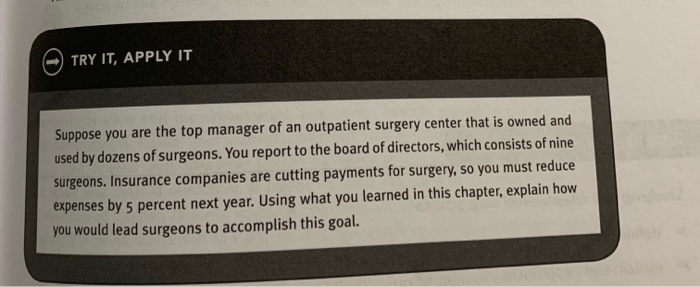
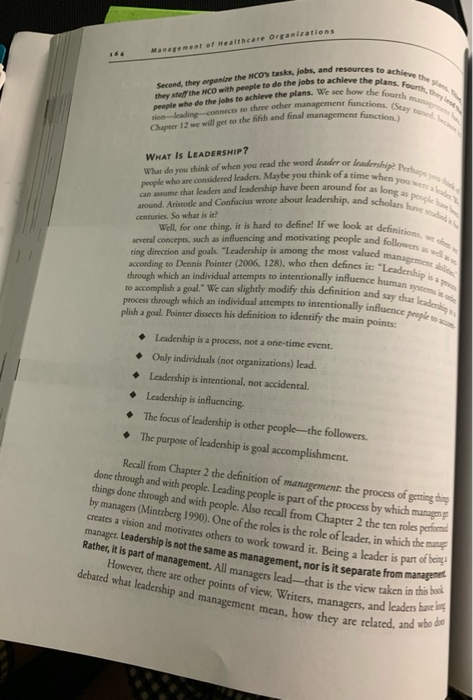
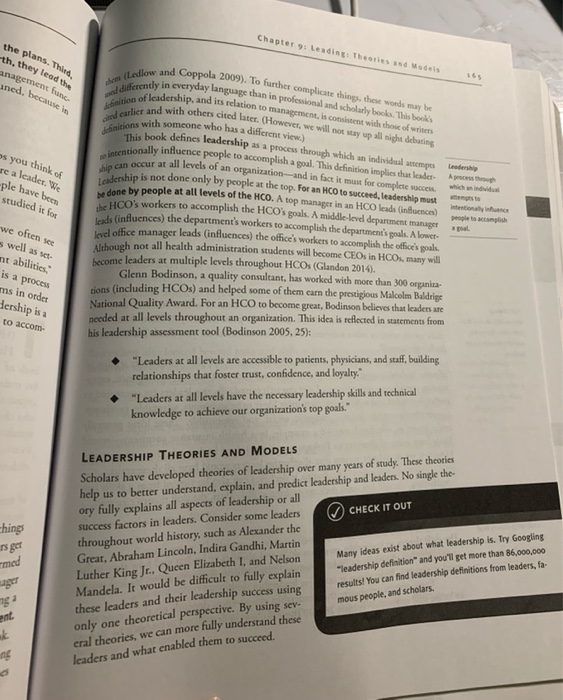
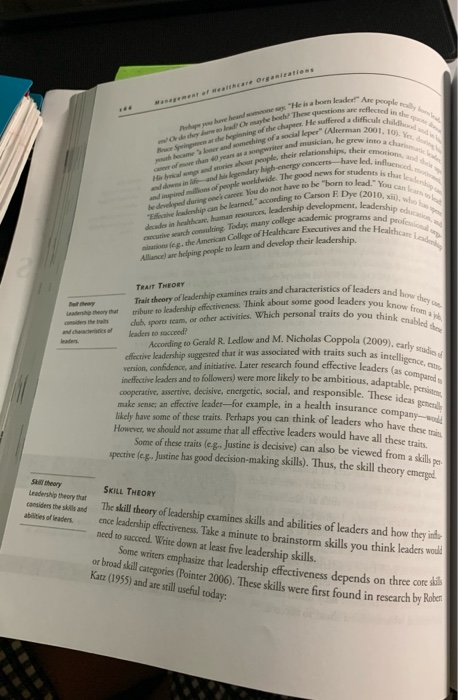
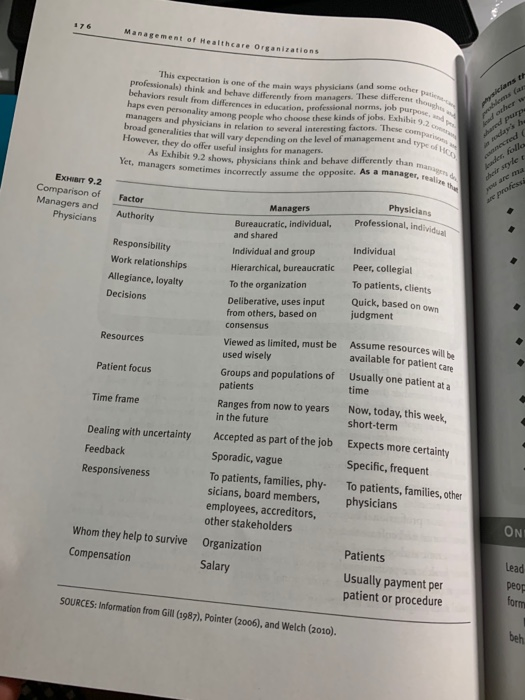
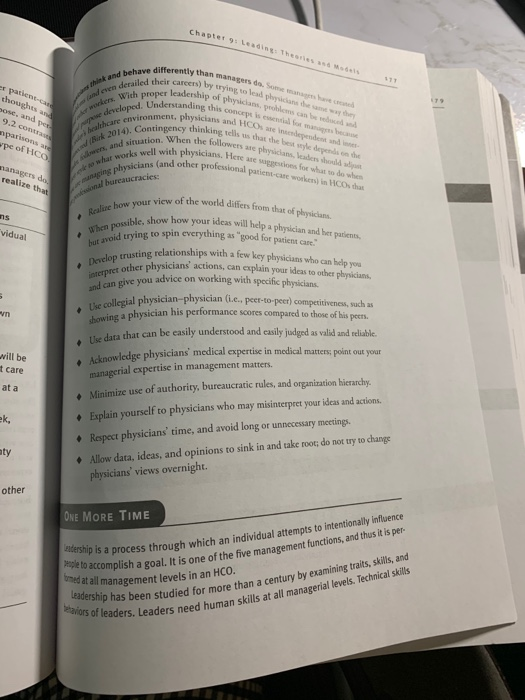
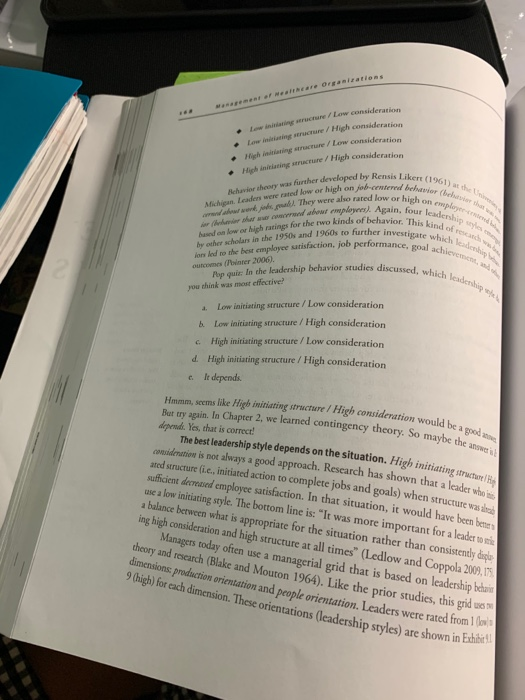
TRY IT, APPLY IT Suppose you are the top manager of an outpatient surgery center that is owned and used by dozens of surgeons. You report to the board of directors, which consists of nine surgeons. Insurance companies are cutting payments for surgery, so you must reduce expenses by 5 percent next year. Using what you learned in this chapter, explain how you would lead surgeons to accomplish this goal. process through which an individual attempts to intentionally influence people debated what leadership and management mean, how they are related, and who dod 164 Management of Healthcare Organizations Second, they are the HCO tasks, jobs, and resources to achieve the they sathe HCO with people to do the jobs to achieve the plans. Fourth, to leading connect to the other management functions. Stay tune people who do the jobs to achieve the plans. We see how the fourth Chapter 12 we will get to the fifth and final management function.) Whar do you think of when you read the word nader or leadership? Perhaps y pople who are considered leaders. Maybe you think of a time when you around. Aristotle and Confucius wrote about leadership, and scholars have Well, for one thing, it is hard to define! If we look at definitions several concepts, such as influencing and motivating people and followers according to Dennis Pointer (2006, 128). who then defines ir: "Leadership ting direction and goal. "Leadership is among the most valued management through which an individual attempts to intentionally influence human systems to accomplish a goal." We can slightly modify this definition and say that leads Rather, it is part of management. All managers lead that is the view taken in this book However, there are other point of view. Writers, managers, and leaders have assume that leaders and leadership have been around for centuries. So what is it? WHAT IS LEADERSHIP? long as pouple plish a goal. Pointer dissects his definition to identify the main points: Leadership is a process, not a one-time event. Only individuals (not organizations) lead. Leadership is intentional, not accidental. Leadership is influencing. The focus of leadership is other peoplethe followers. The purpose of leadership is goal accomplishment Recall from Chapter 2 the definition of management, the process of getting thing done through and with people. Leading people is part of the process by which manan things done through and with people. Also recall from Chapter 2 the ten roles performed by managers (Mintzberg 1990). One of the roles is the role of leader, in which the man creates a vision and motivates others to work toward it. Being a leader is part of being manager. Leadership is not the same as management, nor is it separate from manageme (Ledlow and Coppola 2009). To further complicate things, these words may be mod differently in everyday language than in professional and scholarly books. This book's inition of leadership, and its relation to management is consistent with those of writers ced earlier and with others cited later. However, we will not stay up all night dibuting definitions with someone who has a different view.) intentionally influence people to accomplish a goal. This definition implies that leader hip can occur at all levels of an organization and in fact it must for complete SUCCESS Leadership is not donc only by people at the top. For an HCO to succeed, leadership must be done by people at all levels of the HCO. A top manager in an HCO leads ances) Chapter 9: Leading Theories and Models the plans. Third, th, they lead the anagement func ined, because in This book defines leadership as a process through which an individual ampes Ladesh os you think of se a leader. We -ple have been studied it for we often see s well as set nt abilities, is a process he HCO's workers to accomplish the HCO's goals. A middle-level department manager people to complich leads (influences the department's workers to accomplish the departmen's goals. A lower Jove office manager leads (influences) the office's workers to accomplish the office's goals. Although not all health administration students will become CEOs in HCO., many will become leaders at multiple levels throughout HCOS (Glandon 2014). Glenn Bodinson, a quality consultant, has worked with more than 300 organiza- tions (including HCOs) and helped some of them earn the prestigious Malcolm Baldrige National Quality Award. For an HCO to become great, Bodinson believes that leaders are needed at all levels throughout an organization. This idea is reflected in statements from his leadership assessment tool (Bodinson 2005, 25): ms in order Hership is a to accom "Leaders at all levels are accessible to patients, physicians, and staff, building relationships that foster trust, confidence, and loyalty." "Leaders at all levels have the necessary leadership skills and technical knowledge to achieve our organization's top goals." -hings rs get med LEADERSHIP THEORIES AND MODELS Scholars have developed theories of leadership over many years of study. These theories help us to better understand, explain, and predict leadership and leaders. No single the- ory fully explains all aspects of leadership or all success factors in leaders. Consider some leaders CHECK IT OUT throughout world history, such as Alexander the Great, Abraham Lincoln, Indira Gandhi, Martin Luther King Jr., Queen Elizabeth I, and Nelson Many ideas exist about what leadership is. Try Googling Mandela. It would be difficult to fully explain "leadership definition and you'll get more than 86,000,000 these leaders and their leadership success using results! You can find leadership definitions from leaders, fa- only one theoretical perspective. By using sev- eral theories, we can more fully understand these leaders and what enabled them to succeed. mous people, and scholars. ng prof Wealthcare Organizations in the ved "He is a bon leader Are people derdome Bach The unions are reflected bebe of the chapter. He suffered aduthull dhe her and song of oper" (Alma 2001. 10. Yes can as one and musician, he grew into a cha Hawthout people, their relationships, their emotion and indoofple worktwie The good news for students is that andwind gendary high- concerts have led, inced deyed during you do nor have to be born to lead. You can dership can be learned according to Canon E Dye (2010, X), who decades in her humano, kadership development, leadership search coming Todas many college academic programs and pool meg. the American College of Healthcare Executives and the Healthcare mbure to leadership effective. Think about some good leaders you know from the Traitheory of leadership cumines traits and characteristics of leaders and how they de sport sam, or other activities. Which personal traits do you think enabled the According to Gerald R. Ladlow and M. Nicholas Coppola (2009). early stad version, confidence, and initiative. Later research found effective leaders (as compared ineffective leaders and to followers) were more likely to be ambitious, adaptable, pero cooperative assertive, decisive, energetic, social, and responsible. These ideas likely have some of these traits. Perhaps you can think of leaders who have these tri make sense an effective leader-for example, in a health insurance company leaders to succeed? effective leadership suggested that it was associated with traits such as Alliance are people to learn and develop their leadership TRAIT THEORY intelligence, However, we should not assume that all effective leaders would have all these traits. Some of these traits (eg, Justine is decisive) can also be viewed from a skills per spective (eg. Justine has good decision-making skills). Thus, the skill theory emerged Leadership theory that consider the skills and SKILL THEORY The skill theory of leadership examines skills and abilities of leaders and how they indo ence leadership effectiveness. Take a minute to brainstorm skills think leaders would need to succeed. Write down at least five leadership skills. Some writers emphasize that leadership effectiveness depends on three core sale or broad skill categories (Pointer 2006). These skills were first found in rescarch by Robert you Katz (1955) and are still useful today: This expectation is one of the main ways physicians and some other behaviors result from differences in education, professional norms, job purpose professionals) think and bchave differently from managers. These different haps even personality among people who choose these kinds of jobs. Exhibit 9.2 managers and physicians in relation to several interesting factors. These broad generalities that will vary depending on the level of management and type As Exhibit 9.2 shows, physicians think and behave differently than man Yet, managers sometimes incorrectly assume the opposite. As a manager, the 176 Management of Healthcare Organizations daher and purp , do offer useful for EXHIBIT 9.2 Comparison of Managers and Physicians Factor bir soyle are professe Authority Physicians Professional, Individual Responsibility Work relationships Allegiance, loyalty Decisions Managers Bureaucratic, individual, and shared Individual Individual and group Peer, collegial Hierarchical, bureaucratic To the organization To patients, clients Deliberative, uses input Quick, based on own from others, based on judgment consensus Viewed as limited, must be used wisely Groups and populations of Usually one patient at a patients time Ranges from now to years Now, today, this week, in the future short-term Resources Assume resources will be available for patient care Patient focus Time frame Dealing with uncertainty Feedback Responsiveness Accepted as part of the job Expects more certainty Sporadic, vague Specific, frequent To patients, families, phy To patients, families, other sicians, board members, physicians employees, accreditors, other stakeholders Organization Patients Salary Usually payment per patient or procedure ONI Whom they help to survive Compensation Lead peop form SOURCES: Information from Gill (1987), Pointer (2006), and Welch (2010). beh Dariors of leaders. Leaders need human skills at all managerial levels. Technical skills Chapter 9: Linthos and behave differently than managers do. So denen derailed their careers) by trying to lead the With proper leadership of physicians, problems can be developed. Understanding this concept is essential for me withcare environment, physicians and HCO deben und k 2014). Contingency thinking tells is that the best wyle de son the and situation. When the followers are physicians Vaders whar works well with physicians. Here we hos for what to do whe ng pisicians and other professional patient care workers in HCO al bureaucracies: Realize how your view of the world differs from that of physicians When possible, show how your ideas will help a physician and her patients but avoid trying to spin everything as good for patient care Develop trusting relationships with a few key physicians who can help you interprer other physicians' actions, can explain your ideas to other physicians, and can give you advice on working with specific physicians. Use collegial physician-physician (... peer-to-peer) competitiveness, such as ndership is a process through which an individual attempts to intentionally influence Pople to accomplish a goal. It is one of the five management functions, and thus it is per med at all management levels in an HCO. dership has been studied for more than a century by examining traits, skills, and a er patient-case thoughts an ose and per 9.2 CONE mparisons are pe of H ). anagers do realize that . vidual . . vn will be t care at a showing a physician his performance scores compared to those of his peers. Use data that can be easily understood and easily judged as valid and reliable. Acknowledge physicians' medical expertise in medical matters, point out your managerial expertise in management matters. Minimize use of authority, bureaucratic rules, and organization hierarchy. . Explain yourself to physicians who may misinterpret your ideas and actions. Respect physicians' time, and avoid long or unnecessary meetings. Allow data, ideas, and opinions to sink in and take roos, do not try to change physicians' views overnight. ek, aty other ONE MORE TIME at low consideration Low cure / Hich consideration Hercure / Low consideration Hichiure / High consideration Mehavior theory was her developed by Rensis Likert (1961) Michigan Leaders were low or high on ter betwor (beth www.jul They were also rared low or high on employer- www.rp. Again, four leadership busadas low or high rings for the two kinds of behavior. This kind of by other wholars in the 1950s and 1960s to further investigate which lei ons led to the best employee satisfaction, job performance, goal achievement Map qui in the leadership behavior studies discussed, which Hmmm, seems like High wingste/ High consideration would be a good But try again. In Chapter 2, we learned contingency theory. So maybe the web The best leadership style depends on the situation. High initiating structure semester Organizations tems water 2006). leadership you think was most effective? . Low initiating structure / Low consideration Low initiating structure / High consideration c High initiating structure / Low consideration d High initiating structure / High consideration It depends dependi. Yes, that is correct! consideration is not always a good approach. Research has shown that a leader who ated structure (i.c., initiated action to complete jobs and goals) when structure was already sufficient decreased employee satisfaction. In that situation, it would have been ben case a low initiating style. The bottom line is: "It was more important for a leader to stic a balance between what is appropriate for the situation rather than consistently disple ing high consideration and high structure at all times" (Ledlow and Coppola 2009.15 Managers today often use a managerial grid that is based on leadership behuis theory and research (Blake and Mouton 1964). Like the prior studies, this grid dimensions, production orientation and people orientation. Leaders were rated from I love 9 (high) for each dimension. These orientations (leadership styles) are shown in Exhibiti US









 Study Help