







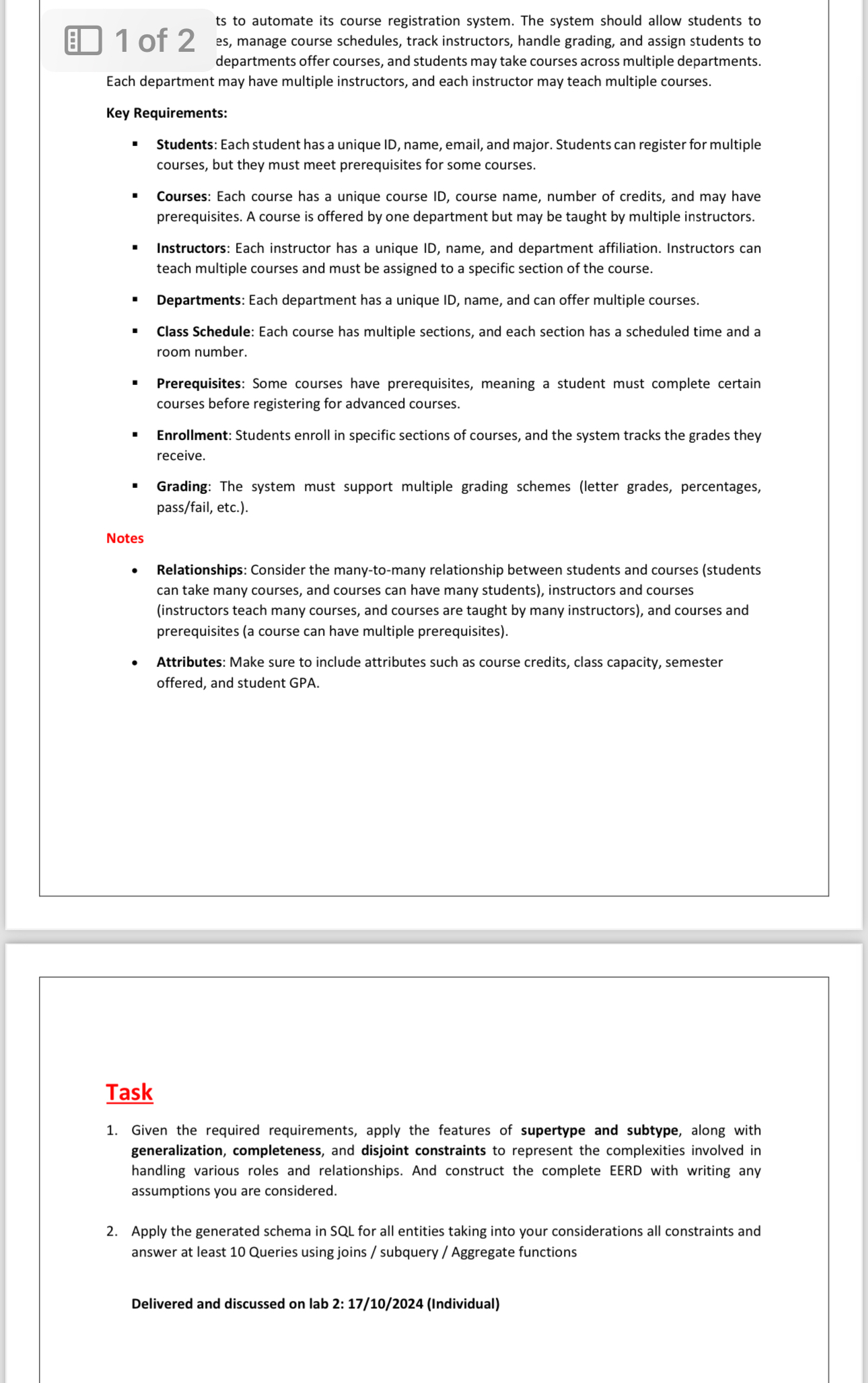
Question: ts to automate its course registration system. The system should allow students to es , manage course schedules, track instructors, handle grading, and assign students
ts to automate its course registration system. The system should allow students to
es manage course schedules, track instructors, handle grading, and assign students to
departments offer courses, and students may take courses across multiple departments.
Each department may have multiple instructors, and each instructor may teach multiple courses.
Key Requirements:
Students: Each student has a unique ID name, email, and major. Students can register for multiple
courses, but they must meet prerequisites for some courses.
Courses: Each course has a unique course ID course name, number of credits, and may have
prerequisites. A course is offered by one department but may be taught by multiple instructors.
Instructors: Each instructor has a unique ID name, and department affiliation. Instructors can
teach multiple courses and must be assigned to a specific section of the course.
Departments: Each department has a unique ID name, and can offer multiple courses.
Class Schedule: Each course has multiple sections, and each section has a scheduled time and a
room number.
Prerequisites: Some courses have prerequisites, meaning a student must complete certain
courses before registering for advanced courses.
Enrollment: Students enroll in specific sections of courses, and the system tracks the grades they
receive.
Grading: The system must support multiple grading schemes letter grades, percentages,
passfail etc.
Notes
Relationships: Consider the manytomany relationship between students and courses students
can take many courses, and courses can have many students instructors and courses
instructors teach many courses, and courses are taught by many instructors and courses and
prerequisites a course can have multiple prerequisites
Attributes: Make sure to include attributes such as course credits, class capacity, semester
offered, and student GPA.
Task
Given the required requirements, apply the features of supertype and subtype, along with
generalization, completeness, and disjoint constraints to represent the complexities involved in
handling various roles and relationships. And construct the complete EERD with writing any
assumptions you are considered.
Apply the generated schema in SQL for all entities taking into your considerations all constraints and
answer at least Queries using joins subquery Aggregate functions
Step by Step Solution
There are 3 Steps involved in it
1 Expert Approved Answer
Step: 1 Unlock

Question Has Been Solved by an Expert!
Get step-by-step solutions from verified subject matter experts
Step: 2 Unlock
Step: 3 Unlock
 Study Help