







Question: Turing reducibility and information ( a ) Let = { 0 , 1 } be the alphabet. Statement: For any two languages A and B
Turing reducibility and information
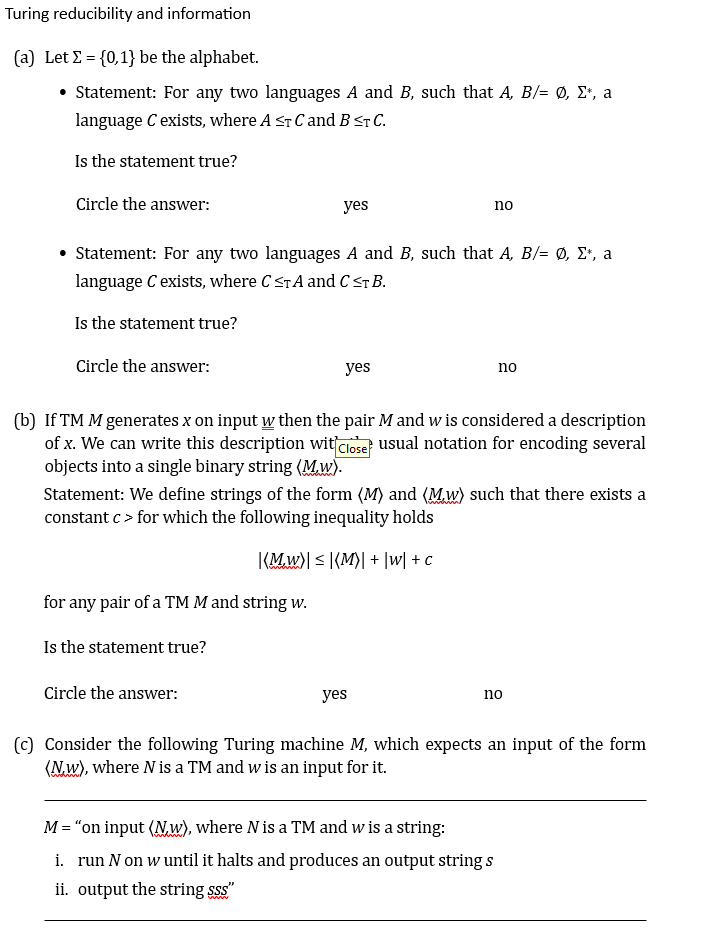
a Let be the alphabet.
Statement: For any two languages A and such that a
language exists, where and
Is the statement true?
Circle the answer:
yes
no
Statement: For any two languages A and such that a
language exists, where A and
Is the statement true?
Circle the answer:
yes
no
b If TM generates on input then the pair and is considered a description
of We can write this description wit Close usual notation for encoding several
objects into a single binary string ::
Statement: We define strings of the form :: and :: such that there exists a
constant for which the following inequality holds
::::
for any pair of a TM and string
Is the statement true?
Circle the answer:
yes
no
c Consider the following Turing machine which expects an input of the form
:: where is a TM and is an input for it
on input :: where is a TM and is a string:
i run on until it halts and produces an output string
ii output the string
Step by Step Solution
There are 3 Steps involved in it
1 Expert Approved Answer
Step: 1 Unlock

Question Has Been Solved by an Expert!
Get step-by-step solutions from verified subject matter experts
Step: 2 Unlock
Step: 3 Unlock
 Study Help