







Question: TUTORIAL 3 - IFS233 (2023) - 10 marks The tutorial period will be divided into the following sessions: Session 1: - PART 1 - Case
![each student participates in the discussion] - PART 2 - [individual task]](https://dsd5zvtm8ll6.cloudfront.net/si.experts.images/questions/2024/11/6729b77ba24d6_1956729b77b3ccd2.jpg)
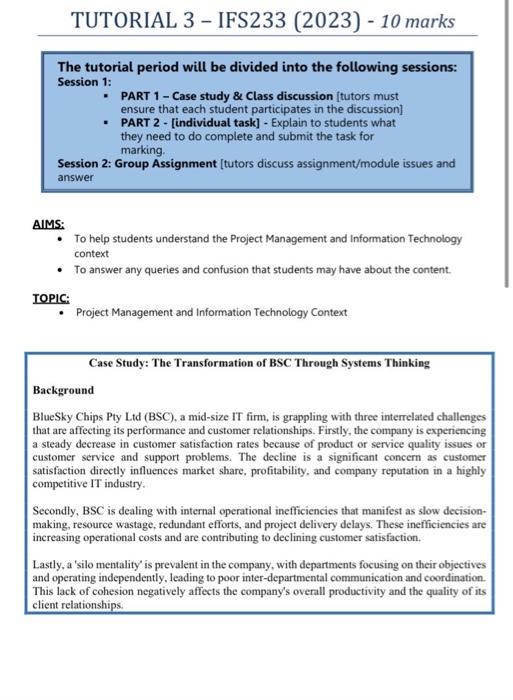
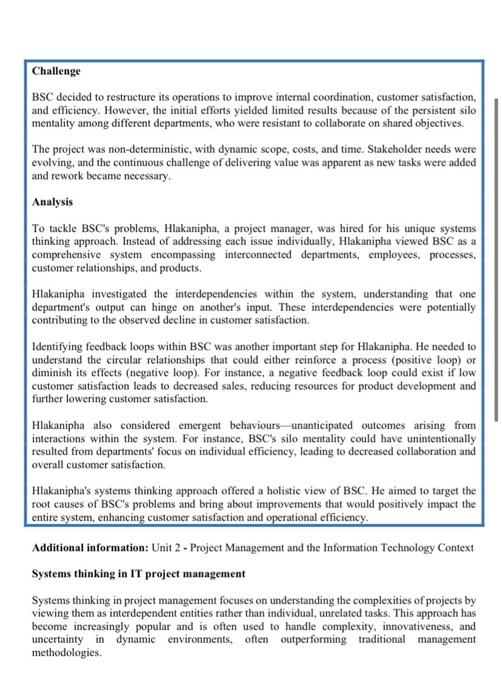
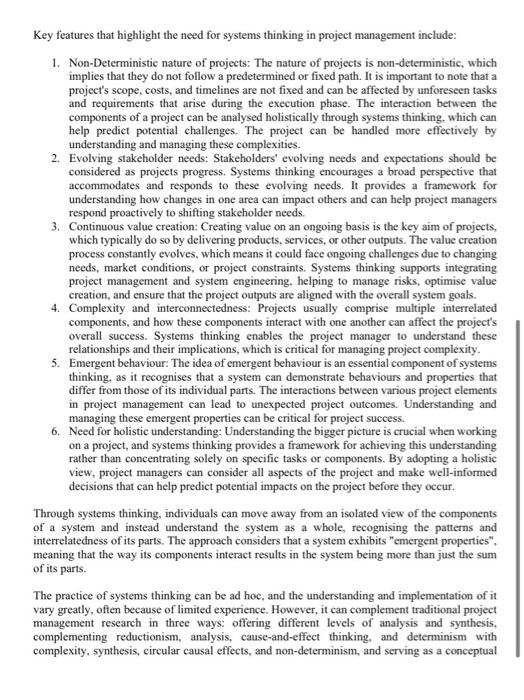
TUTORIAL 3 - IFS233 (2023) - 10 marks The tutorial period will be divided into the following sessions: Session 1: - PART 1 - Case study \\( \\& \\) Class discussion [tutors must ensure that each student participates in the discussion] - PART 2 - [individual task] - Explain to students what they need to do complete and submit the task for marking. Session 2: Group Assignment [tutors discuss assignment/module issues and answer AlMS: - To help students understand the Project Management and Information Technology context - To answer any queries and confusion that students may have about the content. IOPIC: - Project Management and Information Technology Context Case Study: The Transformation of BSC Through Systems Thinking Background BlueSky Chips Pty Ltd (BSC), a mid-size IT firm, is grappling with three interrelated challenges that are affecting its performance and customer relationships. Firstly, the company is experiencing a steady decrease in customer satisfaction rates because of product or service quality issues or customer service and support problems. The decline is a significant concern as customer satisfaction directly influences market share, profitability, and company reputation in a highly competitive IT industry. Secondly, BSC is dealing with internal operational inefficiencies that manifest as slow decisionmaking, resource wastage, redundant efforts, and project delivery delays. These inefficiencies are increasing operational costs and are contributing to declining customer satisfaction. Lastly, a 'silo mentality' is prevalent in the company, with departments focusing on their objectives and operating independently, leading to poor inter-departmental communication and coordination. This lack of cohesion negatively affects the company's overall productivity and the quality of its client relationships. BSC decided to restructure its operations to improve internal coordination, customer satisfaction, and efficiency. However, the initial efforts yielded limited results because of the persistent silo mentality among different departments, who were resistant to collaborate on shared objectives. The project was non-deterministic, with dynamic scope, costs, and time. Stakeholder needs were evolving, and the continuous challenge of delivering value was apparent as new tasks were added and rework became necessary. Analysis To tackle BSC's problems, Hlakanipha, a project manager, was hired for his unique systems thinking approach. Instead of addressing each issue individually, Hlakanipha viewed BSC as a comprehensive system encompassing interconnected departments, employees, processes, customer relationships, and products. Hlakanipha investigated the interdependencies within the system, understanding that one department's output can hinge on another's input. These interdependencies were potentially contributing to the observed decline in customer satisfaction. Identifying feedback loops within BSC was another important step for Hlakanipha. He needed to understand the circular relationships that could either reinforce a process (positive loop) or diminish its effects (negative loop). For instance, a negative feedback loop could exist if low customer satisfaction leads to decreased sales, reducing resources for product development and further lowering customer satisfaction. Hlakanipha also considered emergent behaviours unanticipated outcomes arising from interactions within the system. For instance, BSC's silo mentality could have unintentionally resulted from departments' focus on individual efficiency, leading to decreased collaboration and overall customer satisfaction. Hlakanipha's systems thinking approach offered a holistic view of BSC. He aimed to target the root causes of BSC's problems and bring about improvements that would positively impact the entire system, enhancing customer satisfaction and operational efficiency. Additional information: Unit 2 - Project Management and the Information Technology Context Systems thinking in IT project management Systems thinking in project management focuses on understanding the complexities of projects by viewing them as interdependent entities rather than individual, unrelated tasks. This approach has become increasingly popular and is often used to handle complexity, innovativeness, and uncertainty in dynamic environments, often outperforming traditional management methodologies. Key features that highlight the need for systems thinking in project management include: 1. Non-Deterministic nature of projects: The nature of projects is non-deterministic, which implies that they do not follow a predetermined or fixed path. It is important to note that a project's scope, costs, and timelines are not fixed and can be affected by unforeseen tasks and requirements that arise during the execution phase. The interaction between the components of a project can be analysed holistically through systems thinking, which can help predict potential challenges. The project can be handled more effectively by understanding and managing these complexities. 2. Evolving stakeholder needs: Stakeholders' evolving needs and expectations should be considered as projects progress. Systems thinking encourages a broad perspective that accommodates and responds to these evolving needs. It provides a framework for understanding how changes in one area can impact others and can help project managers respond proactively to shifting stakeholder needs. 3. Continuous value creation: Creating value on an ongoing basis is the key aim of projects, which typically do so by delivering products, services, or other outputs. The value creation process constantly evolves, which means it could face ongoing challenges due to changing needs, market conditions, or project constraints. Systems thinking supports integrating project management and system engineering, helping to manage risks, optimise value creation, and ensure that the project outputs are aligned with the overall system goals. 4. Complexity and interconnectedness: Projects usually comprise multiple interrelated components, and how these components interact with one another can affect the project's overall success. Systems thinking enables the project manager to understand these relationships and their implications, which is critical for managing project complexity. 5. Emergent behaviour: The idea of emergent behaviour is an essential component of systems thinking, as it recognises that a system can demonstrate behaviours and properties that differ from those of its individual parts. The interactions between various project elements in project management can lead to unexpected project outcomes. Understanding and managing these emergent properties can be critical for project success. 6. Need for holistic understanding: Understanding the bigger picture is crucial when working on a project, and systems thinking provides a framework for achieving this understanding rather than concentrating solely on specific tasks or components. By adopting a holistic view, project managers can consider all aspects of the project and make well-informed decisions that can help predict potential impacts on the project before they occur. Through systems thinking, individuals can move away from an isolated view of the components of a system and instead understand the system as a whole, recognising the patterns and interrelatedness of its parts. The approach considers that a system exhibits \"emergent properties\", meaning that the way its components interact results in the system being more than just the sum of its parts. The practice of systems thinking can be ad hoc, and the understanding and implementation of it vary greatly, often because of limited experience. However, it can complement traditional project management research in three ways: offering different levels of analysis and synthesis, complementing reductionism, analysis, cause-and-effect thinking, and determinism with complexity, synthesis, circular causal effects, and non-determinism, and serving as a conceptual framework that utilises different theories, tools, and techniques to construct holistic perspectives and practices. By embracing systems thinking, project managers can broaden their perspective to account for dynamic features contributing to project complexity. System dynamics offers a range of tools to aid in this endeavour, enabling project managers to manage projects more effectively. This approach can better account for the feedback, delays, and nonlinear relationships that are usually omitted in traditional project management but are critical descriptors of project complexity. Four main areas to determine the actual and expected rate of systems thinking in project management are a holistic approach to problem-solving, understanding the network of interactions, role-play scenarios in dynamic and complex systems, and a project team approach. Tutorial 3 instructions: Based on the analysis above, what changes would you recommend Hlakanipha adopt based on the systems thinking approach
Step by Step Solution
There are 3 Steps involved in it

Get step-by-step solutions from verified subject matter experts
 Study Help