







Question: Tutorial Exercise A battery has an emf of 15.0 V. The terminal voltage of the battery is 11.3 V when it is delivering 15.0 W
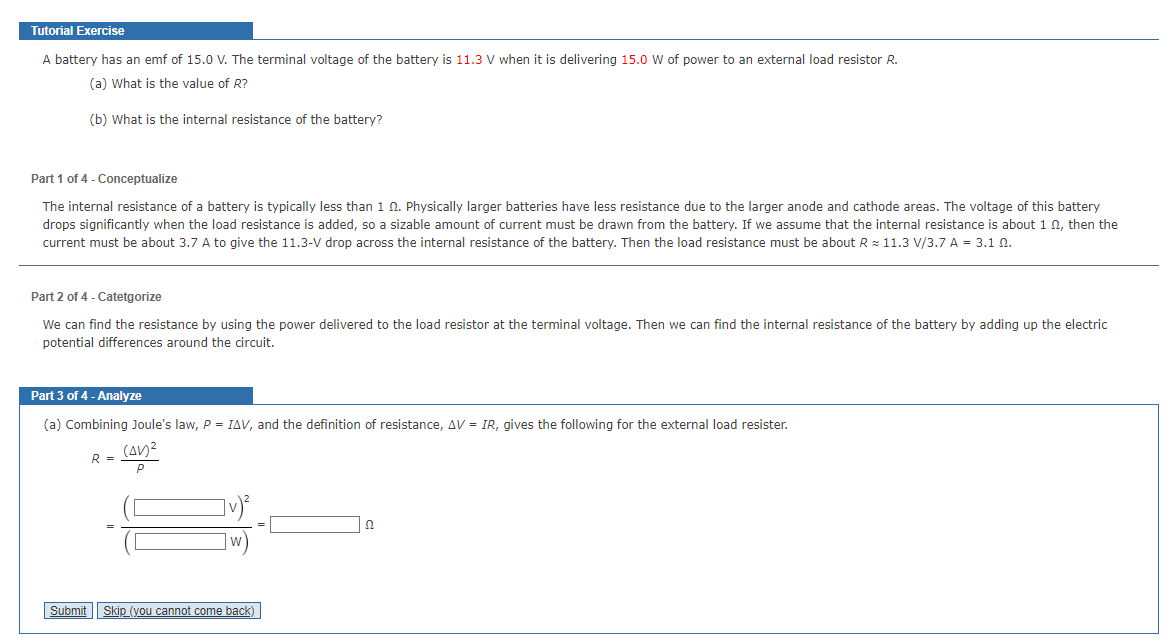
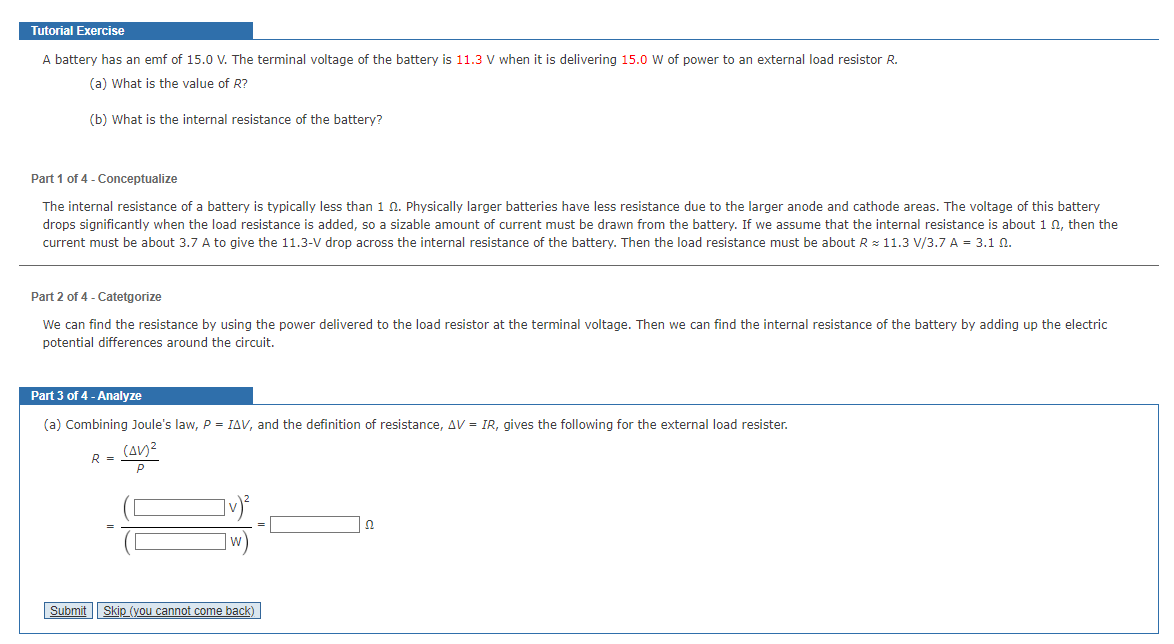
Tutorial Exercise A battery has an emf of 15.0 V. The terminal voltage of the battery is 11.3 V when it is delivering 15.0 W of power to an external load resistor R. (a) What is the value of R? (b) What is the internal resistance of the battery? Part 1 of 4 - Conceptualize The internal resistance of a battery is typically less than 1 0. Physically larger batteries have less resistance due to the larger anode and cathode areas. The voltage of this battery drops significantly when the load resistance is added, so a sizable amount of current must be drawn from the battery. If we assume that the internal resistance is about 1 0, then the current must be about 3.7 A to give the 11.3-V drop across the internal resistance of the battery. Then the load resistance must be about R = 11.3 V/3.7 A = 3.1 0. Part 2 of 4 - Catetgorize We can find the resistance by using the power delivered to the load resistor at the terminal voltage. Then we can find the internal resistance of the battery by adding up the electric potential differences around the circuit. Part 3 of 4 - Analyze (a) Combining Joule's law, P = IAV, and the definition of resistance, AV = IR, gives the following for the external load resister. R = (AV) 2 P W ) Submit Skip (you cannot come back)
Step by Step Solution
There are 3 Steps involved in it

Get step-by-step solutions from verified subject matter experts
 Study Help