





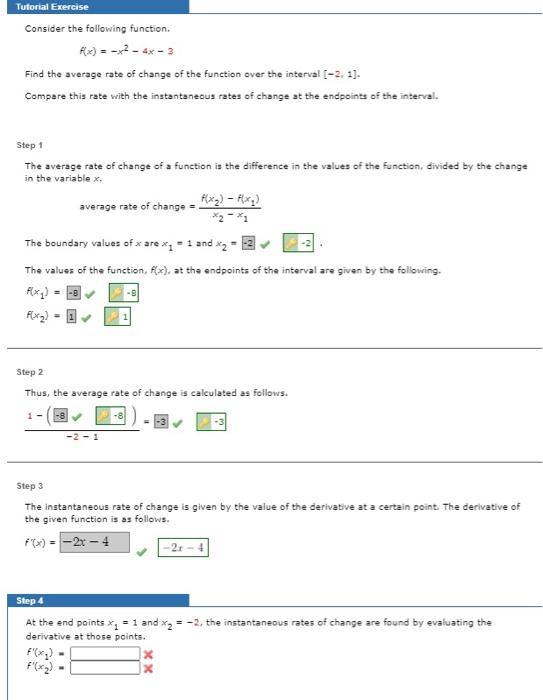
Question: Tutorial Exercise Consider the following function. Rx) = -x2 - 4x - 3 Find the average rate of change of the function over the interval
Tutorial Exercise Consider the following
Tutorial Exercise Consider the following function. Rx) = -x2 - 4x - 3 Find the average rate of change of the function over the interval [-2. 1). Compare this rate with the instantaneous rates of change at the endpoints of the interval. Step 1 The average rate of change of a function is the difference in the values of the function, divided by the change in the variable x. average rate of change f(x2) - Flxg) *2*1 The boundary values of x are *. - 1 and x2 = The values of the function, Fx), at the endpoints of the interval are given by the following. = -8 Fxg) - Step 2 Thus, the average rate of change is calculated as follows. Step 3 The instantaneous rate of change is given by the value of the derivative at a certain point. The derivative of the given function is as follows. F"x) = -2x - 4 -2.1 Step 4 At the end points x1 = 1 and 2 = -2, the instantaneous rates of change are found by evaluating the F'(x) - derivative at those points. X X

Step by Step Solution

There are 3 Steps involved in it

1 Expert Approved Answer
Step: 1 Unlock blur-text-image

Question Has Been Solved by an Expert!

Get step-by-step solutions from verified subject matter experts

Step: 2 Unlock
Step: 3 Unlock

Students Have Also Explored These Related General Management Questions!