





Question: TUTORIAL LETTER 1 ASSIGNMENT 1) - 2020 SECOND SEMESTER MAN101 BUSINESS MANAGEMENT The well-motivated leader who make mistakes may learn from them and bounce back
TUTORIAL LETTER 1 ASSIGNMENT 1) - 2020 SECOND
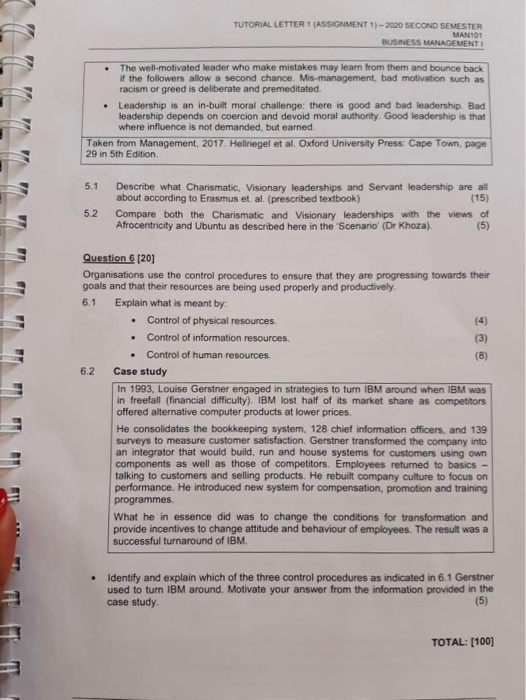
TUTORIAL LETTER 1 ASSIGNMENT 1) - 2020 SECOND SEMESTER MAN101 BUSINESS MANAGEMENT The well-motivated leader who make mistakes may learn from them and bounce back if the followers allow a second chance. Mis-management, bad motivation such as racism or greed is deliberate and premeditated. Leadership is an in-built moral challenge: there is good and bad leadership. Bad leadership depends on coercion and devoid moral authority. Good leadership is that where influence is not demanded, but earned. Taken from Management, 2017. Hellriegel et al. Oxford University Press: Cape Town, page 29 in 5th Edition 5.1 5.2 Describe what Charismatic, Visionary leaderships and Servant leadership are all about according to Erasmus et. al. (prescribed textbook) (15) Compare both the Charismatic and Visionary leaderships with the views of Afrocentricity and Ubuntu as described here in the 'Scenario (Dr Khoza). (5) Question 6 [20] Organisations use the control procedures to ensure that they are progressing towards their goals and that their resources are being used properly and productively. 6.1 Explain what is meant by: Control of physical resources. (4) Control of information resources. (3) Control of human resources. (8) 6.2 Case study In 1993, Louise Gerstner engaged in strategies to turn IBM around when IBM was in freefall (financial difficulty). IBM lost half of its market share as competitors offered alternative computer products at lower prices He consolidates the bookkeeping system, 128 chief information officers, and 139 surveys to measure customer satisfaction. Gerstner transformed the company into an integrator that would build, run and house systems for customers using own components as well as those of competitors. Employees returned to basics - talking to customers and selling products. He rebuilt company culture to focus on performance. He introduced new system for compensation, promotion and training programmes What he in essence did was to change the conditions for transformation and provide incentives to change attitude and behaviour of employees. The result was a successful turnaround of IBM. . Identify and explain which of the three control procedures as indicated in 6.1 Gerstner used to turn IBM around. Motivate your answer from the information provided in the case study (5) TOTAL: [100]

Step by Step Solution

There are 3 Steps involved in it

1 Expert Approved Answer
Step: 1 Unlock blur-text-image

Question Has Been Solved by an Expert!

Get step-by-step solutions from verified subject matter experts

Step: 2 Unlock
Step: 3 Unlock

Students Have Also Explored These Related General Management Questions!