







Question: Tutorial Section 7.6* - Gravity and the assumption of constant momentum As you saw earlier, there are cases in which an external force may be
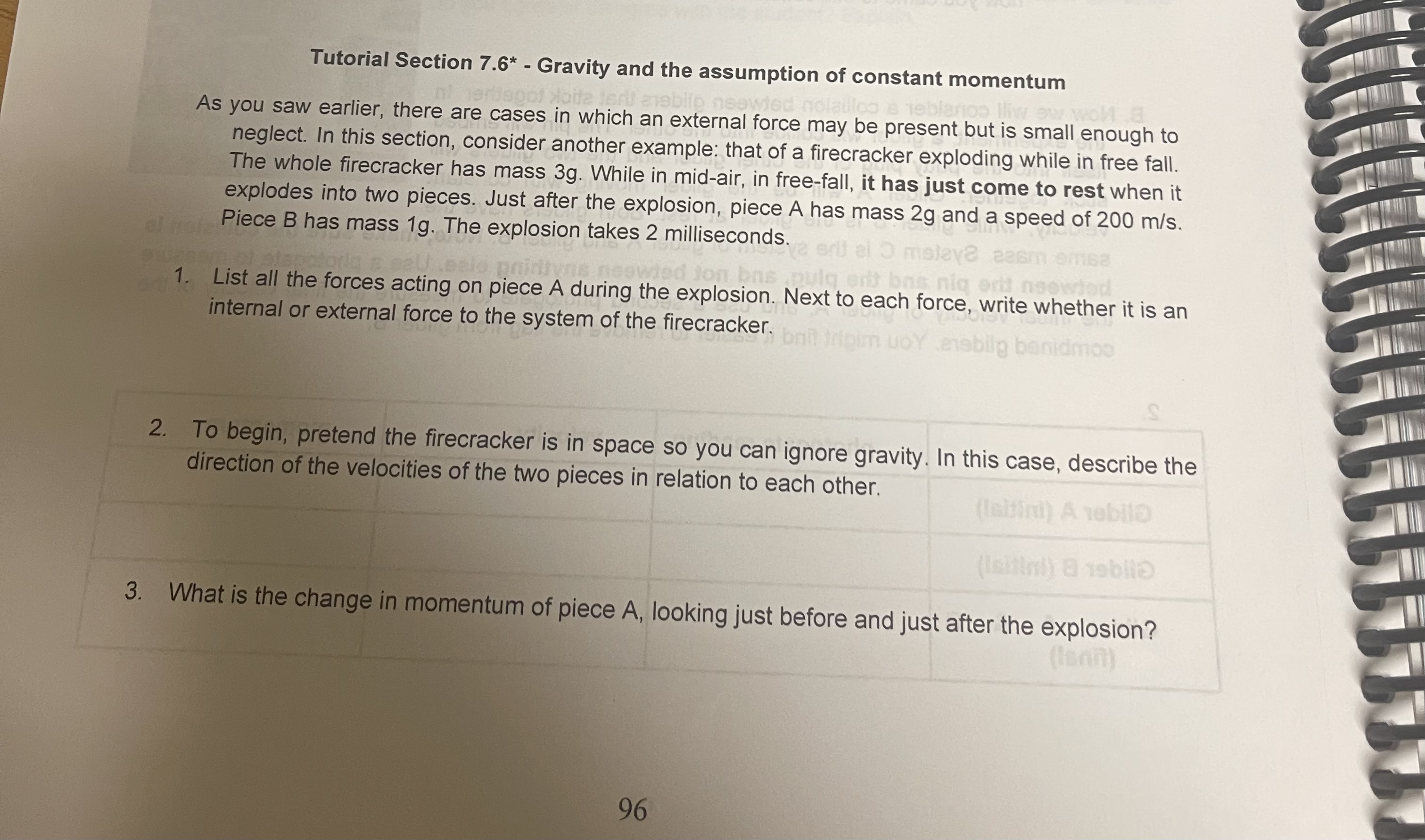
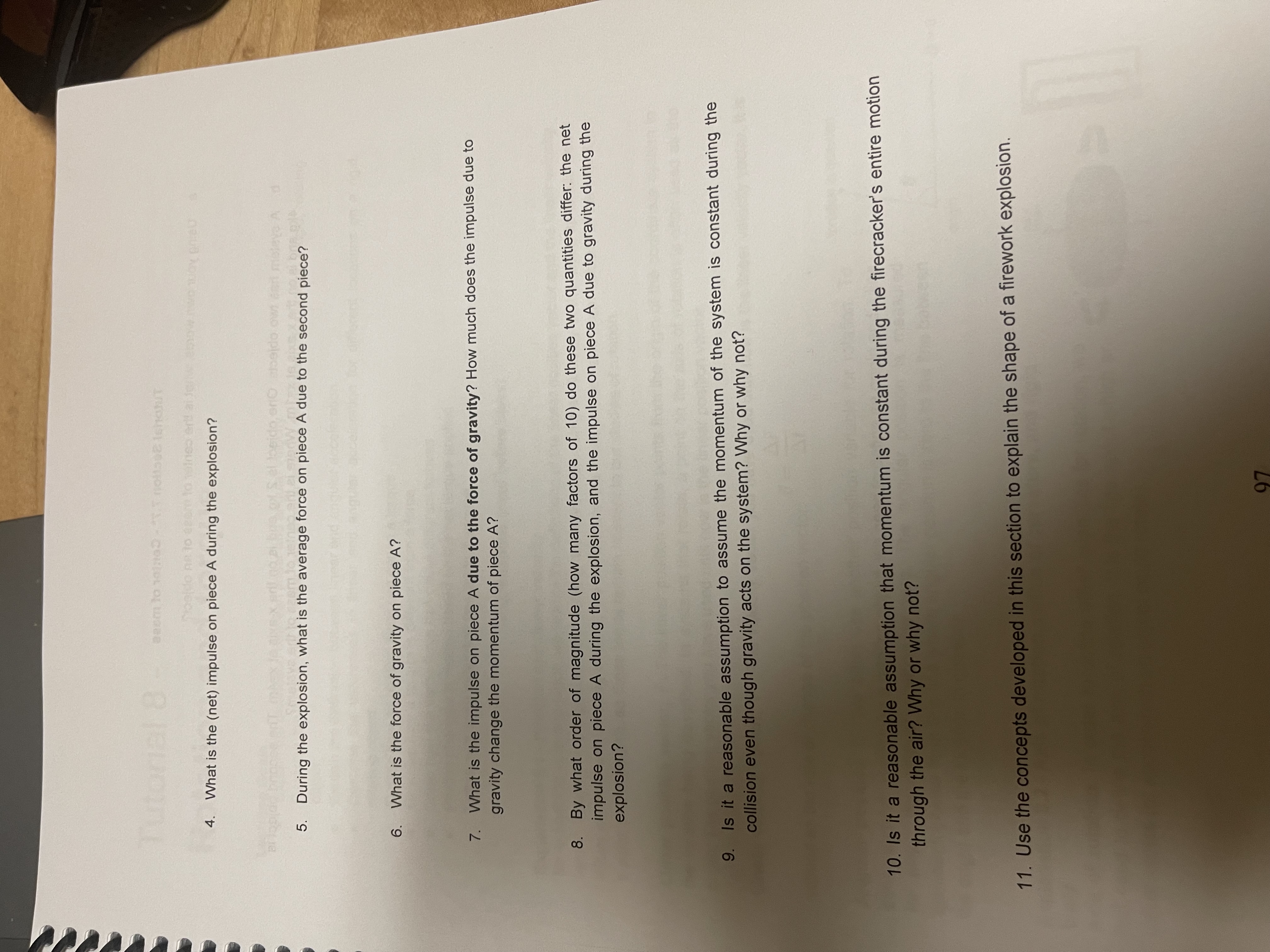
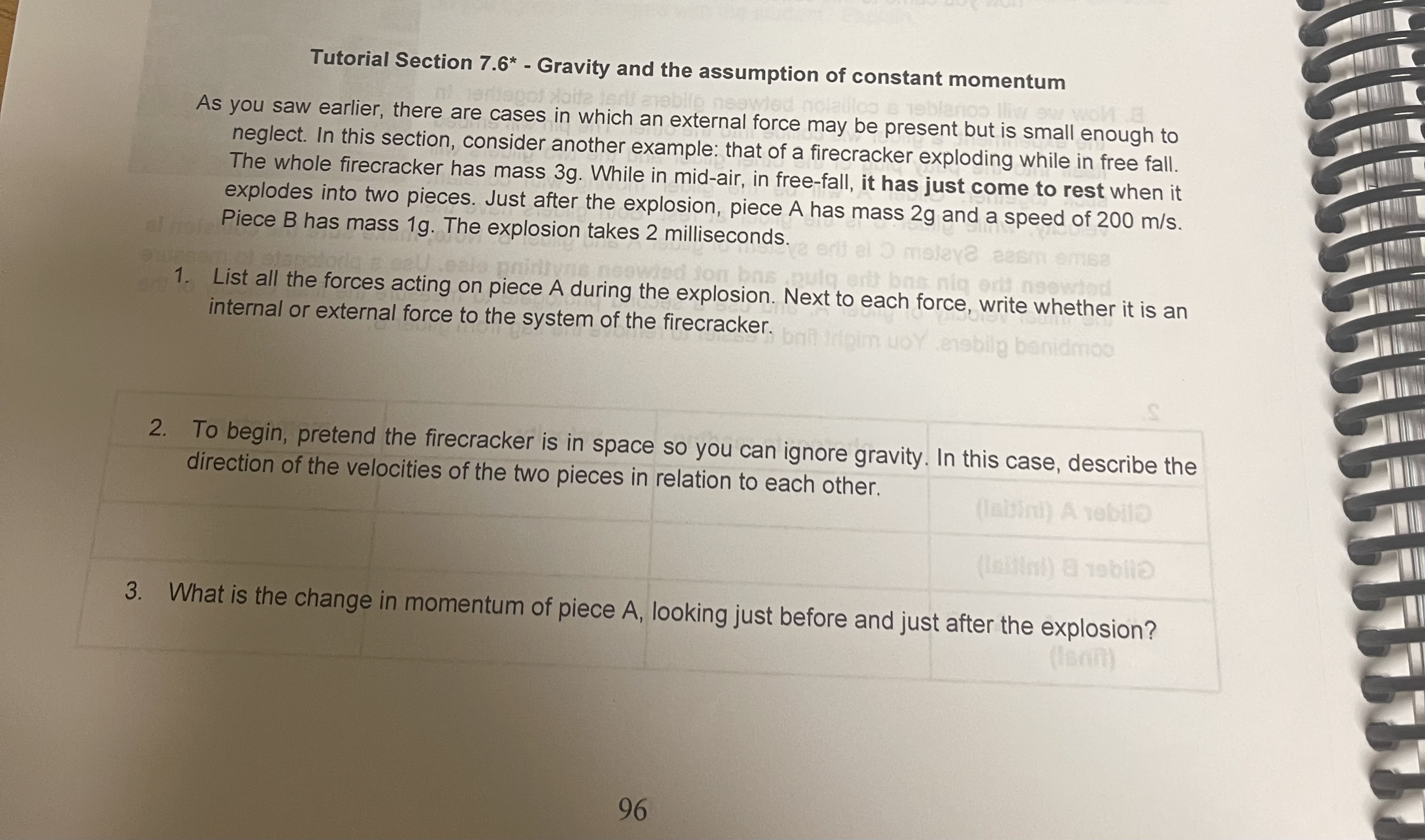
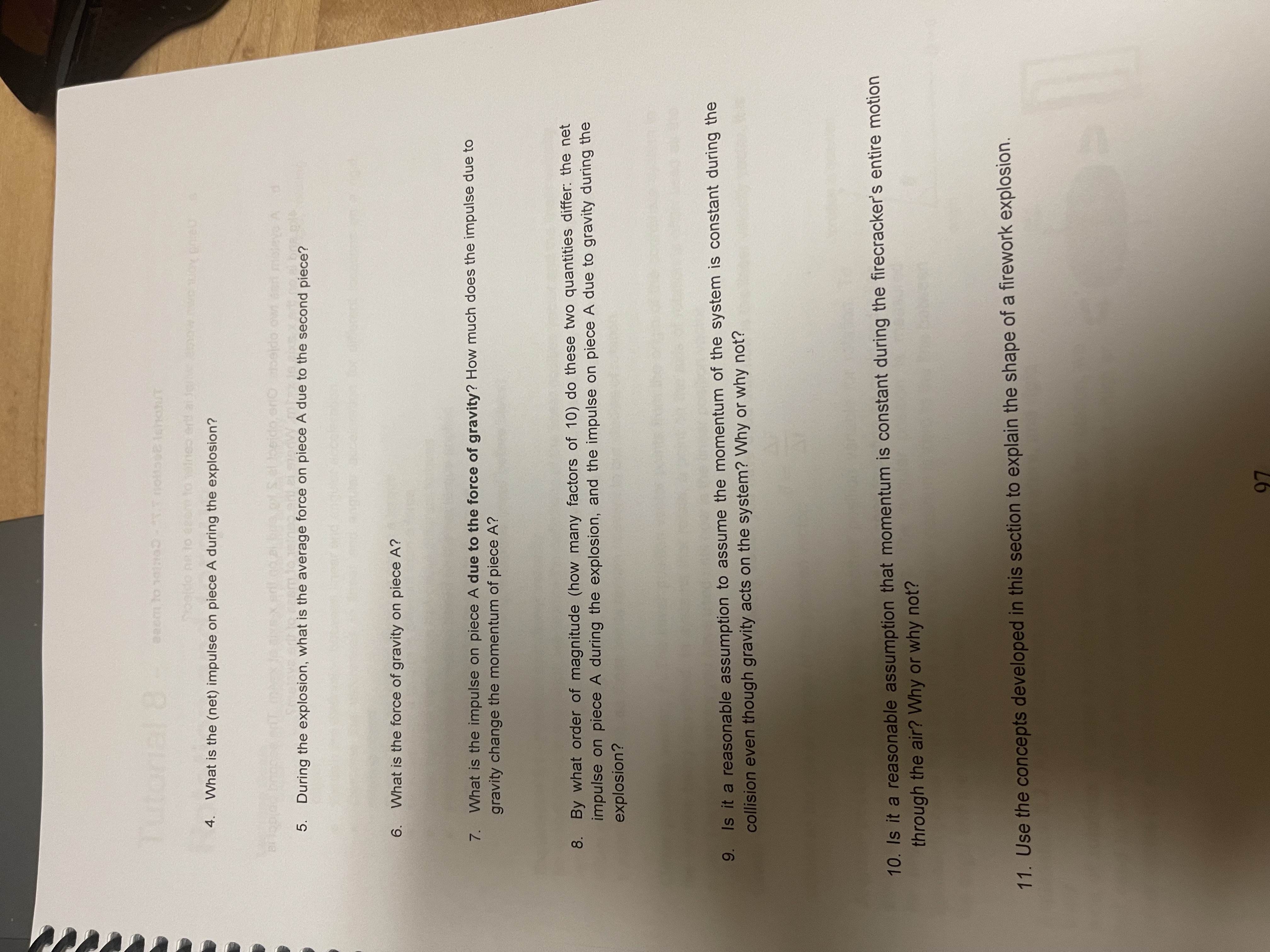
Tutorial Section 7.6* - Gravity and the assumption of constant momentum As you saw earlier, there are cases in which an external force may be present but is small enough to neglect. In this section, consider another example: that of a firecracker exploding while in free fall. The whole firecracker has mass 3g. While in mid-air, in free-fall, it has just come to rest when it explodes into two pieces. Just after the explosion, piece A has mass 2g and a speed of 200 m/s. Piece B has mass 1g. The explosion takes 2 milliseconds. moley& eesm emba ns ban nig ord ns 1. List all the forces acting on piece A during the explosion. Next to each force, write whether it is an internal or external force to the system of the firecracker. m oY mobile banidmoo S 2. To begin, pretend the firecracker is in space so you can ignore gravity. In this case, describe the C141111 direction of the velocities of the two pieces in relation to each other. (labtini) Arebile 3. What is the change in momentum of piece A, looking just before and just after the explosion? (Isan) 964. What is the (net) impulse on piece A during the explosion? 5. During the explosion, what is the average force on piece A due to the second piece? 6. What is the force of gravity on piece A? 7. What is the impulse on piece A due to the force of gravity? How much does the impulse due to gravity change the momentum of piece A? 8. By what order of magnitude (how many factors of 10) do these two quantities differ: the net impulse on piece A during the explosion, and the impulse on piece A due to gravity during the explosion? 9. Is it a reasonable assumption to assume the momentum of the system is constant during the collision even though gravity acts on the system? Why or why not? 10. Is it a reasonable assumption that momentum is constant during the firecracker's entire motion through the air? Why or why not? 11. Use the concepts developed in this section to explain the shape of a firework explosion. 97
Step by Step Solution
There are 3 Steps involved in it

Get step-by-step solutions from verified subject matter experts
 Study Help