







Question: Tutorial: Thermodynamic Processes and PV Diagrams D. You will now use a simulation to check your answer, which can be found here. (If the link
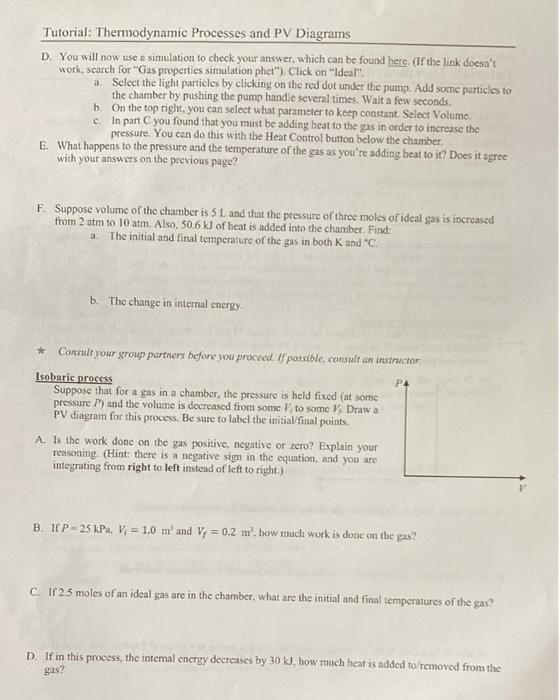
Tutorial: Thermodynamic Processes and PV Diagrams D. You will now use a simulation to check your answer, which can be found here. (If the link doesn't work, search for "Gas properties simulation phet"). Click on "Ideal a. Select the light particles by clicking on the red dot under the pump. Add some particles to the chamber by pushing the pump handie several times. Wait a few seconds. b. On the top right, you can select what parameter to keep constant. Select Volume c. In part C you found that you must be adding heat to the gas in order to increase the pressure. You can do this with the Heat Control button below the chamber. E. What happens to the pressure and the temperature of the gas as you're adding heat to it? Does it agree with your answers on the previous page? F. Suppose volume of the chamber is 5 L and that the pressure of three moles of ideal gas is increased from 2 atm to 10 atm. Also, 50.6 kl of heat is added into the chamber. Find: The initial and final temperature of the gas in both K and C. a b. The change in internal energy * Consult your group partners before you proceed. If possible. consult an instructor Isobaric process PA Suppose that for a gas in a chamber, the pressure is held fixed (at some pressure and the volume is decreased from some to some V/Draw a PV diagram for this process. Be sure to label the initial final points. A. Is the work done on the gas positive, negative or zero? Explain your reasoning (Hint: there is a negative sign in the equation, and you are integrating from right to left instead of left to right) B. ICP-25 kPa, V = 1.0 m' and Vj = 0.2 m. how much work is dotie on the gas? C. If 2.5 moles of an ideal gas are in the chamber, what are the initial and final temperatures of the gas? D. If in this process, the intemal energy decreases by 30. how much heat is added to removed from the gas
Step by Step Solution
There are 3 Steps involved in it

Get step-by-step solutions from verified subject matter experts
 Study Help