







Question: Two antennas located at points A and B are broadcasting radio waves of frequency 94.0 MHz, perfectly in phase with each other. The two
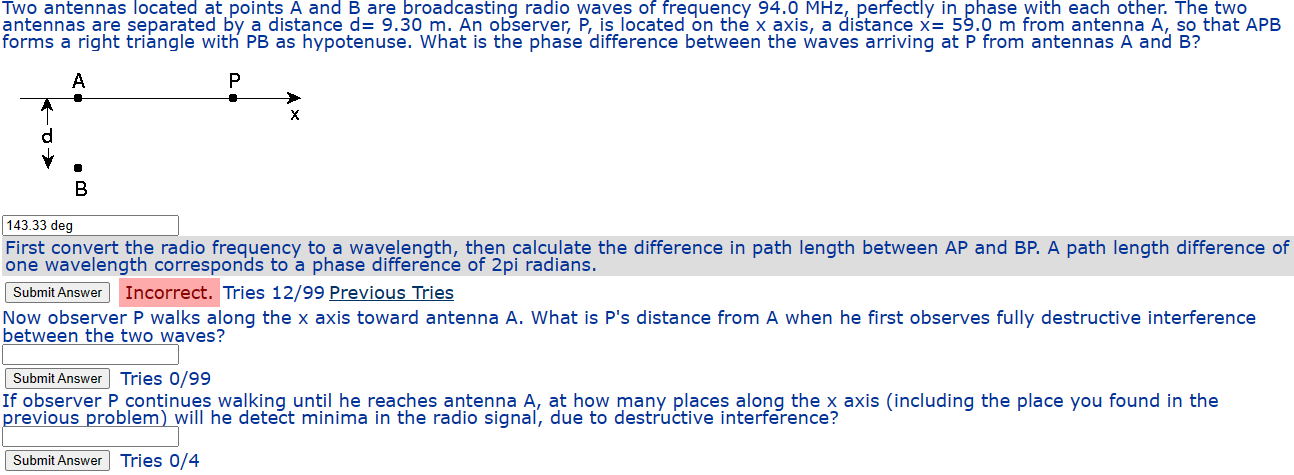
Two antennas located at points A and B are broadcasting radio waves of frequency 94.0 MHz, perfectly in phase with each other. The two antennas are separated by a distance d= 9.30 m. An observer, P, is located on the x axis, a distance x= 59.0 m from antenna A, so that APB forms a right triangle with PB as hypotenuse. What is the phase difference between the waves arriving at P from antennas A and B? A P X 143.33 deg B First convert the radio frequency to a wavelength, then calculate the difference in path length between AP and BP. A path length difference of one wavelength corresponds to a phase difference of 2pi radians. Submit Answer Incorrect. Tries 12/99 Previous Tries Now observer P walks along the x axis toward antenna A. What is P's distance from A when he first observes fully destructive interference between the two waves? Submit Answer Tries 0/99 If observer P continues walking until he reaches antenna A, at how many places along the x axis (including the place you found in the previous problem) will he detect minima in the radio signal, due to destructive interference? Submit Answer Tries 0/4
Step by Step Solution
There are 3 Steps involved in it

Get step-by-step solutions from verified subject matter experts
 Study Help