







Question: Two different balls are rolled (without slipping) toward a . xi ^()omega _(1)=20.2ra(d)/(s) , and ball 2 has an angular speed of omega _(2)=12.8ra(d)/(s) .
Two different balls are rolled (without slipping) toward a\ .\
\\\\xi ^()\\\\omega _(1)=20.2ra(d)/(s), and ball 2 has an angular speed of\
\\\\omega _(2)=12.8ra(d)/(s). The first ball, which has a radius of\
0.0688m, is rolling along a conveyor belt that is moving at\
\\\\sum_0^(\\\\infty ) 1.69(m)/(s)and starts out
9.47mfrom the finish line. The\ second ball has a radius of
0.0488mand is rolling along the\ stationary floor.\ If the second ball starts out
6.14mfrom the finish line, how\ long does each ball take to reach the finish line?\ ball 1 time:\ What angular speed
\\\\omega would the losing ball have needed to\ cross the finish line at the same time as the winning ball?\
\\\\omega = 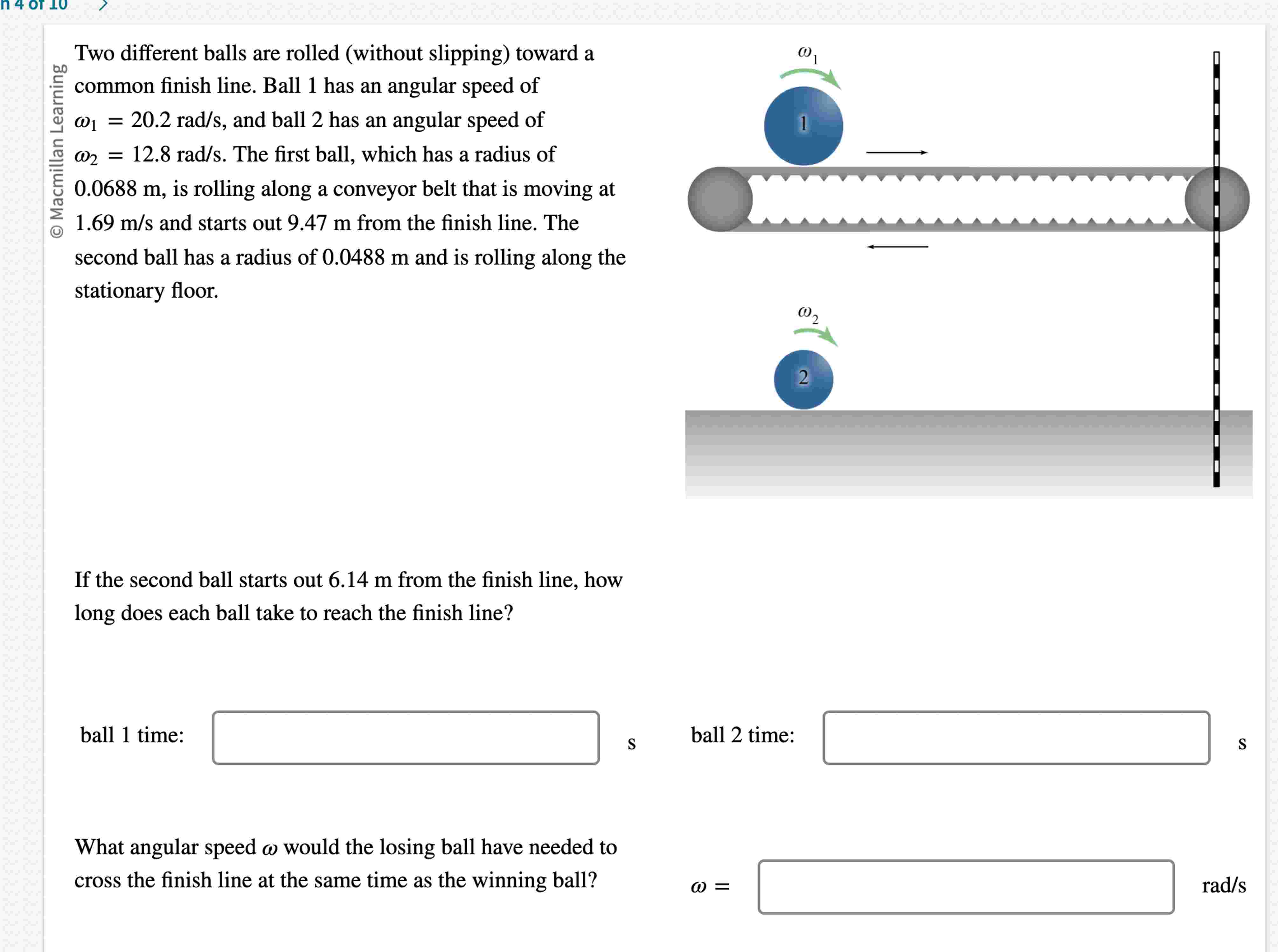
Two different balls are rolled (without slipping) toward a common finish line. Ball 1 has an angular speed of 1=20.2rad/s, and ball 2 has an angular speed of 2=12.8rad/s. The first ball, which has a radius of 0.0688m, is rolling along a conveyor belt that is moving at 1.69m/s and starts out 9.47m from the finish line. The second ball has a radius of 0.0488m and is rolling along the stationary floor. If the second ball starts out 6.14m from the finish line, how long does each ball take to reach the finish line? ball 1 time: S ball 2 time: S What angular speed would the losing ball have needed to cross the finish line at the same time as the winning ball? = rad/s Two different balls are rolled (without slipping) toward a common finish line. Ball 1 has an angular speed of 1=20.2rad/s, and ball 2 has an angular speed of 2=12.8rad/s. The first ball, which has a radius of 0.0688m, is rolling along a conveyor belt that is moving at 1.69m/s and starts out 9.47m from the finish line. The second ball has a radius of 0.0488m and is rolling along the stationary floor. If the second ball starts out 6.14m from the finish line, how long does each ball take to reach the finish line? ball 1 time: S ball 2 time: S What angular speed would the losing ball have needed to cross the finish line at the same time as the winning ball? = rad/s
Step by Step Solution
There are 3 Steps involved in it

Get step-by-step solutions from verified subject matter experts
 Study Help