







Question: Two different shapes are being considered fer a catalyst particle: sphericatignd cylindrical. The particle will be made up of three layers, with either a spherical
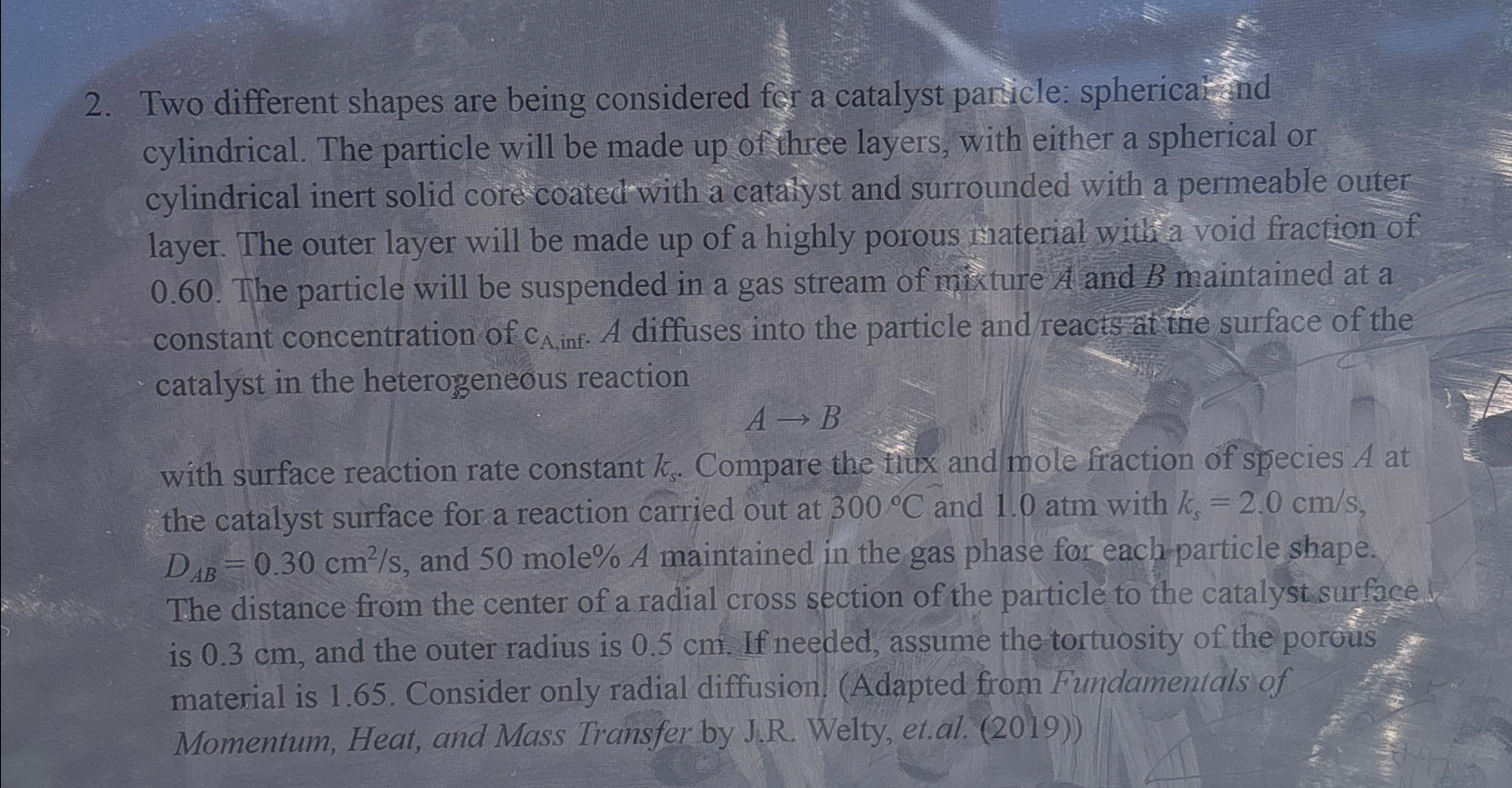
Two different shapes are being considered fer a catalyst particle: sphericatignd cylindrical. The particle will be made up of three layers, with either a spherical or cylindrical inert solid core coated with a catalyst and surrounded with a permeable outer layer. The outer layer will be made up of a highly porous material with a void fraction of The particle will be suspended in a gas stream of mixture A and maintained at a constant concentration of A diffuses into the particle and reacts at the surface of the catalyst in the heterogeneous reaction
with surface reaction rate constant Compare the fiux and mole fraction of species at the catalyst surface for a reaction carried out at and atm with and moleA maintained in the gas phase for each particle shape. The distance from the center of a radial cross section of the particle to the catalyst surface is and the outer radius is If needed, assume the tortuosity of the porous material is Consider only radial diffusion. Adapted from Fundamentals of Momentum, Heat, and Mass Transfer by JR Welty,
etal
Step by Step Solution
There are 3 Steps involved in it
1 Expert Approved Answer
Step: 1 Unlock

It seems there was an error with how the solution for C A r CAr CAr was structured Let me reinitia... View full answer
Question Has Been Solved by an Expert!
Get step-by-step solutions from verified subject matter experts
Step: 2 Unlock
Step: 3 Unlock
 Study Help