







Question: Two integers are drawn independently at random from 1, 2,..., 100 (repetition is allowed, for instance, both numbers could be 1). Consider the following
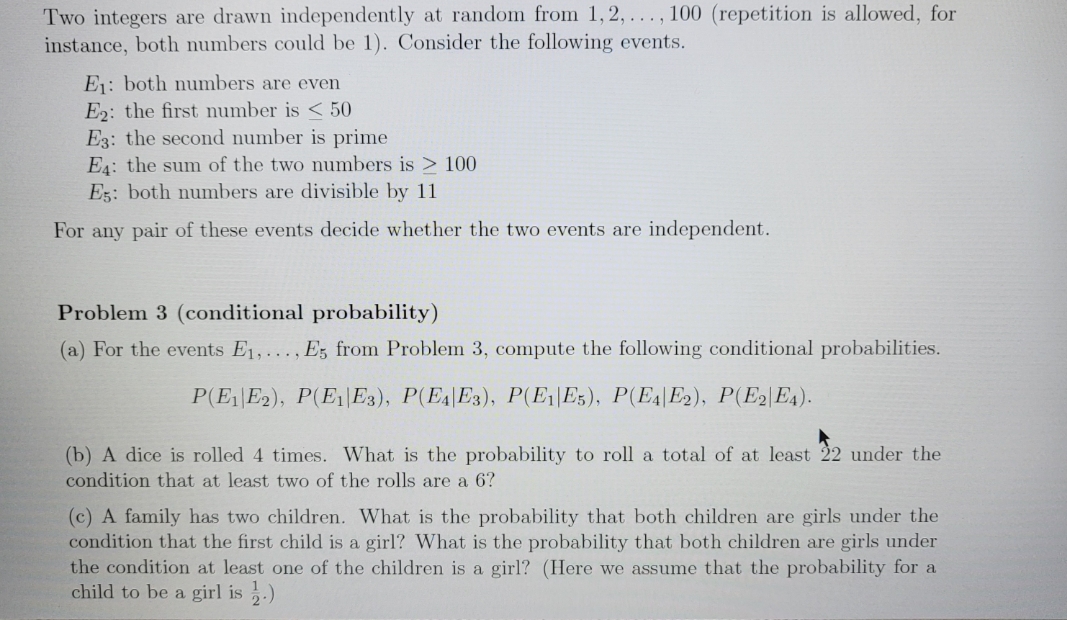
Two integers are drawn independently at random from 1, 2,..., 100 (repetition is allowed, for instance, both numbers could be 1). Consider the following events. E: both numbers are even E2: the first number is 100 E5: both numbers are divisible by 11 For any pair of these events decide whether the two events are independent. Problem 3 (conditional probability) (a) For the events E1,..., Es from Problem 3, compute the following conditional probabilities. P(E1 E2), P(E1 E3), P(E4 E3), P(E1 E5), P(E4 E2), P(E2E4). (b) A dice is rolled 4 times. What is the probability to roll a total of at least 22 under the condition that at least two of the rolls are a 6? (c) A family has two children. What is the probability that both children are girls under the condition that the first child is a girl? What is the probability that both children are girls under the condition at least one of the children is a girl? (Here we assume that the probability for a child to be a girl is 1.)
Step by Step Solution
There are 3 Steps involved in it

Get step-by-step solutions from verified subject matter experts
 Study Help