







Question: Two mutually exclusive projects. Both projects will be depreciated using straight-line depreciation to a zero book value over the life of the project. Neither project
Two mutually exclusive projects. Both projects will be depreciated using straight-line depreciation to a zero book value over the life of the project. Neither project has any salvage value.
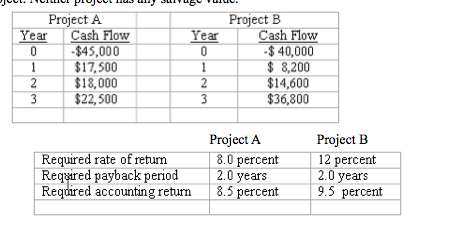
a. What is the NPV for each of the projects? Which project should be accepted if the NPV method is applied? Explain why.
b. What is the IRR for each of the projects? Which project should be accepted if the IRR method is applied? Explain why.
c. What is the payback period for each of the projects? Which project should be accepted if the payback period method is applied? Explain why.
d. What is the discounted payback period for each of the projects? Which project should be accepted if the discounted payback period method is applied? Explain why.
e. What is the profitability index for each of the projects? Which project should be accepted if the profitability index method is applied? Explain why.
f. What is the average accounting return (AAR) for each of the projects, assuming that cash flows occurring after year 0 are net income? Which project should be accepted if AAR method is applied? Also, assume that the target AAR is 10%.
g. Define and find the crossover rate.
h. Sketch the NPV profile. Plot all the relevant coordinates (i.e., the points on the x and y-axis; and the cross-over rate) on the graph.
Project A Year Cash Flow -$45,000 $17,500 $18,000 $22,500 Project B Cash Flow -$ 40,000 $ 8,200 $14,600 $36,800 Required rate of return Required payback period Required accounting return Project A 8.0 percent 2.0 years 8.5 percent Project B 12 percent 2.0 years .5 percent 9
Step by Step Solution
There are 3 Steps involved in it

Get step-by-step solutions from verified subject matter experts
 Study Help