







Question: Two particles execute simple harmonic motion of the same amplitude and frequency along close parallel lines. They pass each other moving in opposite directions each

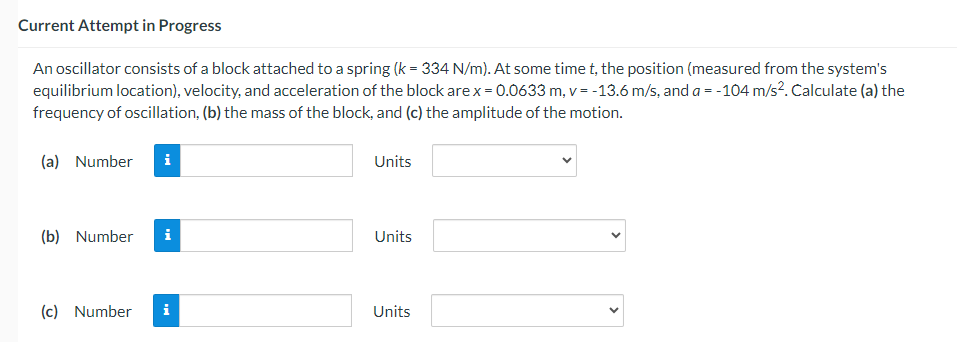
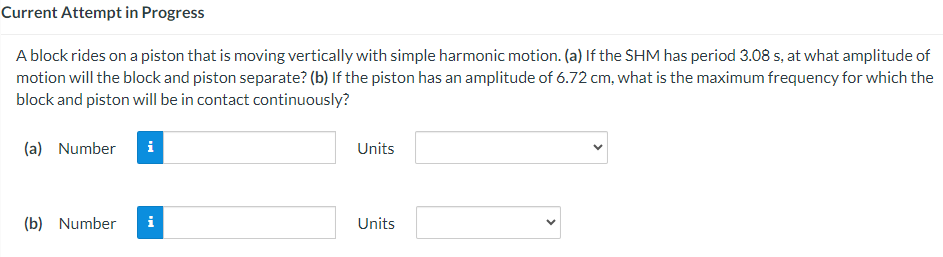
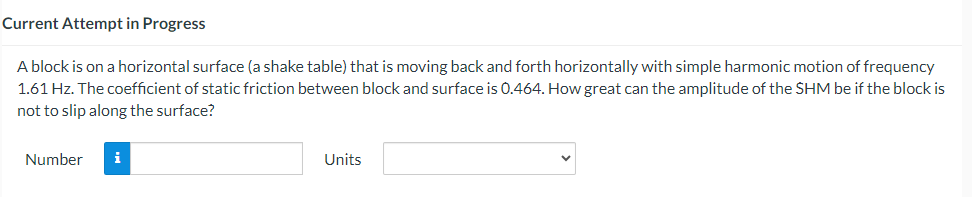
Two particles execute simple harmonic motion of the same amplitude and frequency along close parallel lines. They pass each other moving in opposite directions each time the displacement of the first particle is 1/5 of its amplitude. What is their phase difference? Number n Units v Current Attempt in Progress An oscillator consists of a block attached to a spring (k = 334 N/m). At some time t, the position (measured from the system's equilibrium location), velocity, and acceleration of the block are x = 0.0633 m, v= -13.6 m/s, and a = -104 m/s. Calculate (a) the frequency of oscillation, (b) the mass of the block, and (c) the amplitude of the motion. (a) Number Units (b) Number Units V (c) Number UnitsCurrent Attempt in Progress A block rides on a piston that is moving vertically with simple harmonic motion. (a) If the SHM has period 3.08 s, at what amplitude of motion will the block and piston separate? (b) If the piston has an amplitude of 6.72 cm, what is the maximum frequency for which the block and piston will be in contact continuously? (a) Number n Units v (b) MNumber H Units Current Attempt in Progress Ablockis on a horizontal surface (a shake table) that is moving back and forth horizontally with simple harmonic motion of frequency 1.61 Hz. The coefficient of static friction between block and surface is 0.464. How great can the amplitude of the SHM be if the block is not to slip along the surface? Number n Units v
Step by Step Solution
There are 3 Steps involved in it

Get step-by-step solutions from verified subject matter experts
 Study Help