







Question: two pictures are same question u have seen that riskier investments generally have higher returns. One assumption that can lead to this is ris aversion
two pictures are same question
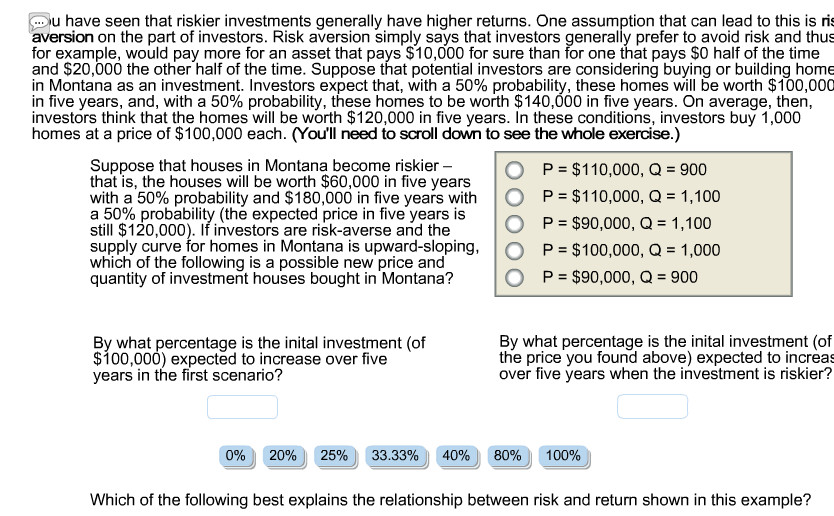
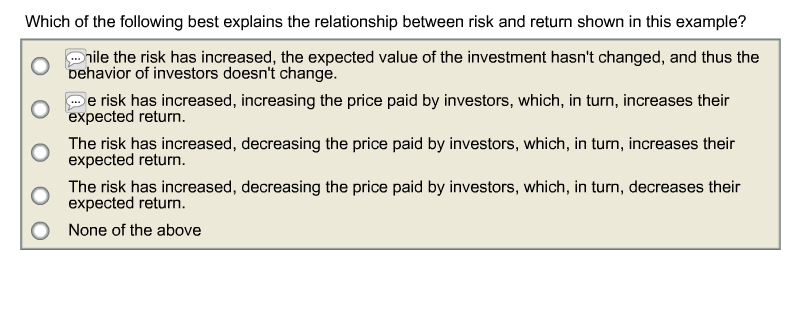
u have seen that riskier investments generally have higher returns. One assumption that can lead to this is ris aversion on the part of investors. Risk aversion simply says that investors generally prefer to avoid risk and thus for example, would pay more for an asset that pays $10,000 for sure than for one that pays $0 half of the time and $20,000 the other half of the time. Suppose that potential investors are considering buying or building home in Montana as an investment. Investors expect that, with a 50% probability, these homes will be worth $100,000 in five years, and, with a 50% probability, these homes to be worth $140,000 in five years. On average, then, investors think that the homes will be worth $120,000 in five years. In these conditions, investors buy 1,000 homes at a price of $100,000 each. (You'll need to scroll down to see the whole exercise.) Suppose that houses in Montana become riskier - that is, the houses will be worth $60,000 in five years with a 50% probability and $180,000 in five years with a 50% probability (the expected price in five years is still $120,000). If investors are risk-averse and the supply curvefor homes in Montana is upward-sloping, which of the following is a possible new price and quantity of investment houses bought in Montana? O | P = $110,000, Q-900 P-31 10,000, Q = 1,100 P = $90,000, Q = 1,100 1 O $100,000, Q = 1,000 P = $90,000, Q = 900 | O By what percentage is the inital investment (of $100,000) expected to increase over five years in the first scenario? By what percentage is the inital investment (of the price you found above) expected to increas over five years when the investment is riskier? 0% 20% 25% 33.33% 40% 80% 100% Which of the following best explains the relationship between risk and return shown in this example? u have seen that riskier investments generally have higher returns. One assumption that can lead to this is ris aversion on the part of investors. Risk aversion simply says that investors generally prefer to avoid risk and thus for example, would pay more for an asset that pays $10,000 for sure than for one that pays $0 half of the time and $20,000 the other half of the time. Suppose that potential investors are considering buying or building home in Montana as an investment. Investors expect that, with a 50% probability, these homes will be worth $100,000 in five years, and, with a 50% probability, these homes to be worth $140,000 in five years. On average, then, investors think that the homes will be worth $120,000 in five years. In these conditions, investors buy 1,000 homes at a price of $100,000 each. (You'll need to scroll down to see the whole exercise.) Suppose that houses in Montana become riskier - that is, the houses will be worth $60,000 in five years with a 50% probability and $180,000 in five years with a 50% probability (the expected price in five years is still $120,000). If investors are risk-averse and the supply curvefor homes in Montana is upward-sloping, which of the following is a possible new price and quantity of investment houses bought in Montana? O | P = $110,000, Q-900 P-31 10,000, Q = 1,100 P = $90,000, Q = 1,100 1 O $100,000, Q = 1,000 P = $90,000, Q = 900 | O By what percentage is the inital investment (of $100,000) expected to increase over five years in the first scenario? By what percentage is the inital investment (of the price you found above) expected to increas over five years when the investment is riskier? 0% 20% 25% 33.33% 40% 80% 100% Which of the following best explains the relationship between risk and return shown in this example
Step by Step Solution
There are 3 Steps involved in it

Get step-by-step solutions from verified subject matter experts
 Study Help