







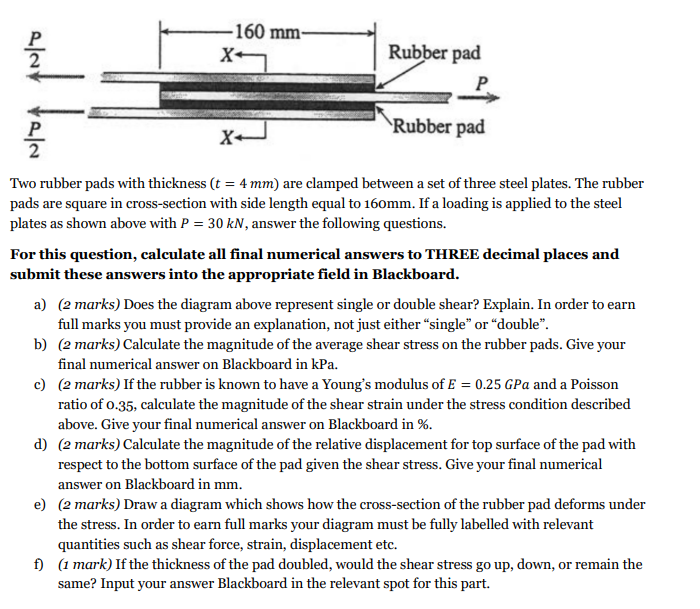
Question: Two rubber pads with thickness ( ( t = 4 mathrm { ~mm } ) ) are clamped between a set of
Two rubber pads with thickness tmathrm~mm are clamped between a set of three steel plates. The rubber pads are square in crosssection with side length equal to mm If a loading is applied to the steel plates as shown above with PmathrmkN answer the following questions.
For this question, calculate all final numerical answers to THREE decimal places and submit these answers into the appropriate field in Blackboard.
a marks Does the diagram above represent single or double shear? Explain. In order to earn full marks you must provide an explanation, not just either "single" or "double".
b marks Calculate the magnitude of the average shear stress on the rubber pads. Give your final numerical answer on Blackboard in kPa.
c marks If the rubber is known to have a Young's modulus of EmathrmGPa and a Poisson ratio of calculate the magnitude of the shear strain under the stress condition described above. Give your final numerical answer on Blackboard in
d marks Calculate the magnitude of the relative displacement for top surface of the pad with respect to the bottom surface of the pad given the shear stress. Give your final numerical answer on Blackboard in mm
e marks Draw a diagram which shows how the crosssection of the rubber pad deforms under the stress. In order to earn full marks your diagram must be fully labelled with relevant quantities such as shear force, strain, displacement etc.
f mark If the thickness of the pad doubled, would the shear stress go up down, or remain the same? Input your answer Blackboard in the relevant spot for this part.
Step by Step Solution
There are 3 Steps involved in it
1 Expert Approved Answer
Step: 1 Unlock

Question Has Been Solved by an Expert!
Get step-by-step solutions from verified subject matter experts
Step: 2 Unlock
Step: 3 Unlock
 Study Help