







Question: Two urns contain k balls each. Initially, the balls in the left urn are all red and the balls in the right urn are
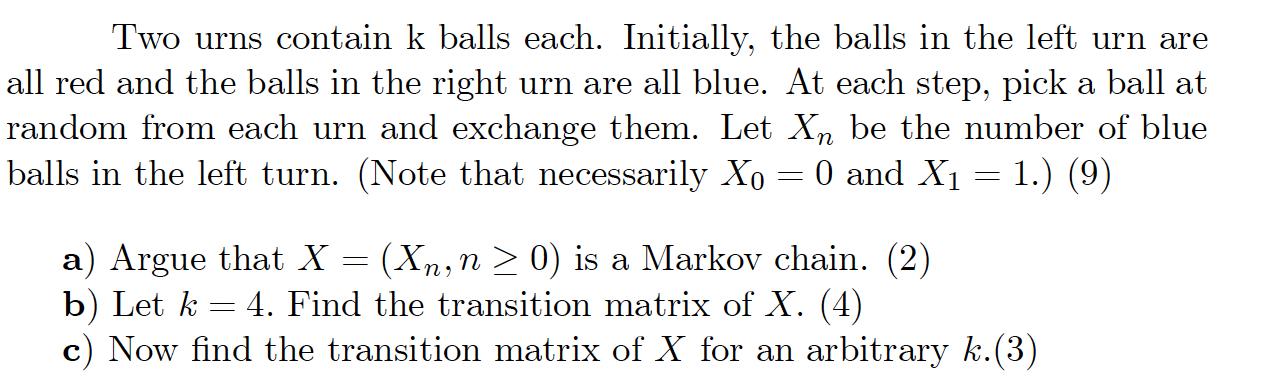
Two urns contain k balls each. Initially, the balls in the left urn are all red and the balls in the right urn are all blue. At each step, pick a ball at random from each urn and exchange them. Let X be the number of blue balls in the left turn. (Note that necessarily Xo 0 and X = 1.) (9) a) Argue that X b) Let k = = = (Xn, n0) is a Markov chain. (2) 4. Find the transition matrix of X. (4) Now find the transition matrix of X for an arbitrary k.(3)
Step by Step Solution
There are 3 Steps involved in it
a To argue that X Xn n 0 is a Markov chain we need to show that it satisfies the Markov property The Markov property states that the future behavior of the process only depends on its current state an... View full answer

Get step-by-step solutions from verified subject matter experts
 Study Help