







Question: TYPED SOLUTIONS ONLY PLEASE Thom has decided to grow a garden at his place. He is wondering how much space he should use for that.
TYPED SOLUTIONS ONLY PLEASE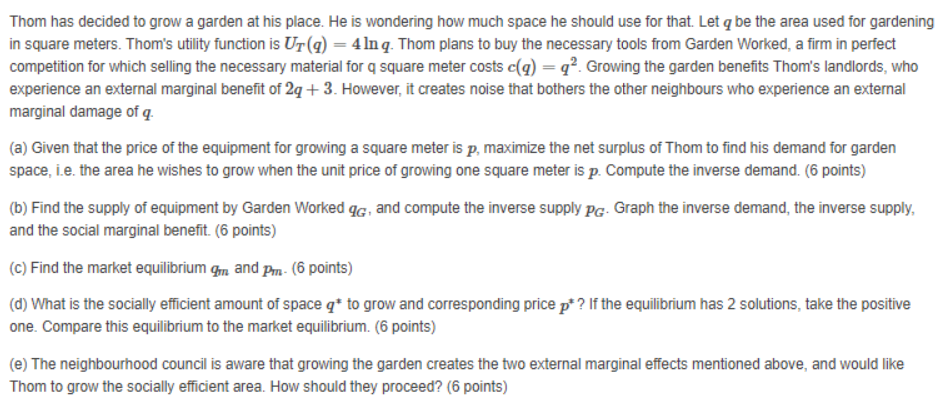
Thom has decided to grow a garden at his place. He is wondering how much space he should use for that. Let q be the area used for gardening in square meters. Thom's utility function is UT(q) = 4 Inq. Thom plans to buy the necessary tools from Garden Worked, a firm in perfect competition for which selling the necessary material for a square meter costs c(q) = q?. Growing the garden benefits Thom's landlords, who experience an external marginal benefit of 2q + 3. However, it creates noise that bothers the other neighbours who experience an external marginal damage of q. (a) Given that the price of the equipment for growing a square meter is p, maximize the net surplus of Thom to find his demand for garden space, i.e. the area he wishes to grow when the unit price of growing one square meter is p. Compute the inverse demand. (6 points) (b) Find the supply of equipment by Garden Worked qg, and compute the inverse supply PG. Graph the inverse demand, the inverse supply, and the social marginal benefit. (6 points) (C) Find the market equilibrium qn and Pm- (6 points) (d) What is the socially efficient amount of space q* to grow and corresponding price p*? If the equilibrium has 2 solutions, take the positive one. Compare this equilibrium to the market equilibrium. (6 points) (e) The neighbourhood council is aware that growing the garden creates the two external marginal effects mentioned above, and would like Thom to grow the socially efficient area. How should they proceed? (6 points) Thom has decided to grow a garden at his place. He is wondering how much space he should use for that. Let q be the area used for gardening in square meters. Thom's utility function is UT(q) = 4 Inq. Thom plans to buy the necessary tools from Garden Worked, a firm in perfect competition for which selling the necessary material for a square meter costs c(q) = q?. Growing the garden benefits Thom's landlords, who experience an external marginal benefit of 2q + 3. However, it creates noise that bothers the other neighbours who experience an external marginal damage of q. (a) Given that the price of the equipment for growing a square meter is p, maximize the net surplus of Thom to find his demand for garden space, i.e. the area he wishes to grow when the unit price of growing one square meter is p. Compute the inverse demand. (6 points) (b) Find the supply of equipment by Garden Worked qg, and compute the inverse supply PG. Graph the inverse demand, the inverse supply, and the social marginal benefit. (6 points) (C) Find the market equilibrium qn and Pm- (6 points) (d) What is the socially efficient amount of space q* to grow and corresponding price p*? If the equilibrium has 2 solutions, take the positive one. Compare this equilibrium to the market equilibrium. (6 points) (e) The neighbourhood council is aware that growing the garden creates the two external marginal effects mentioned above, and would like Thom to grow the socially efficient area. How should they proceed? (6 points)
Step by Step Solution
There are 3 Steps involved in it

Get step-by-step solutions from verified subject matter experts
 Study Help