







Question: u have case study and u have to draw DFD using paper and pen first and then using Online Visual Paradigm Course Code: 224ISM-3 Activity
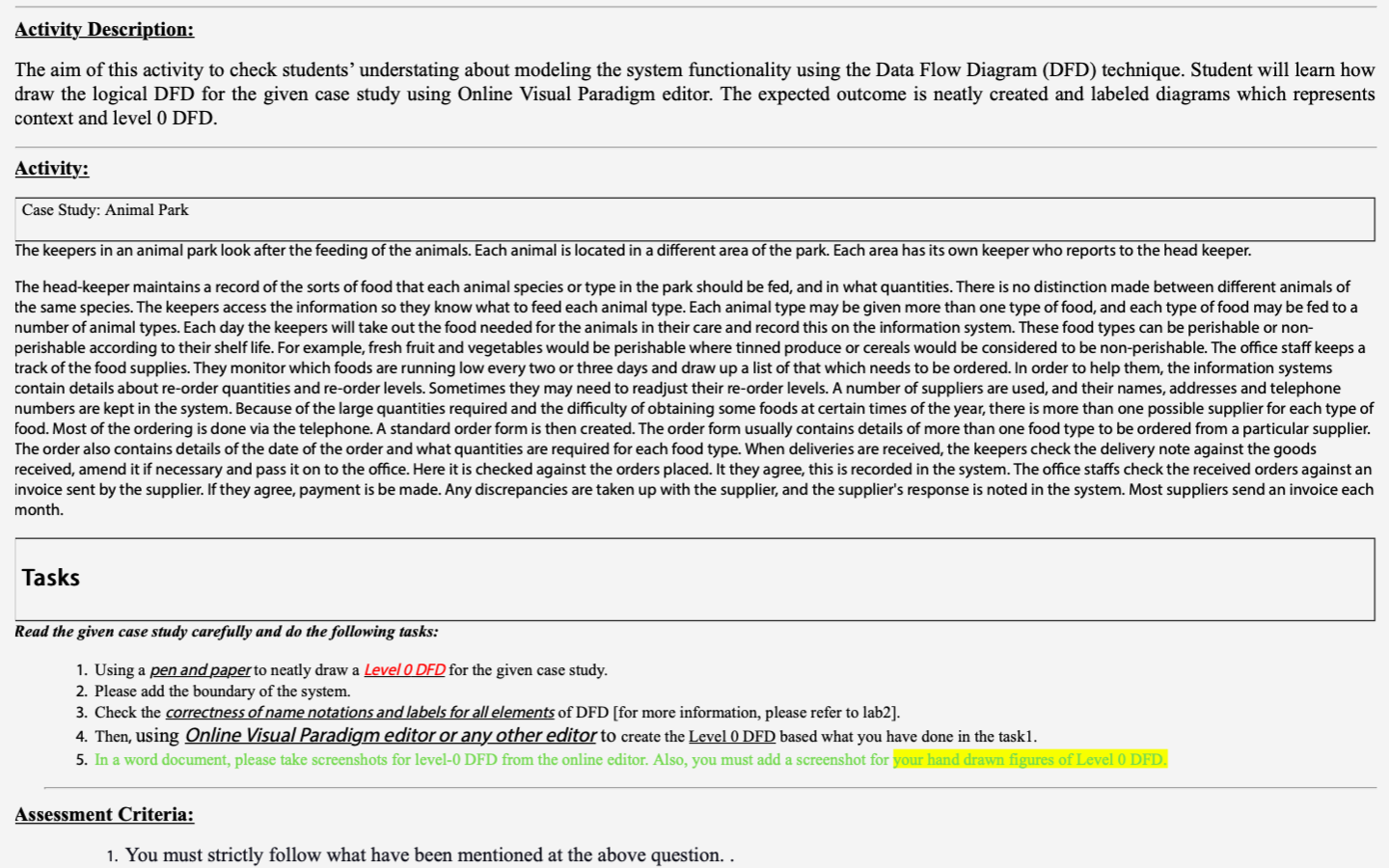
u have case study and u have to draw DFD using paper and pen first and then using Online Visual Paradigm
Course Code: 224ISM-3
Activity Description: The aim of this activity to check students' understating about modeling the system functionality using the Data Flow Diagram (DFD) technique. Student will learn how draw the logical DFD for the given case study using Online Visual Paradigm editor. The expected outcome is neatly created and labeled diagrams which represents context and level 0 DFD. Activity: Case Study: Animal Park The keepers in an animal park look after the feeding of the animals. Each animal is located in a different area of the park. Each area has its own keeper who reports to the head keeper. The head-keeper maintains a record of the sorts of food that each animal species or type in the park should be fed, and in what quantities. There is no distinction made between different animals of the same species. The keepers access the information so they know what to feed each animal type. Each animal type may be given more than one type of food, and each type of food may be fed to a number of animal types. Each day the keepers will take out the food needed for the animals in their care and record this on the information system. These food types can be perishable or non- perishable according to their shelf life. For example, fresh fruit and vegetables would be perishable where tinned produce or cereals would be considered to be non-perishable. The office staff keeps a track of the food supplies. They monitor which foods are running low every two or three days and draw up a list of that which needs to be ordered. In order to help them, the information systems contain details about re-order quantities and re-order levels. Sometimes they may need to readjust their re-order levels. A number of suppliers are used, and their names, addresses and telephone numbers are kept in the system. Because of the large quantities required and the difficulty of obtaining some foods at certain times of the year, there is more than one possible supplier for each type of food. Most of the ordering is done via the telephone. A standard order form is then created. The order form usually contains details of more than one food type to be ordered from a particular supplier. The order also contains details of the date of the order and what quantities are required for each food type. When deliveries are received, the keepers check the delivery note against the goods received, amend it if necessary and pass it on to the office. Here it is checked against the orders placed. It they agree, this is recorded in the system. The office staffs check the received orders against an invoice sent by the supplier. If they agree, payment is be made. Any discrepancies are taken up with the supplier, and the supplier's response is noted in the system. Most suppliers send an invoice each month. Tasks Read the given case study carefully and do the following tasks: 1. Using a pen and paper to neatly draw a Level 0 DFD for the given case study. 2. Please add the boundary of the system. 3. Check the correctness of name notations and labels for all elements of DFD [for more information, please refer to lab2]. 4. Then, using Online Visual Paradigm editor or any other editor to create the Level 0 DFD based what you have done in the taskl. 5. In a word document, please take screenshots for level-0 DFD from the online editor. Also, you must add a screenshot for your hand drawn figures of Level 0 DFD. Assessment Criteria: 1. You must strictly follow what have been mentioned at the above question. . Activity Description: The aim of this activity to check students' understating about modeling the system functionality using the Data Flow Diagram (DFD) technique. Student will learn how draw the logical DFD for the given case study using Online Visual Paradigm editor. The expected outcome is neatly created and labeled diagrams which represents context and level 0 DFD. Activity: Case Study: Animal Park The keepers in an animal park look after the feeding of the animals. Each animal is located in a different area of the park. Each area has its own keeper who reports to the head keeper. The head-keeper maintains a record of the sorts of food that each animal species or type in the park should be fed, and in what quantities. There is no distinction made between different animals of the same species. The keepers access the information so they know what to feed each animal type. Each animal type may be given more than one type of food, and each type of food may be fed to a number of animal types. Each day the keepers will take out the food needed for the animals in their care and record this on the information system. These food types can be perishable or non- perishable according to their shelf life. For example, fresh fruit and vegetables would be perishable where tinned produce or cereals would be considered to be non-perishable. The office staff keeps a track of the food supplies. They monitor which foods are running low every two or three days and draw up a list of that which needs to be ordered. In order to help them, the information systems contain details about re-order quantities and re-order levels. Sometimes they may need to readjust their re-order levels. A number of suppliers are used, and their names, addresses and telephone numbers are kept in the system. Because of the large quantities required and the difficulty of obtaining some foods at certain times of the year, there is more than one possible supplier for each type of food. Most of the ordering is done via the telephone. A standard order form is then created. The order form usually contains details of more than one food type to be ordered from a particular supplier. The order also contains details of the date of the order and what quantities are required for each food type. When deliveries are received, the keepers check the delivery note against the goods received, amend it if necessary and pass it on to the office. Here it is checked against the orders placed. It they agree, this is recorded in the system. The office staffs check the received orders against an invoice sent by the supplier. If they agree, payment is be made. Any discrepancies are taken up with the supplier, and the supplier's response is noted in the system. Most suppliers send an invoice each month. Tasks Read the given case study carefully and do the following tasks: 1. Using a pen and paper to neatly draw a Level 0 DFD for the given case study. 2. Please add the boundary of the system. 3. Check the correctness of name notations and labels for all elements of DFD [for more information, please refer to lab2]. 4. Then, using Online Visual Paradigm editor or any other editor to create the Level 0 DFD based what you have done in the taskl. 5. In a word document, please take screenshots for level-0 DFD from the online editor. Also, you must add a screenshot for your hand drawn figures of Level 0 DFD. Assessment Criteria: 1. You must strictly follow what have been mentioned at the above
Step by Step Solution
There are 3 Steps involved in it

Get step-by-step solutions from verified subject matter experts
 Study Help