







Question: - . .U r. .0...... sum :1) uesmoscom or a graphing calculator to help you. Question 1 a. On a graph, sketch f (2:) =
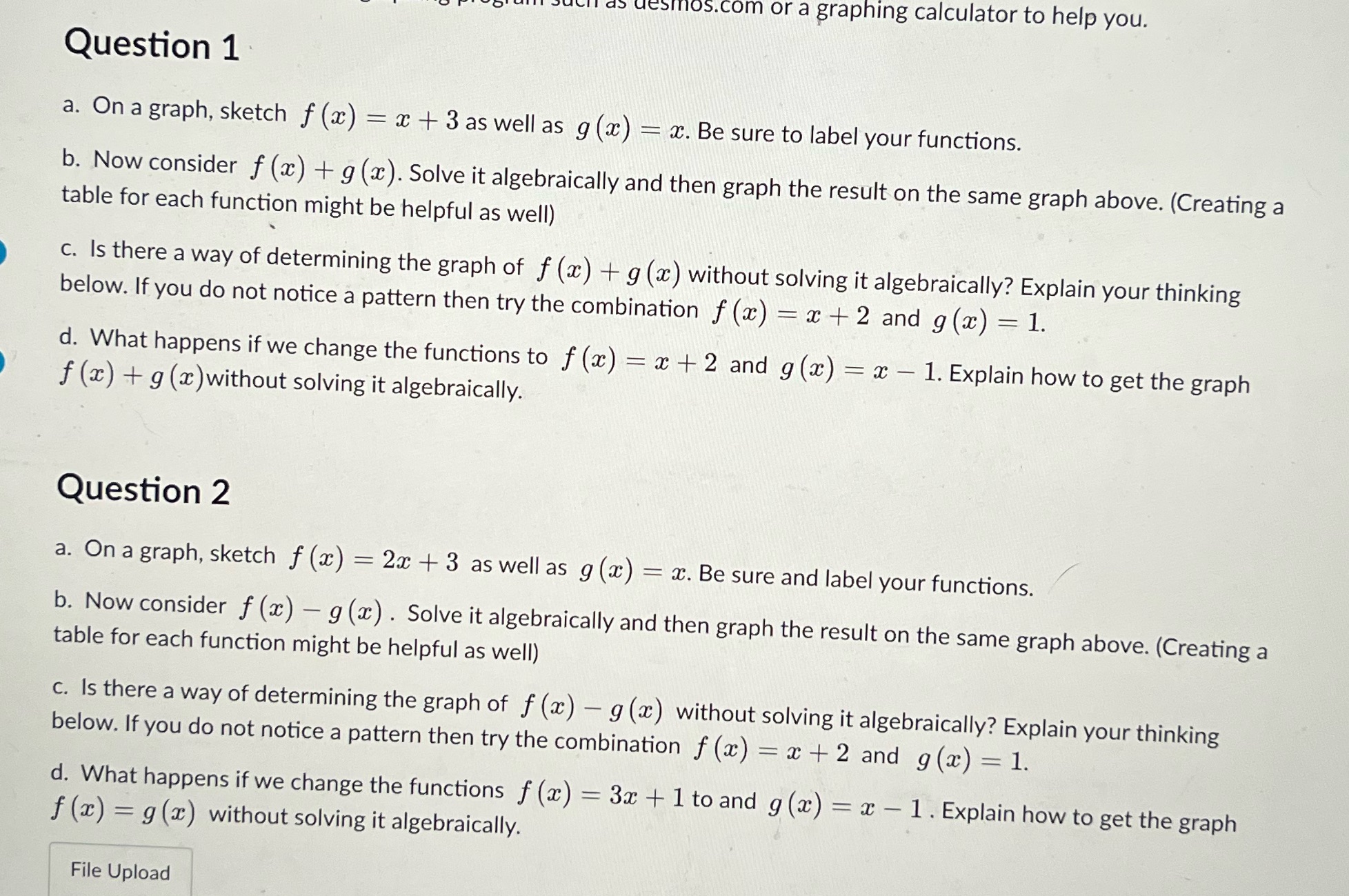
- . .U r. .0...... sum :1) uesmoscom or a graphing calculator to help you. Question 1 a. On a graph, sketch f (2:) = a: + 3 as well as g (.73) = 2:. Be sure to label your functions. b. Now consider f (as) + g (:13) Solve it algebraically and then graph the result on the sa me graph above. (Creating a table for each function might be helpful as well) C. Is there a way of determining the graph of f (:12) + g (m) without solving it algebraically? Explain your thinking below. If you do not notice a pattern then try the combination f(:v) = :B + 2 and g (m) = 1. d. What happens if we change the functions to f (:13) = a: + 2 and g (51:) = a: 1. Explain how to get the graph f (5c) + g (m)without solving it algebraically. Question 2 a. On a graph, sketch f (:10) = 2:1: + 3 as well as g (3:) = :13. Be sure and label your functions. b. Now consider f (as) g (:12) . Solve it algebraically and then graph the result 0 n the same graph above. (Creating a table for each function might be helpful as Well) C. Is there a way of determining the graph of f (as) 9 (ac) without solving it algebraically? Explain your thinking below. if you do not notice a pattern then try the combination f (m) = a: + 2 and g (at) = 1. d. What happens if We change the functions f (27) : 32: + l to and g (2:) : :2: - l . Explain how to get the graph f (:L') = g (m) without solving it algebraically. File Upload
Step by Step Solution
There are 3 Steps involved in it

Get step-by-step solutions from verified subject matter experts
 Study Help